
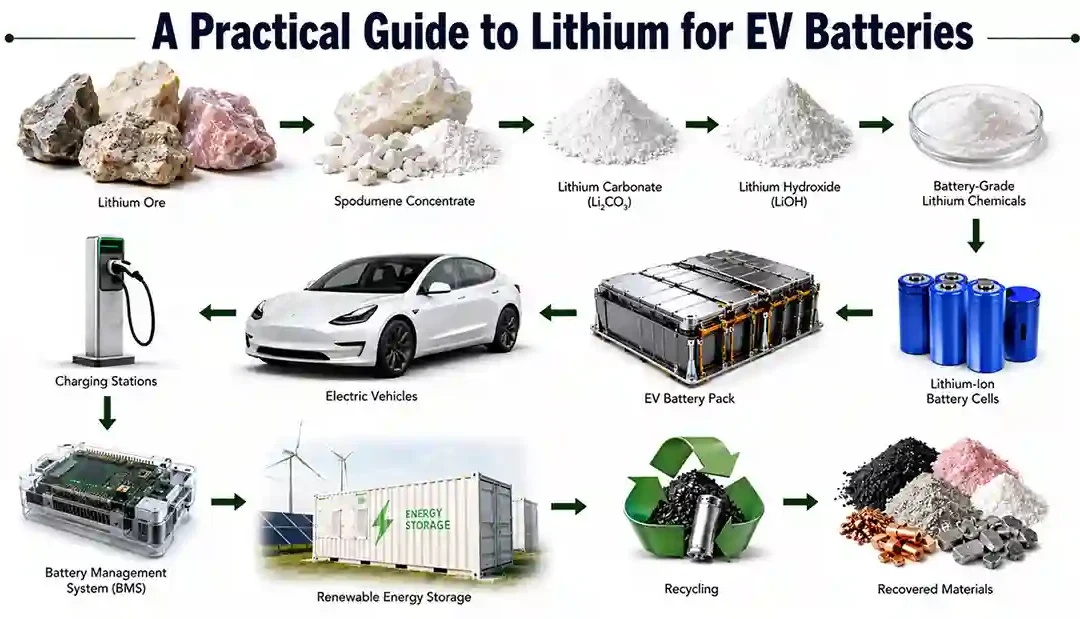
Lithium has become one of the world's most important minerals because it is the key ingredient in rechargeable batteries used by electric vehicles (EVs). From compact electric cars to buses and trucks, lithium-ion batteries provide the energy needed for clean transportation. As countries reduce carbon emissions and increase the use of renewable energy, the demand for lithium continues to rise.
Lithium for EV batteries refers to the use of battery-grade lithium compounds in lithium-ion battery cells that power electric vehicles. Lithium is valued because it is lightweight, stores large amounts of energy, charges quickly, and supports long battery life.
Understanding lithium highlights the close relationship between geology, mining, chemistry, materials science, and the future of sustainable transportation.
This topic should be studied together with Mineral Reaction to Heat, Mineralogy, Petrographic Microscopy, Laboratory Mineral Testing, and Copper in Renewable Energy.
Why EV Batteries Depend on Lithium
Lithium is widely used because it provides:
- High energy density
- Lightweight battery design
- Fast charging capability
- Long cycle life
- High electrical efficiency
- Low self-discharge
- Reliable battery performance
- Support for zero-emission transportation
Without lithium, modern long-range electric vehicles would be much less efficient.
Major Applications of Lithium for EV Batteries
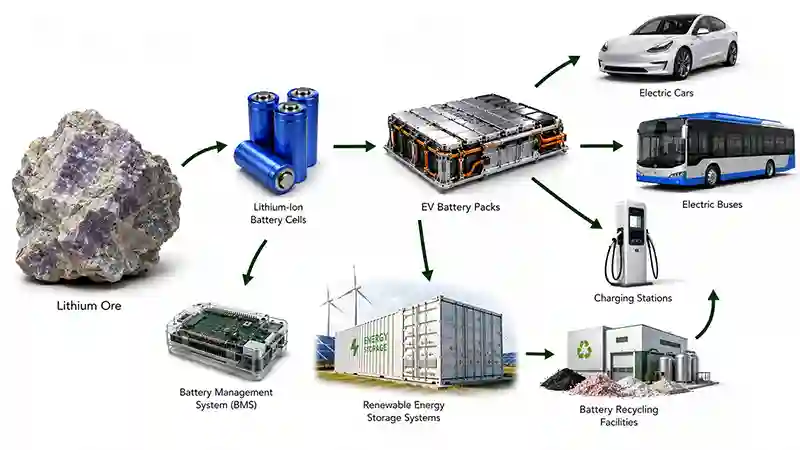
Lithium-Ion Battery Cells
Common uses:
- Rechargeable battery cells
- EV battery modules
- Battery packs
Importance:
Lithium stores electrical energy efficiently, making it the foundation of modern EV batteries.
Electric Passenger Vehicles
Common uses:
- Electric cars
- SUVs
- Compact EVs
Importance:
Lithium-ion batteries provide long driving ranges and efficient performance.
Electric Buses
Common uses:
- Public transportation
- City buses
- School buses
Importance:
Lithium batteries reduce fuel consumption and greenhouse gas emissions.
Electric Trucks
Common uses:
- Commercial vehicles
- Freight transportation
Importance:
High-capacity lithium batteries support heavy-duty transportation.
Battery Management Systems
Common uses:
- Battery monitoring
- Thermal management
- Safety systems
Importance:
Lithium batteries operate safely with advanced battery management technology.
Fast Charging Systems
Common uses:
- DC fast charging
- High-power charging stations
Importance:
Lithium-ion batteries support rapid charging while maintaining high efficiency.
Renewable Energy Integration
Common uses:
- Solar-powered EV charging
- Grid-connected charging stations
Importance:
Lithium batteries connect electric transportation with renewable energy.
Battery Recycling
Common uses:
- Lithium recovery
- Material reuse
- Circular economy
Importance:
Recovered lithium reduces mining demand and supports sustainable battery production.
Battery Research and Development
Common uses:
- Next-generation battery chemistry
- Solid-state battery research
Importance:
Lithium continues to drive innovation in battery technology.
Energy Storage for Charging Networks
Common uses:
- Charging station battery storage
- Grid balancing
Importance:
Lithium batteries help stabilize renewable-powered charging infrastructure.
Lithium by EV Battery Application
| EV Battery Application | Role of Lithium |
|---|---|
| Battery Cells | Energy Storage |
| Battery Packs | Power Supply |
| Electric Cars | Vehicle Propulsion |
| Electric Buses | Public Transportation |
| Electric Trucks | Commercial Transport |
| Fast Charging | Rapid Energy Transfer |
| Renewable Charging | Energy Storage |
| Battery Recycling | Material Recovery |
From Lithium Ore to EV Battery
Lithium passes through several stages before powering an electric vehicle.
- Lithium ore or brine is extracted.
- Lithium concentrate is processed.
- Battery-grade lithium chemicals are refined.
- Cathode materials are manufactured.
- Battery cells are assembled.
- Battery packs are installed in electric vehicles.
- Used batteries are collected and recycled.
This process connects geology directly to electric transportation.
How Lithium Supports Electric Vehicles
Lithium performs several important functions.
Energy Storage
- Lithium-ion battery cells
Electric Transportation
- Passenger EVs
- Electric buses
- Electric trucks
Charging Infrastructure
- Fast charging stations
- Renewable-powered charging
Battery Innovation
- Advanced lithium battery chemistry
- Solid-state battery research
Circular Economy
- Battery recycling
- Lithium recovery
Together, these applications make lithium one of the world's most valuable battery minerals.
Geological Importance
Economic geologists study lithium deposits that supply the global battery industry.
Research includes:
- Lithium exploration
- Pegmatite deposits
- Brine deposits
- Resource assessment
- Sustainable mining
These studies ensure reliable supplies of lithium for future electric mobility.
Laboratory Investigation
Lithium-bearing materials are analyzed using:
- X-Ray Fluorescence (XRF)
- X-Ray Diffraction (XRD)
- ICP-MS
- ICP-OES
- Atomic Absorption Spectroscopy (AAS)
- Scanning Electron Microscopy (SEM)
These techniques determine lithium concentration, purity, and suitability for battery manufacturing.
Applications
Lithium for EV batteries is widely used in:
- Electric passenger cars
- Electric buses
- Electric trucks
- Plug-in hybrid vehicles
- Battery energy storage systems
- Fast charging infrastructure
- Renewable-powered charging stations
- Fleet electrification
- Commercial transportation
- Smart mobility systems
Advantages of Studying Lithium for EV Batteries
Understanding lithium helps:
- Explain EV battery technology
- Support clean transportation
- Improve battery performance
- Strengthen critical mineral supply chains
- Promote sustainable mining
- Advance renewable energy integration
Limitations
Despite its importance, lithium presents several challenges.
- Mining can affect water resources and ecosystems.
- Demand continues to increase rapidly.
- Battery-grade refining requires advanced technology.
- Global lithium supply is concentrated in a limited number of regions.
- Recycling infrastructure is still expanding.
For a broader understanding, study this topic together with:
- Economic Geology
- Mineralogy
- Electrochemistry
- Materials Science
- Renewable Energy Engineering
- Mining Engineering
- Environmental Geology
- Sustainability
Comparison Table
| EV Technology | Role of Lithium | Main Benefit |
| Battery Cells | Energy Storage | High Energy Density |
| Electric Cars | Vehicle Power | Long Driving Range |
| Electric Buses | Transportation | Lower Emissions |
| Electric Trucks | Commercial Mobility | Heavy-Duty Performance |
| Charging Stations | Energy Storage | Fast Charging |
| Battery Recycling | Material Recovery | Resource Conservation |
| Renewable Charging | Energy Integration | Clean Electricity |
| Future Batteries | Advanced Chemistry | Higher Performance |
Summary Table
| Feature | Lithium for EV Batteries |
| Main Purpose | Rechargeable Energy Storage for Electric Vehicles |
| Source | Lithium Ore and Brine Deposits |
| Major Applications | EVs, Battery Packs, Charging Infrastructure |
| Study Methods | XRF, XRD, ICP-MS, SEM |
| Geological Importance | Critical Battery Mineral |
Lithium is used because it is lightweight, stores large amounts of energy, supports fast charging, and provides long battery life.
Lithium is extracted from hard-rock deposits such as spodumene-bearing pegmatites and from lithium-rich brine deposits.
Lithium-ion batteries offer high energy density, long service life, efficient charging, and relatively low weight compared with many other rechargeable battery technologies.
Yes. Lithium can be recovered from used batteries through recycling processes, reducing the need for newly mined materials.
Lithium is considered a critical mineral because it is essential for electric vehicles, energy storage systems, and the global transition to clean energy.
Final Thoughts
Lithium is the foundation of modern electric vehicle batteries. Its exceptional energy storage capability, lightweight properties, and rechargeable performance make it indispensable for electric cars, buses, trucks, battery storage systems, and renewable-powered transportation. As the world accelerates toward cleaner mobility, lithium will remain one of the most important minerals supporting the future of transportation.
Understanding lithium for EV batteries demonstrates the essential connection between geology, mining, battery technology, and sustainable energy development.
Continue Learning
Continue exploring related topics: