
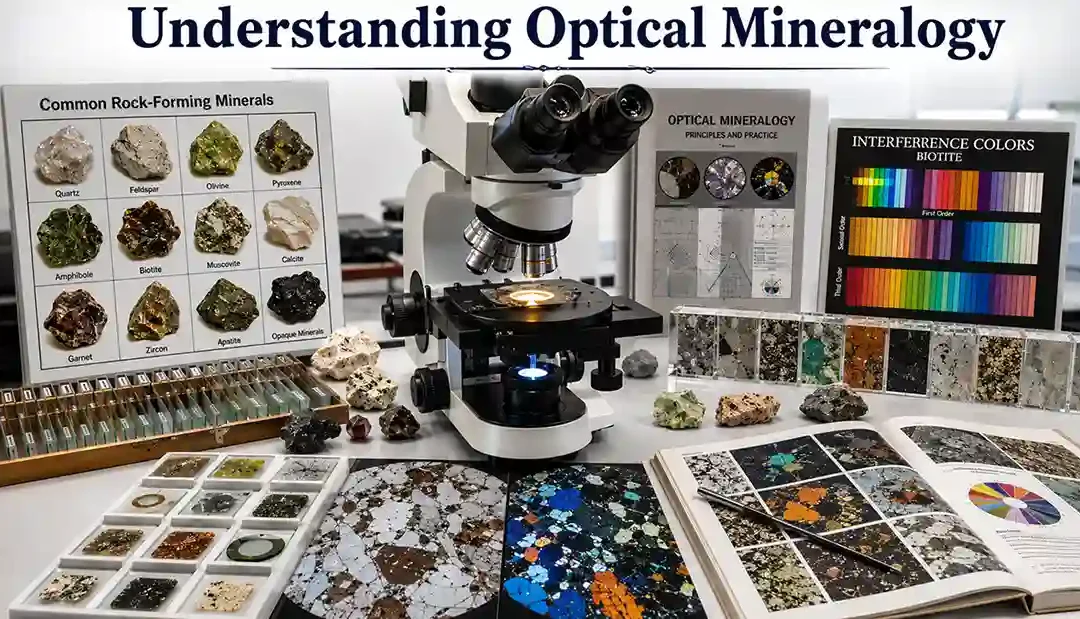
Optical mineralogy is the branch of mineralogy that studies minerals using polarized light microscopy. By observing how minerals interact with light, geologists can identify their crystal structure, optical properties, chemical composition, and geological history. Optical mineralogy is one of the most important tools in geology because many minerals cannot be accurately identified using hand specimens alone.
Using a petrographic microscope, geologists examine thin sections of rocks and minerals under plane-polarized light (PPL) and cross-polarized light (XPL). Properties such as color, pleochroism, birefringence, extinction, interference colors, twinning, and optic sign help distinguish one mineral from another.
Optical mineralogy is fundamental to petrology, mineralogy, economic geology, metamorphic geology, sedimentology, and planetary science.
This topic should be studied together with Petrographic Microscopy, Mineralogy Explained, Optical Properties of Minerals, and Thin Section Mineral Analysis.
What Is Optical Mineralogy?
Optical mineralogy is the scientific study of minerals based on their interaction with polarized light.
It focuses on:
- Mineral identification
- Optical properties
- Crystal orientation
- Crystal symmetry
- Mineral composition
- Rock textures
- Geological history
It provides rapid and reliable identification of minerals in thin sections.
Principles of Optical Mineralogy
Light behaves differently when it passes through different minerals.
Depending on their crystal structure, minerals may:
- Transmit light
- Absorb light
- Split light into two rays
- Rotate polarized light
- Produce interference colors
These behaviors form the basis of optical mineral identification.
The Petrographic Microscope
A petrographic microscope differs from an ordinary microscope because it contains polarized filters.
Major components include:
- Polarizer
- Analyzer
- Rotating stage
- Objective lenses
- Bertrand lens
- Condenser
- Crosshairs
Together these components allow detailed observation of mineral optical properties.
Plane-Polarized Light (PPL)
Under plane-polarized light, geologists observe:
- Color
- Pleochroism
- Relief
- Cleavage
- Crystal habit
- Transparency
PPL provides the first stage of mineral identification.
Cross-Polarized Light (XPL)
Under crossed polars, additional properties become visible.
These include:
- Interference colors
- Extinction
- Twinning
- Birefringence
- Optical sign
Most mineral identification relies heavily on observations made in XPL.
Major Optical Properties
Color
Some minerals have distinctive colors.
Examples:
- Biotite – Brown
- Hornblende – Green
- Chlorite – Green
- Tourmaline – Dark Green to Brown
Quartz and feldspar are generally colorless.
Pleochroism
Pleochroism is the change in color when a mineral is rotated under plane-polarized light.
Common pleochroic minerals include:
- Biotite
- Hornblende
- Tourmaline
Relief
Relief describes how strongly a mineral stands out compared with the mounting medium.
High-relief minerals include:
- Garnet
- Zircon
- Epidote
Low-relief minerals include:
- Quartz
- Feldspar
Cleavage
Many minerals display characteristic cleavage directions.
Examples:
- Mica – One perfect cleavage
- Amphibole – Two cleavages at approximately 60° and 120°
- Pyroxene – Two cleavages near 90°
Birefringence
Birefringence occurs when a mineral splits light into two rays.
High birefringence minerals:
- Calcite
- Zircon
Low birefringence minerals:
- Quartz
- Feldspar
Interference Colors
Interference colors appear under crossed polars due to birefringence.
Examples:
- Quartz – First-order gray
- Calcite – High-order colors
- Muscovite – Bright second- to third-order colors
Extinction
Extinction occurs when a mineral becomes dark during stage rotation.
Types include:
- Straight extinction
- Inclined extinction
- Undulose extinction
Twinning
Twinning consists of repeated crystal growth patterns.
Common examples:
- Albite twinning
- Carlsbad twinning
- Cross-hatched twinning
These are especially useful for identifying feldspars.
Accessory Optical Properties
Other diagnostic properties include:
- Optic sign
- Optic angle (2V)
- Dispersion
- Isotropic vs. anisotropic behavior
- Conoscopic interference figures
These properties provide additional confirmation of mineral identity.
Common Minerals in Optical Mineralogy
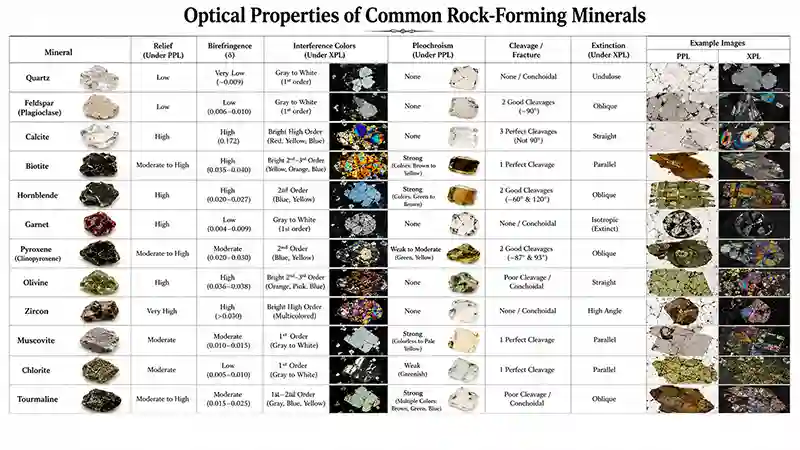
Frequently identified minerals include:
- Quartz
- Plagioclase Feldspar
- Potassium Feldspar
- Muscovite
- Biotite
- Amphibole
- Pyroxene
- Olivine
- Garnet
- Calcite
- Zircon
- Apatite
These minerals are the foundation of petrographic analysis.
Optical Mineralogy in Different Rock Types
| Rock Type | Common Minerals Observed |
|---|---|
| Igneous | Quartz, Feldspar, Olivine, Pyroxene |
| Sedimentary | Quartz, Calcite, Clay Minerals |
| Metamorphic | Garnet, Mica, Amphibole |
| Hydrothermal | Quartz, Calcite, Chlorite |
| Ore Deposits | Gangue and Alteration Minerals |
Each rock type displays distinctive mineral assemblages and textures.
Geological Importance
Optical mineralogy helps geologists:
- Identify minerals accurately
- Classify rocks
- Interpret metamorphic history
- Study igneous crystallization
- Analyze sediment provenance
- Evaluate hydrothermal alteration
It remains one of the most widely used techniques in geology.
Laboratory Investigation
Optical mineralogy is commonly combined with:
- Petrographic Microscopy
- X-Ray Diffraction (XRD)
- Electron Microprobe Analysis (EPMA)
- Scanning Electron Microscopy (SEM)
- Raman Spectroscopy
- X-Ray Fluorescence (XRF)
- Mineral Chemistry Analysis
These methods complement optical observations and improve identification accuracy.
Applications
Optical mineralogy is widely used in:
- Mineralogy
- Igneous Petrology
- Metamorphic Petrology
- Sedimentology
- Economic Geology
- Engineering Geology
- Planetary Science
- Environmental Geology
Advantages of Studying Optical Mineralogy
Studying optical mineralogy helps scientists:
- Identify minerals quickly and accurately
- Interpret rock-forming processes
- Reconstruct geological histories
- Support mineral exploration
- Evaluate alteration and metamorphism
- Improve petrographic analysis
Limitations
Optical mineralogy has several limitations:
- Opaque minerals require reflected-light microscopy or SEM.
- Extremely fine-grained minerals may be difficult to identify.
- Some minerals have similar optical properties and require chemical confirmation.
- Accurate interpretation depends on properly prepared thin sections and experience.
For comprehensive interpretation, combine optical mineralogy with:
- Petrographic Microscopy
- Thin Section Mineral Analysis
- Mineralogy Explained
- Optical Properties of Minerals
- Refractive Index in Minerals
- Double Refraction Explained
- Mineral Chemistry Analysis
- X-Ray Diffraction in Mineralogy
Comparison Table
| Optical Property | Purpose | Example Minerals |
| Color | Initial Identification | Biotite, Hornblende |
| Relief | Compare Refractive Index | Garnet, Quartz |
| Pleochroism | Identify Colored Minerals | Tourmaline, Biotite |
| Birefringence | Measure Optical Behavior | Calcite, Quartz |
| Interference Colors | Mineral Identification | Muscovite, Calcite |
| Extinction | Crystal Orientation | Pyroxene, Amphibole |
| Twinning | Feldspar Identification | Plagioclase, Microcline |
Summary Table
| Feature | Optical Mineralogy |
| Main Technique | Polarized Light Microscopy |
| Primary Tool | Petrographic Microscope |
| Main Purpose | Mineral Identification |
| Common Study Methods | PPL, XPL, Conoscopy |
| Geological Importance | Mineral and Rock Analysis |
Optical mineralogy is the study of minerals using polarized light microscopy to identify their optical properties, crystal structure, and mineral composition.
Plane-polarized light (PPL) is used to observe color, relief, pleochroism, and cleavage, while cross-polarized light (XPL) reveals interference colors, birefringence, extinction, and twinning.
It enables accurate identification of minerals in thin sections, helping geologists classify rocks, interpret geological processes, and reconstruct Earth's history.
Quartz, feldspar, biotite, muscovite, amphibole, pyroxene, olivine, garnet, calcite, zircon, apatite, and many other rock-forming minerals.
They prepare thin sections and examine them under a petrographic microscope using plane-polarized light, cross-polarized light, and, when necessary, advanced techniques such as XRD, SEM, EPMA, and Raman spectroscopy.
Final Thoughts
Optical mineralogy remains one of the most powerful and widely used methods for identifying minerals and interpreting rocks. By examining minerals under polarized light, geologists can determine crystal orientation, optical behavior, mineral composition, and geological history with remarkable precision. Despite the development of advanced analytical instruments, petrographic microscopy continues to be the foundation of mineral identification and rock analysis.
By combining optical observations with X-ray diffraction, electron microprobe analysis, scanning electron microscopy, Raman spectroscopy, and mineral chemistry, geologists gain a comprehensive understanding of mineral formation, alteration, and geological evolution. Optical mineralogy remains indispensable in mineralogy, petrology, economic geology, environmental science, and planetary exploration.
Continue Learning
Expand your knowledge of mineral identification with these related guides: