
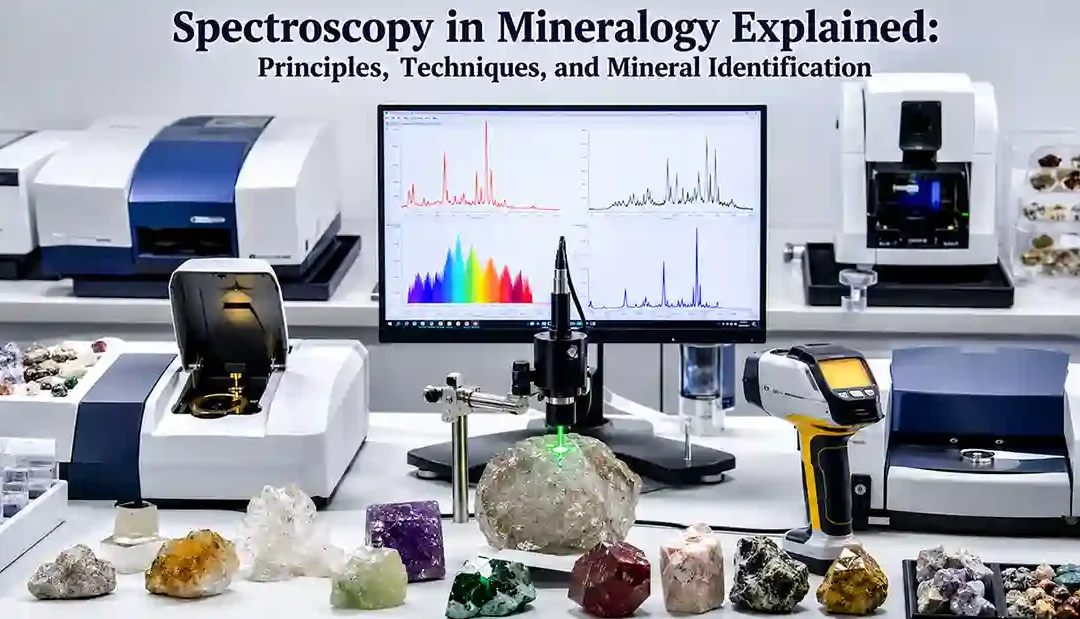
Spectroscopy is one of the most powerful analytical techniques used in modern mineralogy. It studies how minerals interact with electromagnetic radiation, allowing scientists to identify minerals, determine their chemical composition, investigate crystal structures, and detect impurities without destroying the sample.
Unlike traditional physical tests such as hardness or streak, spectroscopic methods analyze the interaction of light, infrared radiation, lasers, or X-rays with a mineral. Each mineral produces a characteristic spectrum that serves as a unique fingerprint, enabling accurate identification even for microscopic grains.
Today, spectroscopy plays a vital role in mineralogy, geology, mining, planetary science, environmental research, archaeology, and gemstone identification. It is commonly used alongside X-ray diffraction (XRD), Electron Microprobe Analysis (EPMA), Scanning Electron Microscopy (SEM), and petrographic microscopy to provide a complete understanding of mineral properties.
If you are studying modern mineral analysis, spectroscopy should be learned together with X-Ray Diffraction in Mineralogy, Electron Microprobe Analysis, and Laboratory Mineral Testing.
What Is Spectroscopy?
Spectroscopy is the study of how minerals absorb, emit, reflect, or scatter electromagnetic radiation.
When radiation interacts with a mineral, its atoms and molecules respond differently depending on their:
- Chemical composition
- Crystal structure
- Atomic bonding
- Trace elements
- Crystal defects
The resulting spectrum can be used to identify the mineral and study its properties.
Why Is Spectroscopy Important?
Spectroscopy allows geologists to:
- Identify unknown minerals
- Determine chemical composition
- Detect trace elements
- Study crystal structure
- Identify alteration minerals
- Analyze gemstones
- Investigate planetary materials
Many spectroscopic techniques are non-destructive and require little sample preparation.
Principle of Spectroscopy
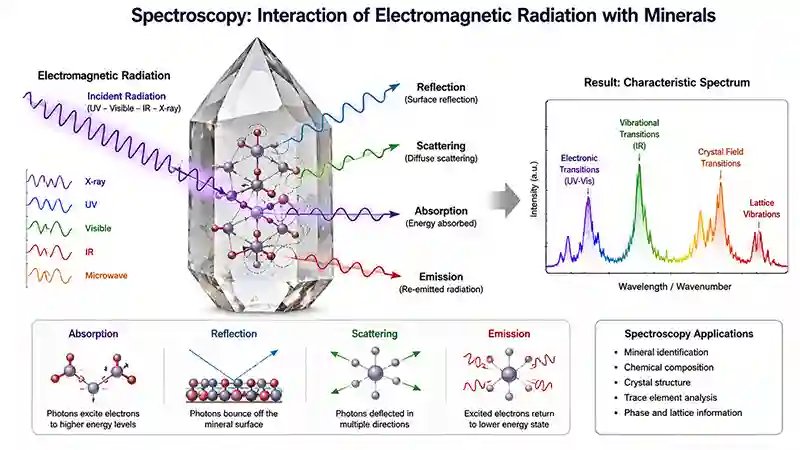
Spectroscopic analysis is based on the interaction between electromagnetic radiation and matter.
The process generally involves:
- Radiation reaches the mineral.
- Atoms or molecules absorb or scatter energy.
- The detector records the response.
- Software converts the signal into a spectrum.
- The spectrum is compared with reference databases.
Each mineral produces a characteristic spectral signature.
Major Types of Spectroscopy
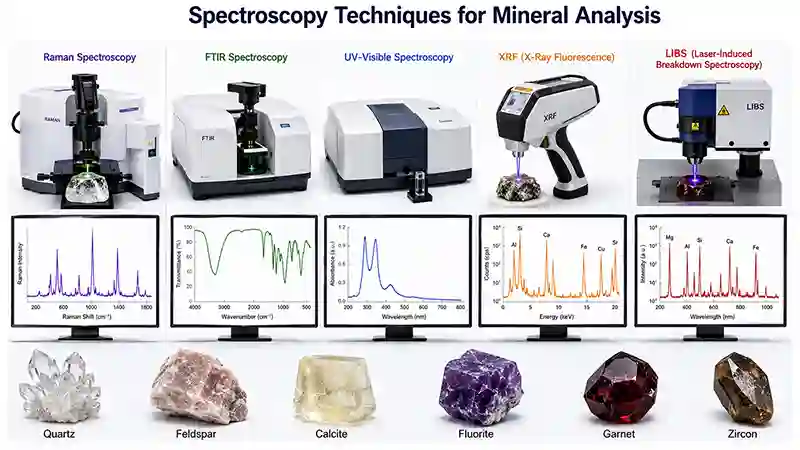
Several spectroscopic methods are widely used in mineralogy.
Raman Spectroscopy
Raman spectroscopy uses a laser beam to measure scattered light.
Applications include:
- Mineral identification
- Crystal structure analysis
- Gemstone authentication
- Inclusion studies
Raman spectroscopy requires very little sample preparation.
Fourier-Transform Infrared (FTIR) Spectroscopy
FTIR measures infrared absorption caused by molecular vibrations.
It is commonly used for:
- Clay minerals
- Carbonates
- Hydrated minerals
- Organic inclusions
FTIR is particularly useful for identifying hydroxyl groups and water in minerals.
UV-Visible Spectroscopy
UV-Visible spectroscopy measures the absorption of ultraviolet and visible light.
Applications include:
- Gemstone color analysis
- Transition metal identification
- Iron oxidation states
- Trace element studies
X-Ray Fluorescence (XRF)
XRF determines elemental composition by measuring characteristic X-rays emitted from a sample.
It is widely used in:
- Ore exploration
- Mining
- Environmental studies
- Geochemistry
Unlike Raman and FTIR, XRF provides elemental rather than molecular information.
Laser-Induced Breakdown Spectroscopy (LIBS)
LIBS uses a high-energy laser pulse to create a microscopic plasma.
Applications include:
- Rapid field analysis
- Planetary exploration
- Mining exploration
- Elemental identification
Minerals Commonly Studied
Spectroscopy is used to analyze many minerals.
| Mineral | Common Spectroscopic Techniques |
|---|---|
| Quartz | Raman, FTIR |
| Feldspar | Raman, XRF |
| Calcite | Raman, FTIR |
| Fluorite | UV-Vis, Raman |
| Olivine | Raman, FTIR |
| Garnet | Raman, XRF |
| Zircon | Raman, LIBS |
| Magnetite | XRF, Raman |
| Clay Minerals | FTIR, Raman |
Each technique provides different information about the mineral.
Applications in Mineralogy
Spectroscopy is widely used for:
- Mineral identification
- Crystal chemistry
- Trace element analysis
- Gemstone authentication
- Weathering studies
- Metamorphic mineral analysis
- Ore deposit investigation
It complements many other laboratory techniques.
Applications in Industry
Spectroscopy supports industries including:
- Mining
- Petroleum exploration
- Environmental monitoring
- Gemology
- Archaeology
- Materials science
- Planetary science
Portable spectrometers also allow rapid field analysis.
Spectroscopy vs X-Ray Diffraction
| Spectroscopy | X-Ray Diffraction (XRD) |
| Chemical bonding information | Crystal structure |
| Molecular vibrations | Atomic lattice spacing |
| Often non-destructive | Non-destructive |
| Fast analysis | Highly accurate phase identification |
| Suitable for many sample types | Best for crystalline materials |
Both methods are frequently used together.
Spectroscopy vs Electron Microprobe
| Spectroscopy | Electron Microprobe (EPMA) |
| Optical or laser-based | Electron beam-based |
| Molecular and elemental information | Quantitative elemental chemistry |
| Minimal sample preparation | Requires polished, carbon-coated samples |
| Fast identification | High-precision chemical analysis |
These techniques complement one another in mineral research.
Advantages of Spectroscopy
Spectroscopy provides many advantages.
- Non-destructive analysis
- Rapid mineral identification
- High analytical sensitivity
- Minimal sample preparation
- Portable instruments available
- Suitable for laboratory and field investigations
Many techniques can analyze minerals without damaging valuable specimens.
Limitations
Spectroscopy also has some limitations.
- Different techniques provide different types of information.
- Some methods require expensive equipment.
- Fluorescence may interfere with Raman analysis.
- Interpretation often requires reference databases and experienced analysts.
For comprehensive mineral characterization, spectroscopy is commonly combined with:
- Laboratory Mineral Testing
- X-Ray Diffraction in Mineralogy
- Electron Microprobe Analysis
- Petrographic Microscopy
- Scanning Electron Microscopy (SEM)
- Optical Properties of Minerals
- How to Identify Minerals
Comparison Table
| Technique | Main Information |
| Raman Spectroscopy | Molecular Structure & Mineral Identification |
| FTIR Spectroscopy | Molecular Vibrations & Water Content |
| UV-Visible Spectroscopy | Color Centers & Trace Elements |
| XRF | Elemental Composition |
| LIBS | Rapid Elemental Analysis |
Summary Table
| Feature | Spectroscopy in Mineralogy |
| Main Purpose | Mineral Identification and Chemical Analysis |
| Common Techniques | Raman, FTIR, UV-Vis, XRF, LIBS |
| Sample Type | Minerals, Rocks, Gemstones |
| Best For | Non-destructive Mineral Analysis |
| Scientific Importance | Mineralogy, Geochemistry, Mining, Research |
Spectroscopy is the study of how minerals interact with electromagnetic radiation to determine their composition, crystal chemistry, and physical properties.
Raman spectroscopy and FTIR spectroscopy are among the most widely used techniques for mineral identification, while XRF is commonly used for elemental analysis.
Yes. Many minerals produce unique spectral fingerprints that allow accurate identification using reference databases.
Most spectroscopic techniques, including Raman, FTIR, UV-Visible, and XRF, are non-destructive and preserve the sample.
Spectroscopy provides rapid, accurate, and often non-destructive information about mineral composition, crystal chemistry, trace elements, and geological processes.
Final Thoughts
Spectroscopy has become one of the most versatile tools in modern mineralogy, allowing scientists to investigate minerals through their interaction with light and other forms of electromagnetic radiation. From Raman and FTIR spectroscopy to UV-Visible analysis, XRF, and LIBS, each technique reveals unique information about a mineral's composition, structure, and formation history.
When combined with X-ray diffraction, electron microprobe analysis, petrographic microscopy, and other laboratory techniques, spectroscopy provides a comprehensive understanding of Earth's minerals. Its speed, accuracy, and non-destructive nature make it indispensable for research, mining, environmental studies, and gemstone identification.
Continue Learning
Expand your knowledge with these related guides: