
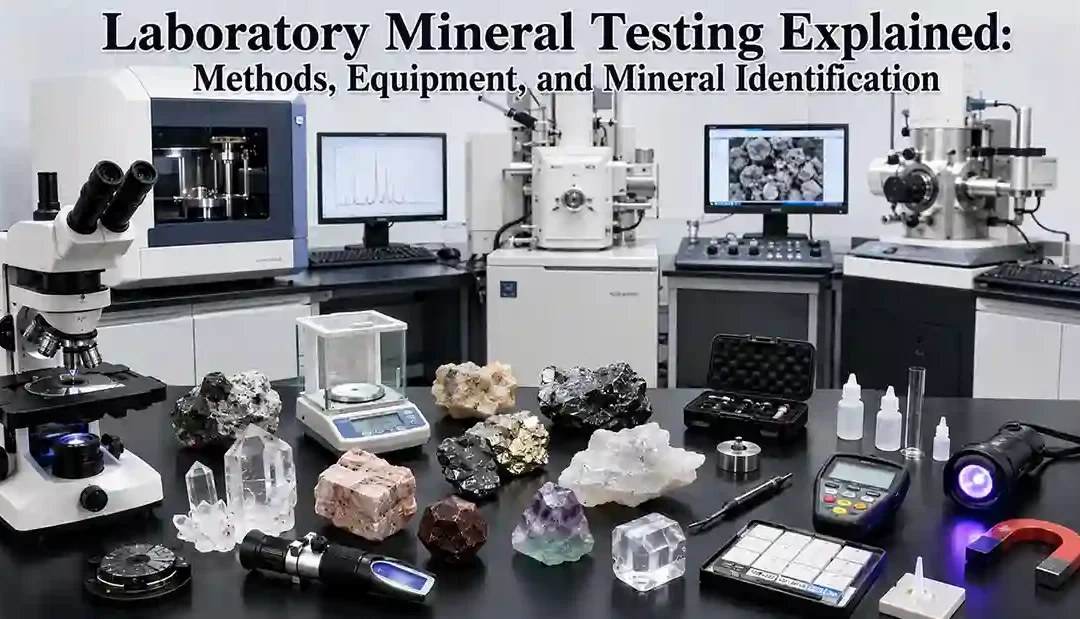
Laboratory mineral testing is the scientific process of identifying, analyzing, and characterizing minerals using specialized instruments and standardized testing methods. While field observations provide an initial understanding of a mineral specimen, laboratory tests offer much greater accuracy by examining its physical, optical, chemical, and crystallographic properties.
Modern mineralogy laboratories combine traditional identification techniques—such as hardness, streak, and acid testing—with advanced analytical instruments including polarized light microscopes, X-ray diffraction (XRD), electron microprobes (EPMA), scanning electron microscopes (SEM), and X-ray fluorescence (XRF). These methods help geologists identify minerals, determine their chemical composition, study crystal structures, and evaluate economic resources.
Laboratory mineral testing is widely used in geology, mining, environmental science, engineering, archaeology, and academic research.
For a complete understanding of mineral analysis, this topic should be studied together with How to Identify Minerals, Petrographic Microscopy, and X-Ray Diffraction in Mineralogy.
What Is Laboratory Mineral Testing?
Laboratory mineral testing is the systematic examination of mineral specimens using scientific instruments and standardized analytical techniques.
The main objectives are to:
- Identify unknown minerals
- Measure physical properties
- Determine chemical composition
- Analyze crystal structure
- Study mineral textures
- Evaluate mineral quality
Laboratory testing provides more reliable results than visual identification alone.
Why Is Laboratory Testing Important?
Laboratory analysis helps scientists:
- Confirm mineral identity
- Distinguish similar minerals
- Study geological history
- Evaluate ore deposits
- Assess industrial minerals
- Support academic research
- Verify gemstone authenticity
Many minerals appear similar in hand specimens but differ significantly under laboratory examination.
Categories of Laboratory Mineral Tests
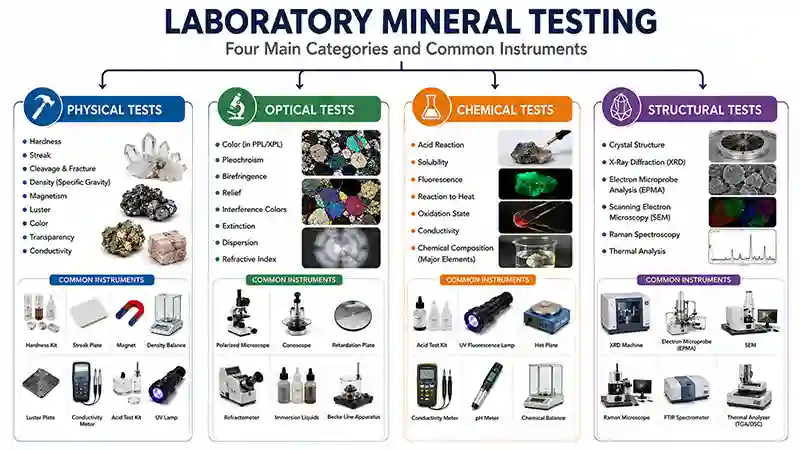
Mineral testing is generally divided into four major categories.
Physical Tests
These evaluate measurable physical characteristics.
Examples include:
- Hardness
- Streak
- Cleavage
- Fracture
- Specific gravity
- Density
- Magnetism
- Conductivity
Optical Tests
These examine how minerals interact with light.
Examples include:
- Color
- Luster
- Transparency
- Refractive index
- Birefringence
- Pleochroism
- Fluorescence
- Interference colors
Chemical Tests
Chemical tests identify mineral composition and reactions.
Common methods include:
- Acid test
- Solubility test
- X-ray fluorescence (XRF)
- Electron microprobe analysis (EPMA)
Structural Tests
Structural methods reveal atomic arrangement and crystal structure.
Common techniques include:
- X-ray diffraction (XRD)
- Electron diffraction
- Scanning electron microscopy (SEM)
Common Laboratory Equipment
Modern mineral laboratories commonly use:
- Polarized Light Microscope
- Petrographic Microscope
- X-ray Diffractometer (XRD)
- Electron Microprobe Analyzer (EPMA)
- Scanning Electron Microscope (SEM)
- X-ray Fluorescence Spectrometer (XRF)
- UV Fluorescence Lamp
- Refractometer
- Digital Balance
- Mohs Hardness Kit
- Conductivity Meter
- Magnet
- Acid Testing Kit
Each instrument provides different information about a mineral.
Physical Property Testing
Physical testing is often the first step in mineral identification.
Common tests include:
Hardness Test
Measures scratch resistance using the Mohs Hardness Scale.
Streak Test
Determines the color of a mineral's powdered form.
Cleavage and Fracture
Examines how minerals break.
Density and Specific Gravity
Measures the relationship between mass and volume.
Magnetism
Determines whether minerals respond to magnetic fields.
Conductivity
Measures electrical and thermal conductivity.
Optical Mineral Testing
Optical tests are usually performed using a petrographic microscope.
Common observations include:
- Color
- Relief
- Pleochroism
- Twinning
- Birefringence
- Extinction
- Interference colors
- Crystal habit
These properties are especially useful for transparent minerals.
Chemical Analysis
Chemical testing determines elemental composition and mineral reactions.
Common techniques include:
Acid Test
Identifies carbonate minerals.
X-Ray Fluorescence (XRF)
Measures bulk elemental composition.
Electron Microprobe Analysis (EPMA)
Determines quantitative chemical composition of individual mineral grains.
Wet Chemical Analysis
Used for specialized laboratory investigations.
Crystal Structure Analysis
Crystal structure is studied using advanced analytical methods.
X-Ray Diffraction (XRD)
Identifies minerals based on diffraction patterns.
Electron Diffraction
Provides crystallographic information at microscopic scales.
These techniques help distinguish minerals with similar chemistry but different crystal structures.
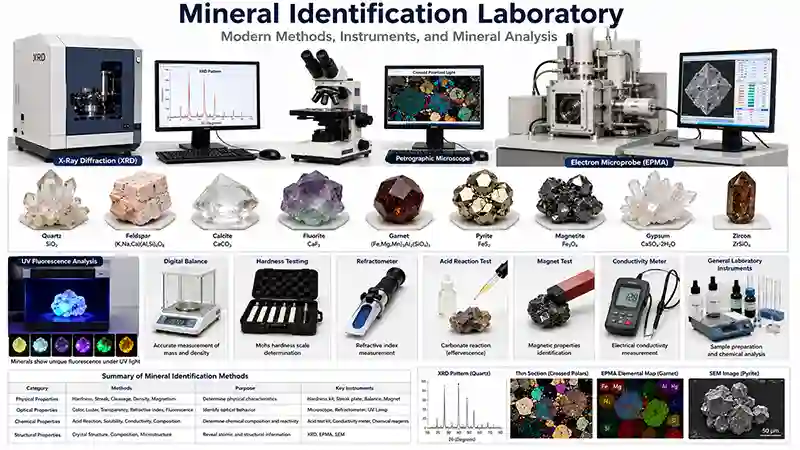
Common Minerals Tested
Laboratories routinely analyze:
| Mineral | Typical Laboratory Tests |
|---|---|
| Quartz | Optical, XRD, Hardness |
| Feldspar | Optical, XRD, EPMA |
| Calcite | Acid Test, Optical |
| Fluorite | Fluorescence, Optical |
| Magnetite | Magnetism, XRD |
| Pyrite | Conductivity, EPMA |
| Garnet | Optical, EPMA |
| Gypsum | Hardness, XRD |
| Olivine | Optical, EPMA |
| Zircon | Optical, EPMA |
Multiple tests provide the most reliable identification.
Applications of Laboratory Mineral Testing
Laboratory testing is essential in:
- Mineral identification
- Mining exploration
- Ore evaluation
- Petrology
- Geochemistry
- Engineering geology
- Environmental geology
- Gemology
- Academic research
It supports nearly every branch of Earth science.
Laboratory Testing Workflow
A typical laboratory investigation follows these steps:
- Collect the mineral sample.
- Record field observations.
- Perform physical property tests.
- Conduct optical examination.
- Analyze chemical composition.
- Determine crystal structure.
- Compare results with reference databases.
- Confirm mineral identification.
Using multiple techniques improves analytical accuracy.
Advantages of Laboratory Mineral Testing
Laboratory testing provides:
- Highly accurate identification
- Quantitative chemical analysis
- Crystal structure determination
- Non-destructive testing for many methods
- Reliable and repeatable results
- Scientific documentation
It offers much greater precision than field observations alone.
Limitations
Laboratory testing also has limitations.
- Advanced instruments are expensive.
- Some analyses require destructive sample preparation.
- Skilled operators are essential.
- Certain techniques require vacuum systems or specialized laboratories.
For the most reliable results, laboratories often combine:
- Petrographic Microscopy
- Thin Section Mineral Analysis
- X-Ray Diffraction in Mineralogy
- Electron Microprobe Analysis
- Optical Properties of Minerals
- Mineral Hardness Test
- How to Identify Minerals
Comparison Table
| Test Type | Main Purpose | Common Equipment |
| Physical | Measure physical properties | Hardness kit, balance, magnet |
| Optical | Study light interaction | Petrographic microscope, refractometer |
| Chemical | Determine elemental composition | EPMA, XRF, acid testing kit |
| Structural | Analyze crystal structure | XRD, SEM |
Summary Table
| Feature | Laboratory Mineral Testing |
| Main Purpose | Mineral Identification and Analysis |
| Major Categories | Physical, Optical, Chemical, Structural |
| Common Instruments | XRD, EPMA, SEM, Petrographic Microscope |
| Best For | Comprehensive Mineral Characterization |
| Scientific Importance | Mineralogy, Geology, Mining, Research |
Laboratory mineral testing is the scientific analysis of minerals using physical, optical, chemical, and structural techniques to accurately identify and characterize mineral specimens.
There is no single best test. Geologists typically combine physical tests, petrographic microscopy, X-ray diffraction (XRD), and chemical analyses such as EPMA or XRF for the most accurate results.
Many minerals have similar appearances but different chemical compositions or crystal structures. Combining several methods improves identification accuracy.
Common instruments include petrographic microscopes, XRD systems, electron microprobes (EPMA), scanning electron microscopes (SEM), XRF spectrometers, UV lamps, refractometers, and hardness testing kits.
It provides reliable mineral identification, supports geological research, evaluates mineral resources, assists mining exploration, and ensures accurate scientific analysis.
Final Thoughts
Laboratory mineral testing combines traditional mineral identification techniques with advanced analytical technologies to provide a complete understanding of mineral properties. From simple hardness and acid tests to sophisticated X-ray diffraction and electron microprobe analyses, each method contributes unique information about a mineral's physical characteristics, chemical composition, and crystal structure.
By integrating multiple laboratory techniques, geologists can accurately identify minerals, reconstruct geological histories, evaluate ore deposits, and support research across mineralogy, petrology, mining, engineering, and environmental science. Laboratory mineral testing remains one of the most essential foundations of modern Earth science.
Continue Learning
Continue exploring mineral analysis with these related guides: