
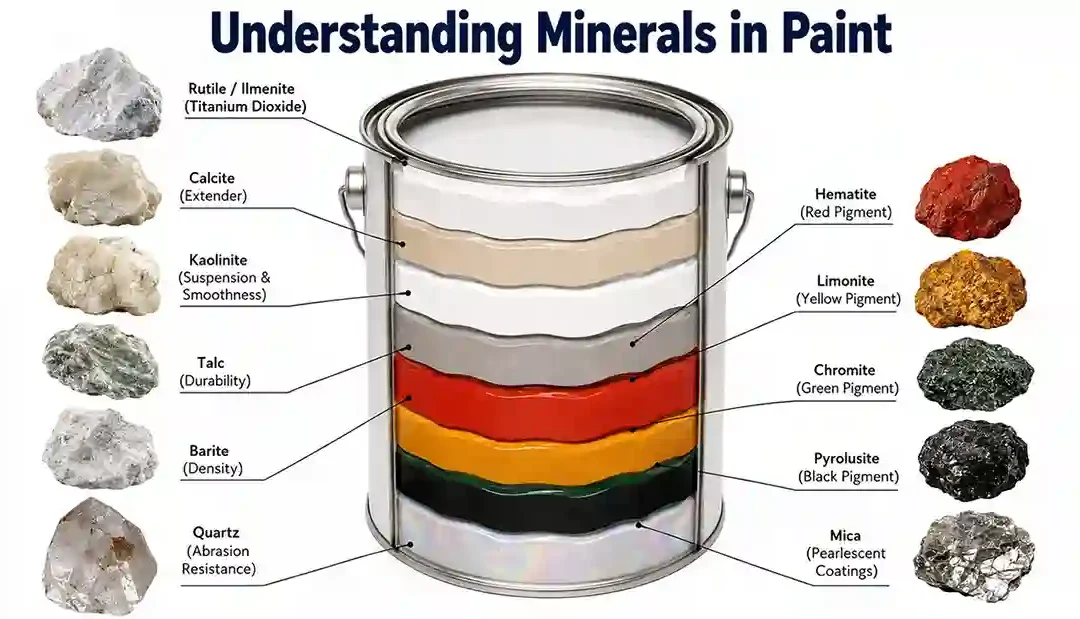
Paint is far more than a colorful coating. It protects buildings, automobiles, bridges, machinery, furniture, and countless everyday products from weathering, corrosion, moisture, ultraviolet radiation, and chemical damage. While binders and solvents are essential components, many of the most important properties of modern paint come from naturally occurring minerals.
Minerals in paint provide color, opacity, brightness, durability, abrasion resistance, corrosion protection, and improved application performance. Some minerals become pigments, while others act as fillers, extenders, or functional additives that improve the quality and lifespan of paint.
Understanding these minerals demonstrates how geology contributes to architecture, manufacturing, transportation, and industrial coatings.
This topic should be studied together with Industrial Minerals, Mineralogy, and Minerals in Glass.
Why Paint Depends on Minerals
Paint requires minerals with specialized physical and chemical properties.
These minerals provide:
- Color and pigmentation
- Opacity and hiding power
- Durability
- UV resistance
- Corrosion protection
- Smooth application
- Abrasion resistance
- Weather resistance
Without these minerals, modern paints would lack the performance required for construction, transportation, and industrial applications.
Major Minerals Used in Paint
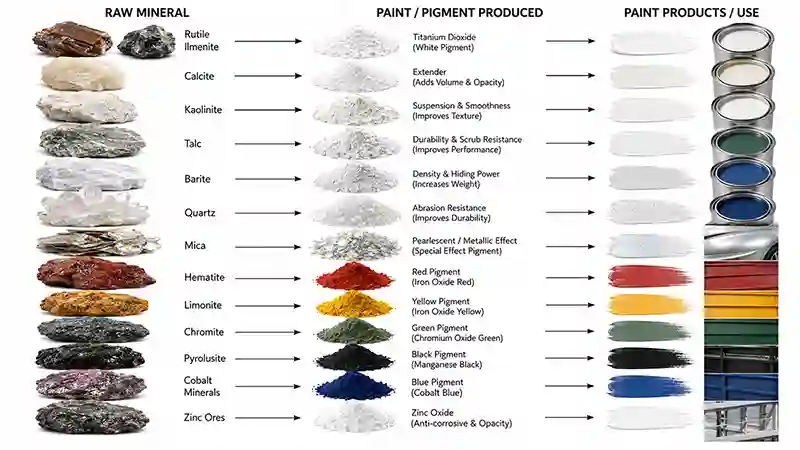
Titanium Minerals
Common source minerals:
- Rutile
- Ilmenite
Uses:
- Titanium dioxide (TiO₂)
- White paints
- Protective coatings
Importance:
Titanium dioxide is the world's most widely used white pigment because of its exceptional brightness, opacity, and UV resistance.
Calcite
Main mineral:
- Calcite
Uses:
- Extender pigment
- Interior paints
- Exterior coatings
Importance:
Calcite improves paint coverage, reduces production costs, and enhances surface smoothness.
Kaolinite
Uses:
- Paint filler
- Suspension agent
- Matte finishes
Importance:
Kaolin improves paint consistency, brightness, and application properties.
Talc
Uses:
- Industrial coatings
- Decorative paints
- Primers
Importance:
Talc improves durability, moisture resistance, and smoothness.
Barite
Main mineral:
- Barite
Uses:
- High-density coatings
- Marine paints
- Protective paints
Importance:
Barite increases density, chemical resistance, and durability.
Quartz
Uses:
- Abrasion-resistant coatings
- Floor paints
- Industrial coatings
Importance:
Silica improves hardness and wear resistance.
Mica
Uses:
- Decorative coatings
- Anti-corrosion paints
- Pearlescent finishes
Importance:
Mica improves durability, weather resistance, and reflective appearance.
Hematite
Uses:
- Red pigments
- Anti-corrosion primers
Importance:
Iron oxide pigments produce durable red colors with excellent weather resistance.
Limonite
Uses:
- Yellow and brown pigments
Importance:
Natural iron hydroxides create stable earth-tone colors.
Chromite
Uses:
- Green pigments
- Protective coatings
Importance:
Chromium compounds produce durable green colors with high chemical resistance.
Pyrolusite
Main mineral:
- Pyrolusite
Uses:
- Black pigments
- Specialty coatings
Importance:
Manganese dioxide produces deep black coloration.
Cobalt Minerals
Uses:
- Blue pigments
- High-temperature coatings
Importance:
Cobalt pigments provide brilliant blue colors with excellent stability.
Zinc Minerals
Common source:
- Smithsonite
- Sphalerite
Uses:
- Zinc oxide paints
- Anti-fungal coatings
Importance:
Zinc compounds improve mildew resistance and protect metal surfaces.
Minerals by Paint Component
| Paint Component | Main Minerals |
|---|---|
| White Pigment | Rutile, Ilmenite |
| Red Pigment | Hematite |
| Yellow Pigment | Limonite |
| Blue Pigment | Cobalt Minerals |
| Green Pigment | Chromite |
| Black Pigment | Pyrolusite |
| Fillers | Calcite, Kaolinite, Talc |
| Decorative Effects | Mica |
| Abrasion Resistance | Quartz |
| Protective Coatings | Barite, Zinc Minerals |
Types of Paint and Their Mineral Composition
Architectural Paint
Main minerals:
- Titanium dioxide
- Calcite
- Kaolin
- Talc
Used for residential and commercial buildings.
Industrial Paint
Main minerals:
- Barite
- Quartz
- Mica
- Titanium dioxide
Provides durability and corrosion resistance.
Automotive Paint
Main minerals:
- Titanium dioxide
- Mica
- Iron oxides
Produces smooth, weather-resistant finishes.
Marine Paint
Main minerals:
- Barite
- Zinc compounds
- Mica
Protects ships from corrosion and seawater.
Protective Coatings
Main minerals:
- Titanium dioxide
- Hematite
- Zinc compounds
Used on bridges, pipelines, and industrial equipment.
From Mine to Paint
Paint minerals undergo several production stages.
- Geological exploration
- Mining and quarrying
- Mineral processing
- Pigment production
- Paint formulation
- Mixing and quality control
- Packaging
- Consumer application
- Recycling or disposal
Each stage transforms natural minerals into high-performance paint products.
Environmental Challenges
Paint manufacturing presents several environmental challenges.
These include:
- Mining impacts
- Energy-intensive pigment production
- Chemical emissions
- Waste generation
- Heavy metal management
Modern paint formulations increasingly use environmentally friendly mineral pigments and low-VOC technologies.
Recycling Paint Materials
Although paint recycling is complex, several materials can be recovered.
Recycling helps:
- Reduce waste
- Recover pigments
- Reuse containers
- Conserve mineral resources
- Lower environmental impacts
Geological Importance
Paint manufacturing depends on a reliable supply of industrial minerals.
Geologists help:
- Locate titanium mineral deposits
- Evaluate kaolin resources
- Assess barite quality
- Explore industrial silica deposits
- Support sustainable mining
Their work ensures consistent raw materials for the paint industry.
Laboratory Investigation
Paint minerals are studied using:
- X-Ray Diffraction (XRD)
- X-Ray Fluorescence (XRF)
- Scanning Electron Microscopy (SEM)
- Particle size analysis
- ICP-MS
- Colorimetric testing
These techniques evaluate mineral composition, purity, particle size, and pigment performance.
Applications
Paint minerals are essential in:
- Residential buildings
- Commercial buildings
- Automobiles
- Bridges
- Ships
- Industrial equipment
- Pipelines
- Furniture
- Consumer products
Advantages of Studying Paint Minerals
Understanding paint minerals helps scientists and engineers:
- Improve paint durability
- Develop safer pigments
- Enhance corrosion resistance
- Increase weather protection
- Improve color stability
- Support sustainable manufacturing
Limitations
Despite their importance, paint minerals present several challenges.
- High-quality titanium minerals are limited in some regions.
- Mining and pigment production require significant energy.
- Some traditional pigments have environmental concerns.
- Paint formulations must balance cost, performance, and sustainability.
- Strict environmental regulations continue to influence mineral selection.
For a broader understanding, study this topic together with:
- Industrial Minerals
- Economic Minerals
- Mineralogy
- Materials Science
- Surface Coatings
- Corrosion Engineering
- Sustainable Manufacturing
- Environmental Geology
Comparison Table
| Mineral | Main Paint Function | Example Product |
| Rutile | White Pigment | Interior Paint |
| Ilmenite | Titanium Dioxide Source | Exterior Paint |
| Calcite | Extender | Wall Paint |
| Kaolinite | Filler | Decorative Paint |
| Talc | Smoothness | Primer |
| Barite | Density | Marine Coating |
| Quartz | Abrasion Resistance | Floor Paint |
| Mica | Pearlescent Effect | Automotive Paint |
| Hematite | Red Pigment | Anti-corrosion Primer |
| Chromite | Green Pigment | Industrial Coating |
Summary Table
| Feature | Minerals in Paint |
| Main Purpose | Paint and Coating Manufacturing |
| Key Minerals | Rutile, Ilmenite, Calcite, Kaolinite |
| Specialty Minerals | Mica, Barite, Chromite, Hematite |
| Study Methods | XRD, XRF, SEM, Particle Size Analysis |
| Geological Importance | Industrial Mineral Resources and Surface Coatings |
Titanium minerals such as rutile and ilmenite are the most important because they are processed into titanium dioxide, the world's leading white pigment.
Calcite acts as an extender that improves coverage, reduces costs, and creates a smoother finish.
Hematite produces red pigments, limonite creates yellow and brown colors, chromite contributes green pigments, cobalt minerals create blue pigments, and pyrolusite produces black pigments.
Yes. Minerals such as talc, quartz, mica, and barite improve hardness, weather resistance, abrasion resistance, and corrosion protection.
Mineral pigments generally offer excellent stability, UV resistance, long-lasting color, and durability under harsh environmental conditions.
Final Thoughts
Modern paint relies on a wide range of industrial minerals that provide color, opacity, durability, and protection. Titanium minerals produce brilliant white pigments, while calcite, kaolinite, talc, barite, quartz, and mica enhance paint performance. Iron oxides, chromium minerals, cobalt minerals, and manganese minerals create durable natural colors used in architectural, automotive, and industrial coatings.
As demand grows for longer-lasting and environmentally friendly coatings, sustainable mining, advanced mineral processing, and improved paint recycling will become increasingly important. Understanding the geology behind paint ingredients highlights the vital role minerals play in protecting and beautifying the built environment.
Continue Learning
Continue exploring related topics: