
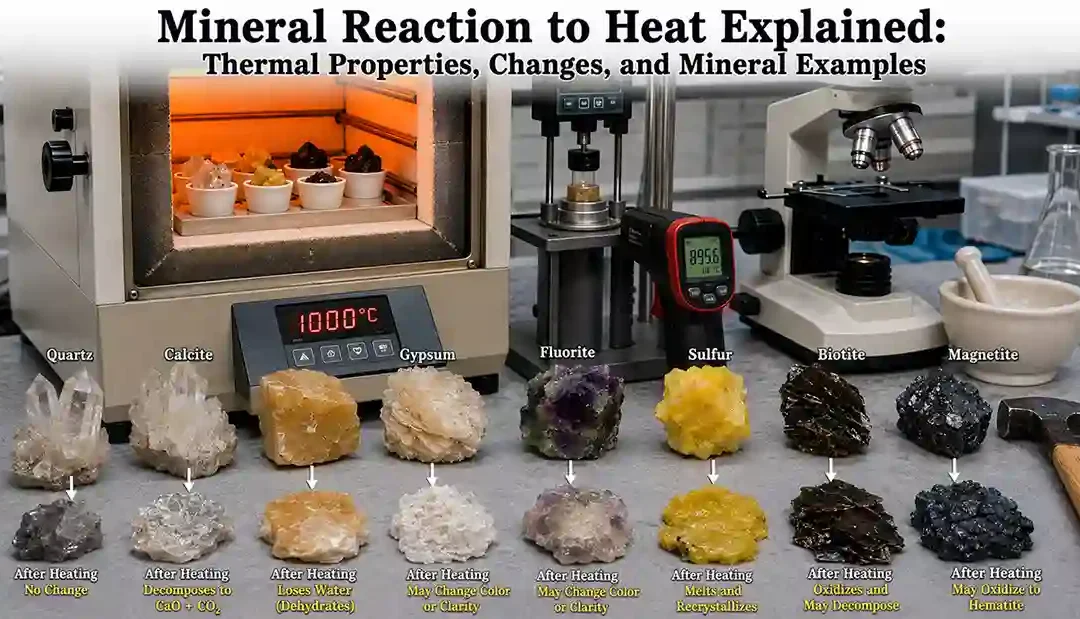
Heat plays a fundamental role in the formation, transformation, and destruction of minerals. From the crystallization of minerals in cooling magma to the alteration of rocks during metamorphism, changes in temperature continuously reshape Earth's crust. When minerals are heated, they may expand, change color, lose water, decompose, melt, or transform into entirely new mineral species.
The way a mineral reacts to heat depends on its chemical composition, crystal structure, water content, and melting temperature. Some minerals remain stable at very high temperatures, while others begin to dehydrate or decompose at only a few hundred degrees Celsius.
Understanding mineral reactions to heat is important in mineralogy, petrology, metallurgy, ceramics, engineering geology, and industrial mineral processing.
If you are studying mineral properties, this topic should be learned together with Mineral Stability Explained, Crystal Growth in Minerals, and How to Identify Minerals.
What Is a Mineral's Reaction to Heat?
A mineral's reaction to heat refers to the physical or chemical changes that occur when its temperature increases.
Possible changes include:
- Thermal expansion
- Color changes
- Dehydration
- Decomposition
- Phase transformation
- Melting
Not every mineral responds to heat in the same way.
Why Do Minerals Change When Heated?
Heating increases the vibration of atoms within a crystal.
As temperature rises:
- Atomic bonds stretch.
- Crystal structures expand.
- Chemical reactions may occur.
- Water may escape.
- New minerals may form.
If enough heat is supplied, the mineral eventually melts.
Types of Heat Reactions
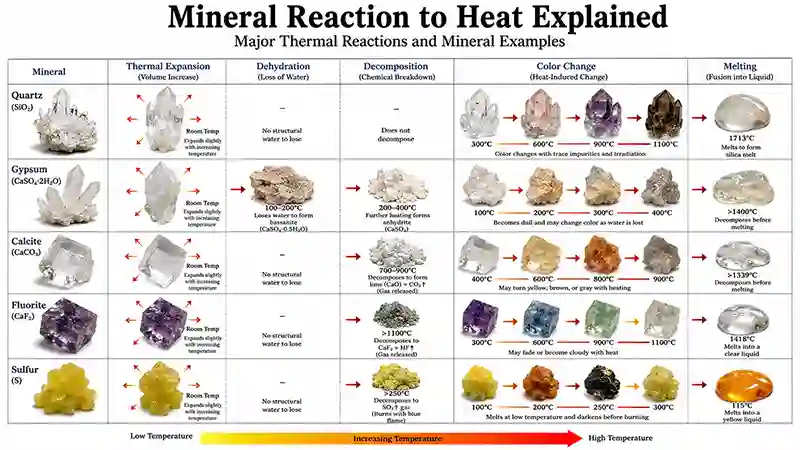
Minerals commonly exhibit several thermal responses.
Thermal Expansion
Most minerals increase slightly in size when heated. Expansion varies among different crystal directions and mineral species. Quartz, for example, expands differently along different crystallographic axes.
Color Change
Some minerals change color after heating because of chemical or structural changes.
Examples include:
- Amethyst → Yellow Citrine (under controlled heating)
- Smoky Quartz → Lighter Color
- Certain Feldspars → Color Modification
Natural and laboratory heating can produce different results.
Dehydration
Hydrated minerals lose water when heated.
Examples:
- Gypsum → Bassanite → Anhydrite
- Goethite → Hematite
Dehydration often changes both crystal structure and physical properties.
Decomposition
Some minerals break down into new compounds when heated.
Example:
Calcite decomposes into:
- Calcium oxide (lime)
- Carbon dioxide gas
This reaction occurs at temperatures above approximately 825°C under normal atmospheric pressure.
Melting
At sufficiently high temperatures, minerals melt and become liquid. Melting temperatures vary greatly among mineral species.
Heat Reaction of Common Minerals
| Mineral | Reaction to Heat |
|---|---|
| Quartz | Thermal Expansion, Phase Transition |
| Calcite | Decomposes to Lime + CO₂ |
| Gypsum | Loses Water (Dehydration) |
| Sulfur | Melts Easily |
| Fluorite | May Fluoresce Under Heating, Minor Changes |
| Biotite | Dehydrates at High Temperature |
| Magnetite | Generally Stable Until Very High Temperatures |
Each mineral has a unique thermal behavior based on its chemistry and crystal structure.
Quartz and Heat
Quartz is one of the most studied minerals in thermal mineralogy.
Important thermal properties include:
- Excellent heat resistance
- Thermal expansion
- Alpha-to-beta quartz transition at approximately 573°C
- High melting temperature (about 1,710°C)
Quartz remains chemically stable over a wide temperature range.
Calcite and Heat
Calcite behaves very differently.
As temperature increases:
- Crystal structure becomes unstable.
- Carbon dioxide is released.
- Calcium oxide remains.
This reaction is the basis of lime production used in cement manufacturing.
Gypsum and Heat
Gypsum contains chemically bound water.
Heating produces:
- Gypsum
- Bassanite (Plaster of Paris)
- Anhydrite
This dehydration reaction is widely used in the construction industry.
Sulfur and Heat
Sulfur is one of the most heat-sensitive common minerals because of its relatively low melting temperature.
Important thermal properties include:
- Low melting point (approximately 115°C)
- Changes from solid to liquid when heated
- Burns in oxygen to produce sulfur dioxide (SO₂)
- Blue flame during combustion
- Low thermal stability compared with most rock-forming minerals
Sulfur melts and burns much more easily than most common minerals.
Fluorite and Heat
Fluorite remains relatively stable under moderate heating but undergoes changes at higher temperatures.
Important thermal properties include:
- Good thermal stability under moderate heat
- Fluorescence may decrease after prolonged heating
- Color may change because of crystal defects
- High melting temperature (approximately 1,418°C)
- Crystal structure remains stable until very high temperatures
Fluorite is generally heat resistant but may lose some optical properties after strong heating.
Biotite and Heat
Biotite undergoes gradual chemical and structural changes when exposed to high temperatures.
Important thermal properties include:
- Stable under moderate temperatures
- Dehydrates at elevated temperatures
- Hydroxyl (OH) groups are released during heating
- Crystal structure gradually alters
- May transform into high-temperature metamorphic minerals
Biotite becomes progressively less stable as temperature increases during metamorphism.
Magnetite and Heat
Magnetite is one of the most thermally stable iron oxide minerals.
Important thermal properties include:
- Excellent heat resistance
- Remains chemically stable at high temperatures
- Loses permanent magnetism above the Curie temperature (~580°C)
- May oxidize to hematite in oxygen-rich environments
- Very high melting temperature (approximately 1,597°C)
Magnetite retains its crystal structure over a wide temperature range but its magnetic properties change with heating.
Heat and Crystal Structure
Heat can modify crystal structures.
Possible changes include:
- Atomic rearrangement
- Expansion of crystal lattice
- Phase transitions
- Loss of symmetry
- Formation of new minerals
These transformations are important in metamorphic geology.
Heat During Metamorphism
Metamorphism occurs when rocks experience elevated temperatures and pressures.
Heat promotes the growth of new minerals such as:
- Garnet
- Kyanite
- Sillimanite
- Andalusite
These minerals indicate the temperature conditions during metamorphism.
Heat in Industrial Mineral Processing
Heating is widely used in:
- Cement production
- Lime manufacture
- Ceramic production
- Glass manufacturing
- Metal smelting
- Refractory materials
Many industrial processes rely on predictable mineral reactions to heat.
Laboratory Tests for Heat Reactions
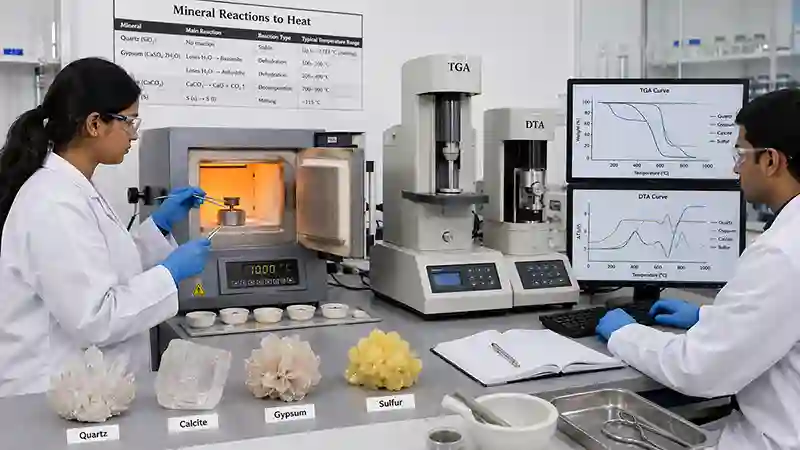
Scientists study thermal behavior using:
- Laboratory furnace
- Thermogravimetric Analysis (TGA)
- Differential Thermal Analysis (DTA)
- Differential Scanning Calorimetry (DSC)
- Infrared thermometer
These techniques measure temperature-related physical and chemical changes.
Importance of Heat Reactions
Understanding thermal behavior helps scientists:
- Identify minerals
- Study metamorphism
- Design industrial processes
- Manufacture ceramics
- Produce cement
- Understand volcanic processes
- Evaluate engineering materials
Advantages of Studying Thermal Properties
Thermal studies allow geologists to:
- Predict mineral stability
- Understand phase transitions
- Interpret geological history
- Improve industrial processing
- Evaluate fire-resistant materials
Limitations
Mineral reactions to heat vary because of:
- Heating rate
- Pressure
- Mineral impurities
- Grain size
- Water content
- Surrounding atmosphere
For reliable interpretation, combine thermal studies with:
- Mineral Stability Explained
- Crystal Growth in Minerals
- Chemical Properties of Minerals
- Optical Properties of Minerals
- Mineral Conductivity
- How to Identify Minerals
- Mineral Weathering Explained
Comparison Table
| Heat Reaction | Typical Minerals |
| Thermal Expansion | Quartz, Feldspar |
| Dehydration | Gypsum, Goethite |
| Decomposition | Calcite |
| Melting | Sulfur (low melting), Most Minerals (high temperatures) |
| Phase Transition | Quartz |
Summary Table
| Feature | Mineral Reaction to Heat |
| Main Concept | Physical and Chemical Changes Due to Heating |
| Common Reactions | Expansion, Dehydration, Decomposition, Melting |
| Key Laboratory Tools | Furnace, TGA, DTA, DSC |
| Geological Importance | Metamorphism, Magmatism, Industrial Processing |
| Identification Value | High (with Other Tests) |
Minerals may expand, change color, lose water, undergo phase transitions, decompose, or melt depending on their composition and crystal structure.
Gypsum loses chemically bound water and transforms first into bassanite (Plaster of Paris) and then into anhydrite with continued heating.
Calcite decomposes into calcium oxide (lime) and carbon dioxide gas at high temperatures.
No. Quartz has a high melting temperature of about 1,710°C, although it undergoes a crystal structure transition at approximately 573°C.
It helps scientists understand mineral stability, metamorphism, volcanic processes, industrial mineral processing, and material performance under high temperatures.
Final Thoughts
Mineral reactions to heat reveal how Earth's materials respond to changing temperature conditions. From the dehydration of gypsum and the decomposition of calcite to the phase transition of quartz and the formation of metamorphic minerals, thermal behavior provides valuable insight into geological processes and industrial applications.
Understanding these reactions helps geologists interpret metamorphism, volcanic activity, and mineral stability while supporting industries such as cement production, ceramics, metallurgy, and glass manufacturing. When combined with crystal structure, chemical composition, and other physical properties, thermal behavior becomes an essential aspect of mineral science.
Continue Learning
Expand your knowledge with these related guides: