
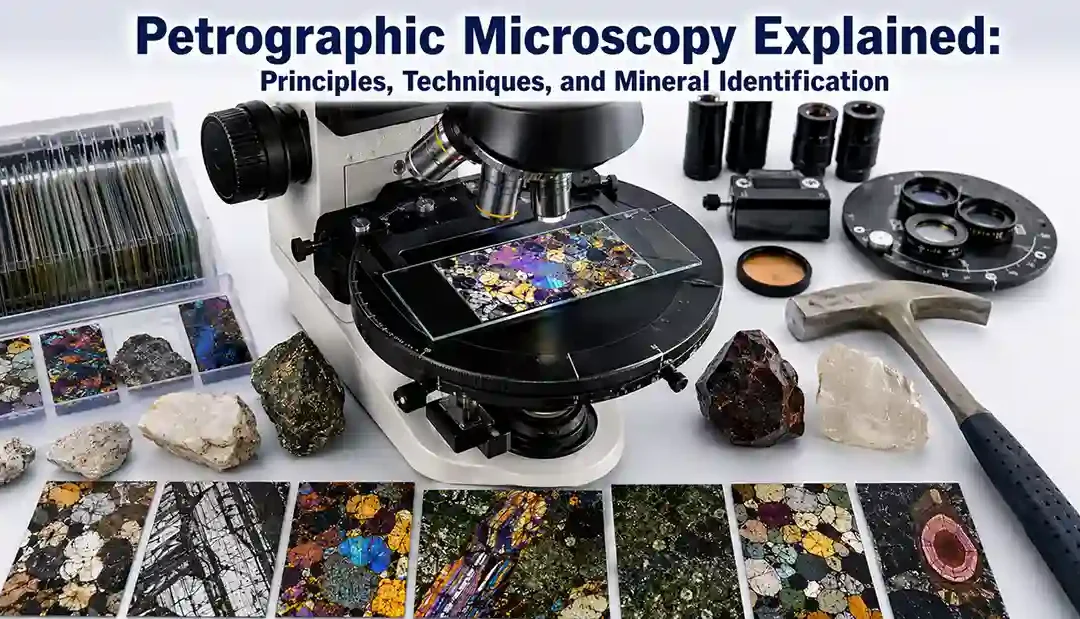
Petrographic microscopy is one of the most important analytical techniques in geology, mineralogy, and petrology. It uses a specialized polarized light microscope to study minerals and rocks in thin sections, allowing geologists to identify minerals based on their optical properties rather than appearance alone.
A petrographic microscope reveals characteristics such as birefringence, interference colors, extinction angles, twinning, crystal habit, pleochroism, and mineral textures that cannot be seen with the naked eye. These observations help geologists classify rocks, determine mineral composition, interpret geological history, and understand the conditions under which rocks formed.
Petrographic microscopy is widely used in universities, geological surveys, mining, petroleum exploration, engineering geology, and scientific research. It remains one of the most reliable methods for studying Earth's rocks and minerals.
If you are learning optical mineralogy, study this topic together with Thin Section Mineral Analysis, Optical Properties of Minerals, and Double Refraction Explained.
What Is Petrographic Microscopy?
Petrographic microscopy is the examination of rock and mineral thin sections using a polarized light microscope (PLM).
Unlike ordinary microscopes, a petrographic microscope uses polarized light to reveal the optical behavior of minerals.
It allows geologists to study:
- Mineral composition
- Crystal structure
- Rock textures
- Optical properties
- Mineral relationships
What Is a Petrographic Microscope?
A petrographic microscope is a modified optical microscope designed specifically for geological studies.
It includes special components such as:
- Polarizer
- Analyzer
- Rotating stage
- Bertrand lens
- Compensator plates
- Conoscopic observation system
These features make it possible to examine minerals under polarized light.
Why Is Petrographic Microscopy Important?
Petrographic microscopy helps geologists:
- Identify minerals accurately
- Classify igneous, sedimentary, and metamorphic rocks
- Study mineral textures
- Interpret rock formation processes
- Investigate ore deposits
- Analyze geological history
It provides far more information than hand-specimen examination.
Major Parts of a Petrographic Microscope
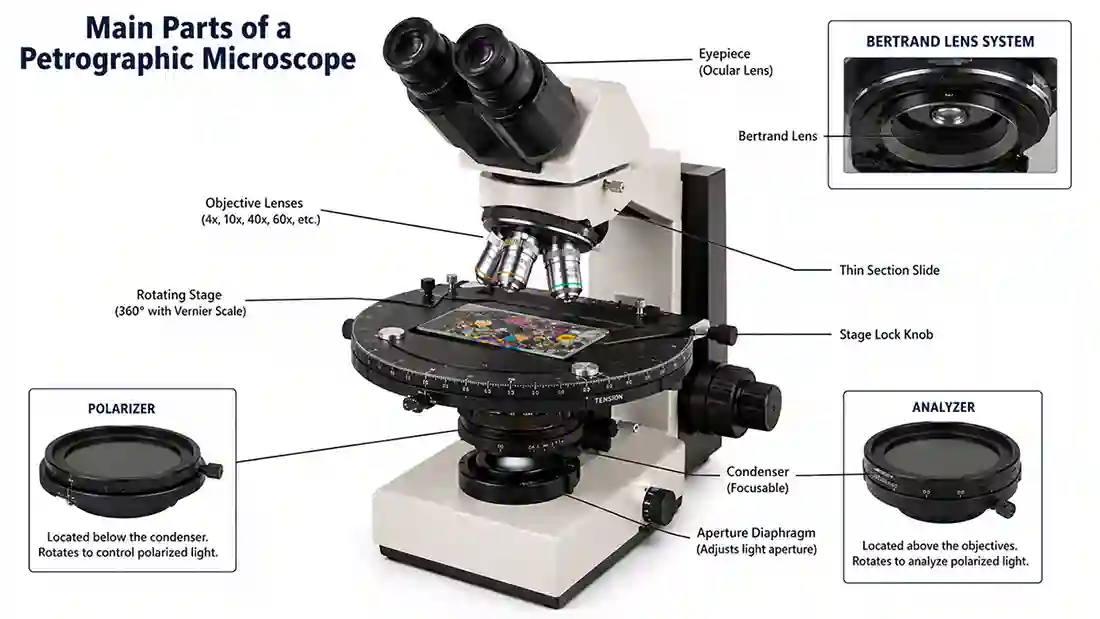
A standard petrographic microscope consists of:
- Eyepiece (ocular lens)
- Objective lenses
- Polarizer
- Analyzer
- Rotating circular stage
- Condenser
- Bertrand lens
- Compensator slot
- Fine and coarse focus knobs
- Light source
Each component contributes to accurate optical mineral analysis.
Plane-Polarized Light (PPL)
With only the polarizer inserted, minerals are viewed under plane-polarized light (PPL).
Properties observed include:
- Color
- Pleochroism
- Relief
- Cleavage
- Crystal habit
- Transparency
PPL is often the first step in mineral identification.
Cross-Polarized Light (XPL)
When both the polarizer and analyzer are inserted, minerals are observed under cross-polarized light (XPL).
Important observations include:
- Interference colors
- Birefringence
- Extinction
- Twinning
- Crystal orientation
These properties are essential for distinguishing similar minerals.
Conoscopic Observation
Conoscopic microscopy uses the Bertrand lens to examine interference figures.
This technique helps determine:
- Optical sign
- Optic axis
- Crystal symmetry
- Optic angle (2V)
Conoscopic observations are especially useful for advanced mineral identification.
Optical Properties Studied
Petrographic microscopy allows observation of:
- Color
- Relief
- Cleavage
- Crystal habit
- Pleochroism
- Refractive index
- Birefringence
- Interference colors
- Extinction
- Twinning
- Zoning
- Mineral inclusions
Together, these properties allow precise mineral identification.
Common Minerals Identified
| Mineral | Diagnostic Features |
|---|---|
| Quartz | Low relief, first-order gray interference colors, undulose extinction |
| Feldspar | Twinning, low relief, low birefringence |
| Biotite | Brown pleochroism, perfect cleavage |
| Muscovite | Bright interference colors, perfect cleavage |
| Amphibole | Green to brown pleochroism, two cleavages at ~60°/120° |
| Pyroxene | High relief, two cleavages near 90° |
| Olivine | High relief, no cleavage, fractures |
| Calcite | Very high birefringence, bright interference colors |
| Garnet | High relief, isotropic under XPL |
Petrographic Textures
Petrographic microscopy also reveals rock textures such as:
- Granular
- Porphyritic
- Poikilitic
- Ophitic
- Intergranular
- Foliated
- Glassy
- Cataclastic
Textures provide clues about rock formation and geological history.
Applications of Petrographic Microscopy
Petrographic microscopy is widely used in:
- Mineral identification
- Igneous petrology
- Sedimentary petrology
- Metamorphic petrology
- Economic geology
- Petroleum geology
- Engineering geology
- Environmental geology
- Academic research
Advantages
Petrographic microscopy offers:
- Highly accurate mineral identification
- Non-destructive analysis
- Detailed optical observations
- Rock texture analysis
- Crystal orientation studies
- Reliable laboratory results
It remains one of the most important techniques in geology.
Limitations
Petrographic microscopy has some limitations:
- Requires thin section preparation.
- Opaque minerals cannot be fully studied in transmitted light.
- Proper training is needed for interpretation.
- Equipment can be expensive.
For comprehensive analysis, petrographic microscopy is often combined with:
- Thin Section Mineral Analysis
- Optical Properties of Minerals
- Refractive Index in Minerals
- Double Refraction Explained
- X-ray Diffraction (XRD)
- Scanning Electron Microscopy (SEM)
- How to Identify Minerals
Comparison Table
| Technique | Main Information |
| Plane-Polarized Light (PPL) | Color, Relief, Pleochroism |
| Cross-Polarized Light (XPL) | Interference Colors, Birefringence, Twinning |
| Conoscopic Observation | Optical Sign, Interference Figures |
| Hand Specimen | Color, Hardness, Cleavage |
| X-ray Diffraction | Crystal Structure |
Summary Table
| Feature | Petrographic Microscopy |
| Main Instrument | Polarized Light Microscope |
| Sample Type | 30 µm Thin Section |
| Primary Purpose | Mineral & Rock Identification |
| Major Techniques | PPL, XPL, Conoscopic Observation |
| Scientific Importance | Mineralogy, Petrology, Petrography |
Petrographic microscopy is the study of minerals and rocks using a polarized light microscope and thin sections to observe optical properties and textures.
Plane-polarized light (PPL) reveals properties such as color, relief, and pleochroism, while cross-polarized light (XPL) reveals birefringence, interference colors, twinning, and extinction.
A standard thickness of approximately 30 µm allows most transparent minerals to transmit light and display characteristic optical properties.
Quartz, feldspar, biotite, muscovite, amphibole, pyroxene, olivine, calcite, garnet, and many other transparent minerals are routinely identified.
It provides detailed information about mineral composition, textures, crystal orientation, and rock history that cannot be observed in hand specimens.
Final Thoughts
Petrographic microscopy is a cornerstone of modern geology, allowing scientists to identify minerals and interpret rocks with exceptional accuracy. By examining thin sections under plane-polarized, cross-polarized, and conoscopic illumination, geologists can reveal the optical properties and textures that record a rock's origin and geological evolution.
Whether studying igneous, sedimentary, or metamorphic rocks, petrographic microscopy provides essential information for mineral identification, petrology, economic geology, and research. Combined with thin section preparation, optical mineralogy, and advanced analytical techniques, it remains one of the most powerful laboratory methods in Earth science.
Continue Learning
Expand your knowledge with these related guides: