
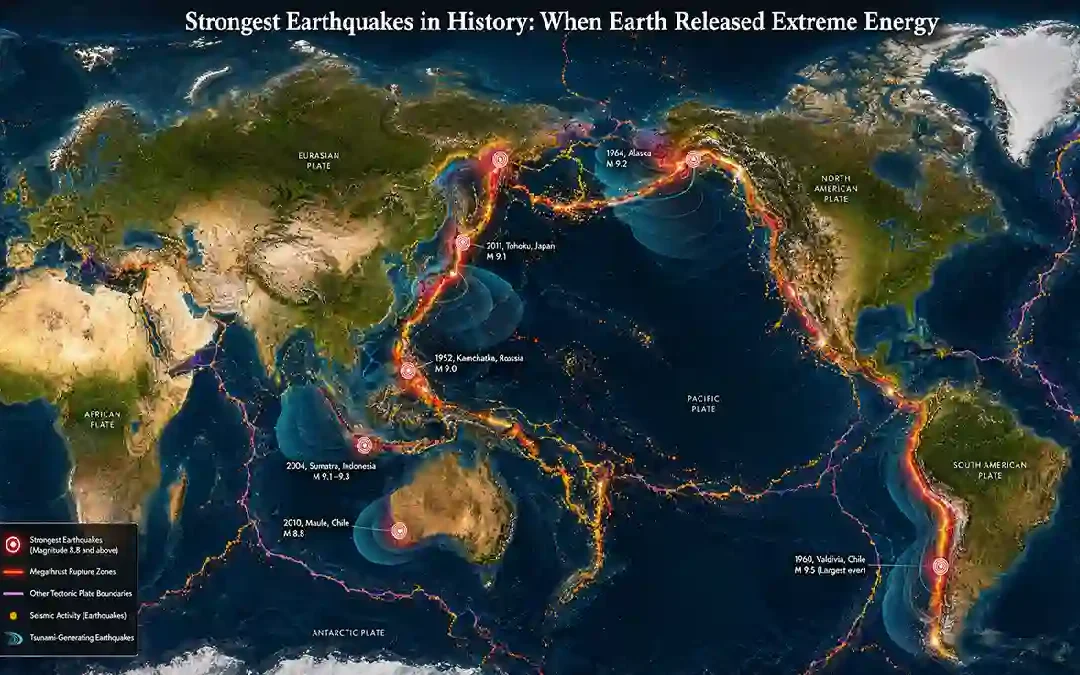
Some earthquakes are so powerful that they permanently reshape coastlines, move land by meters, and generate tsunamis across entire oceans. These events are known as megathrust earthquakes.
The strongest earthquakes in history mostly occurred along subduction zones where one tectonic plate dives beneath another. These are the places where Earth stores and suddenly releases unimaginable amounts of energy.
If you’re new to earthquakes, begin here → what is an earthquake
What Makes an Earthquake Extremely Powerful?
The strongest earthquakes usually happen when:
| Geological Factor | Result |
|---|---|
| Large subduction zones | Massive rupture areas |
| Locked tectonic plates | Huge stress buildup |
| Deep ocean trenches | Megathrust earthquakes |
| Long fault rupture lengths | Greater magnitude |
| Sudden plate movement | Tsunami generation |
Most M9+ earthquakes occur beneath oceans. Learn more → causes of earthquakes
See how much energy these earthquakes released by using the Earthquake Energy Calculator
10 Strongest Earthquakes Ever Recorded
1. 1960 Valdivia Earthquake, Chile (M9.5)
The 1960 Valdivia Earthquake in Chile remains the strongest earthquake ever measured.
Key Facts
- Magnitude: 9.5
- Massive tsunami across the Pacific
- Coastlines shifted dramatically
It released enormous tectonic energy along the Nazca Plate subduction zone.
Explore → earthquakes Santiago Chile
2. 1964 Alaska Earthquake (M9.2)
The Great Alaska Earthquake was North America’s most powerful recorded earthquake.
Main Impacts
- Massive ground uplift
- Tsunamis across the Pacific
- Severe coastal damage
Learn more → earthquakes Alaska
3. 2004 Sumatra-Andaman Earthquake (M9.1)
This earthquake triggered one of the deadliest tsunamis in modern history.
Why It Was So Significant
- Huge rupture length
- Massive Indian Ocean tsunami
- Global seismic effects
Indonesia sits along one of Earth’s most active subduction zones.
Explore → earthquakes Indonesia
4. 2011 Tohoku Earthquake, Japan (M9.0)
The Tohoku Earthquake caused catastrophic tsunami damage in Japan.
Main Features
- Powerful offshore rupture
- Massive tsunami waves
- Widespread infrastructure damage
Learn more → earthquakes Tokyo region
5. 1952 Kamchatka Earthquake, Russia (M9.0)
The Kamchatka Peninsula is one of the world’s most active seismic regions.
Why?
- Pacific Plate subduction
- Frequent megathrust earthquakes
- Tsunami generation potential
6. 2010 Maule Earthquake, Chile (M8.8)
Another major Chilean megathrust earthquake.
Main Impacts
- Strong coastal shaking
- Tsunami generation
- Significant tectonic displacement
7. 1906 Ecuador–Colombia Earthquake (M8.8)
This major subduction earthquake affected northwestern South America.
Main Features
- Offshore rupture
- Tsunami generation
- Large tectonic displacement
8. 1965 Rat Islands Earthquake, Alaska (M8.7)
This earthquake occurred along the Aleutian subduction zone.
Why It Matters
- Powerful offshore rupture
- Major tectonic movement
- Pacific tsunami effects
9. 1950 Assam–Tibet Earthquake (M8.6)
One of the strongest continental collision earthquakes ever recorded.
Main Features
- Himalayan tectonic compression
- Massive landslides
- Strong inland shaking
Explore → earthquakes Nepal
10. 1700 Cascadia Megathrust Earthquake (Estimated M8.7–9.2)
The Cascadia earthquake occurred before modern instruments existed.
Scientists Know About It Through:
- Japanese tsunami records
- Coastal geological evidence
- Tree-ring analysis
Learn more → earthquakes Vancouver
Why Most Giant Earthquakes Happen Under Oceans
Most M9 earthquakes occur along offshore subduction zones because:
- plates lock for centuries
- stress accumulates over huge areas
- rupture zones become enormous
This also explains why giant earthquakes often generate tsunamis.
Megathrust vs Inland Earthquakes
| Type | Typical Strength |
|---|---|
| Megathrust earthquakes | M8–M9+ |
| Transform fault earthquakes | Usually smaller |
| Inland crustal earthquakes | Often shallow but lower magnitude |
| Volcanic earthquakes | Usually small |
Megathrust earthquakes release the greatest seismic energy.
Understand magnitude vs impact
Could an Even Bigger Earthquake Happen?
Scientists believe earthquakes slightly larger than M9.5 may be theoretically possible, but extremely rare.
Potential future high-risk regions include:
- Cascadia Subduction Zone
- Japan Trench
- Chilean coast
- Sunda Trench
Learn more → earthquake risk zones worldwide
The 1960 Valdivia earthquake in Chile (M9.5).
Because large subduction zones exist beneath oceans.
One tectonic plate becoming locked beneath another before suddenly slipping.
Scientists believe the current magnitude scale makes M10 extremely unlikely on Earth.
Final Thoughts
The strongest earthquakes in history reveal the enormous power stored within Earth’s tectonic system. Most of these events occurred along giant subduction zones where tectonic plates remained locked for centuries before releasing extraordinary amounts of energy.
Understanding these historic earthquakes helps scientists better understand seismic hazards — and why some regions remain among the most dangerous places on Earth.