
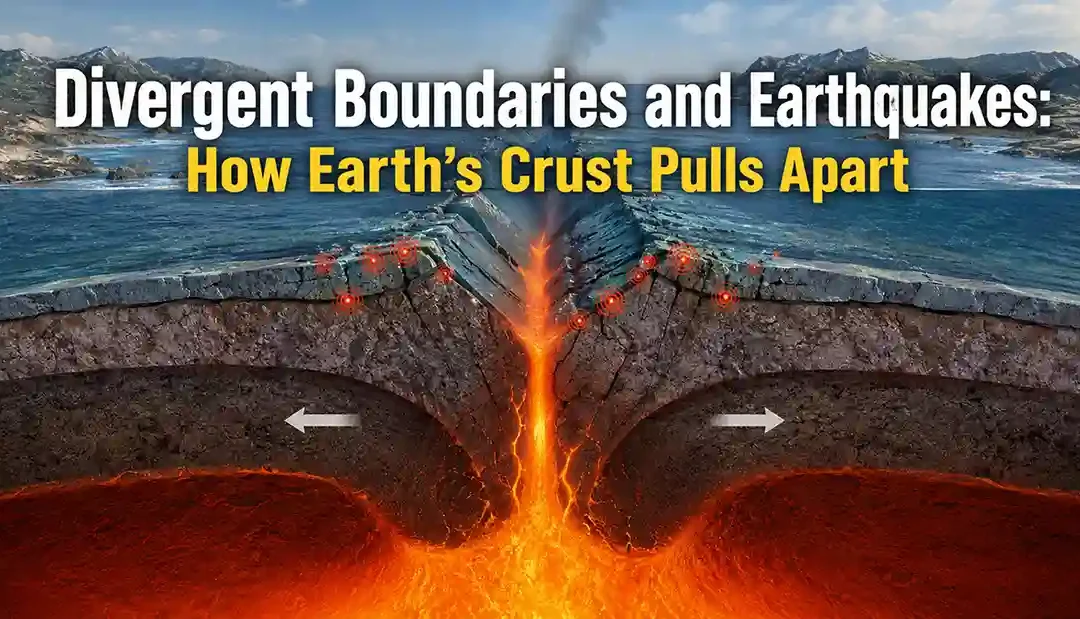
Not all earthquakes happen because tectonic plates collide. Some earthquakes occur because tectonic plates move away from each other. These regions are called divergent boundaries
At divergent boundaries:
- Earth’s crust stretches
- cracks form underground
- magma rises upward
- shallow earthquakes occur
These tectonic zones constantly reshape Earth’s surface and ocean floors.
If you’re new to earthquakes, begin here → what is an earthquake
Main Features of Divergent Boundaries
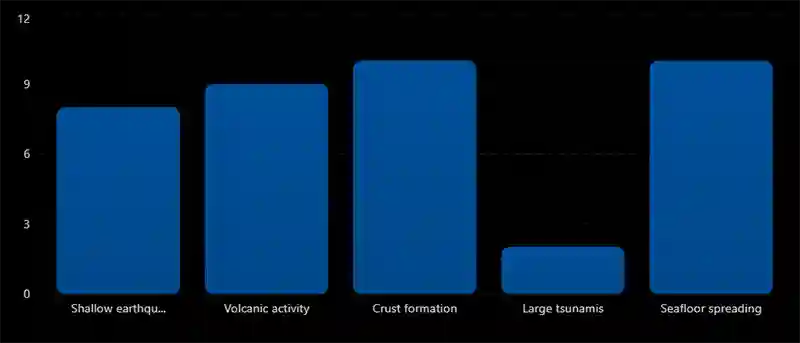
Key Features of Divergent Boundaries
Major geological processes associated with divergent plate boundaries.
What Is a Divergent Boundary?
A divergent boundary forms where two tectonic plates move apart from each other.
As the plates separate:
- cracks develop in Earth’s crust
- magma rises from below
- new crust forms
This process continuously changes Earth’s surface over millions of years.
How Divergent Boundaries Create Earthquakes
As tectonic plates pull apart:
- rocks stretch and fracture
- faults develop
- stress releases suddenly
This creates shallow earthquakes.
Most divergent-boundary earthquakes are:
- smaller than subduction earthquakes
- relatively shallow
- concentrated along rift zones
Learn more → earthquake depth explained
Magma and Volcanic Activity
When plates separate, magma rises into the gap.
This magma cools and hardens into:
- new oceanic crust
- volcanic rock
- lava formations
That’s why divergent boundaries often contain:
- volcanoes
- lava fields
- geothermal activity
Mid-Ocean Ridges
Most divergent boundaries exist beneath oceans. These underwater mountain chains are called mid-ocean ridges
Important Facts
- they are Earth’s longest mountain systems
- new seafloor forms continuously
- earthquakes happen regularly along ridge faults
The Mid-Atlantic Ridge is one of the best-known examples.
Continental Rift Zones
Some divergent boundaries form on land. These regions create Rift valleys.
As crust stretches:
- valleys sink downward
- faults develop
- volcanic activity increases
Famous Example
- East African Rift System
Divergent vs Other Plate Boundaries
| Boundary Type | Plate Movement | Main Result |
|---|---|---|
| Divergent | Plates move apart | New crust formation |
| Transform | Plates slide sideways | Shallow earthquakes |
| Subduction | One plate sinks | Giant earthquakes & tsunamis |
| Collision | Plates crash together | Mountain building |
Divergent boundaries mainly create spreading and crust formation.
Why Divergent Earthquakes Are Usually Smaller
Unlike subduction zones:
- divergent boundaries usually release less tectonic stress
- faults are smaller
- crust is thinner
This means earthquakes are often:
- moderate or small
- shallow
- locally felt
Giant megathrust earthquakes usually do NOT occur here.
Iceland: A Famous Divergent Boundary
Iceland sits directly on the Mid-Atlantic Ridge
Here:
- North American Plate
and - Eurasian Plate
are slowly pulling apart.
Iceland Experiences
- volcanic eruptions
- geothermal activity
- frequent earthquakes
Learn more → earthquakes Iceland
Seafloor Spreading Explained
At divergent boundaries new ocean floor is constantly created. This process is called Seafloor Spreading
As magma cools:
- new crust forms
- older crust moves outward
- oceans slowly widen over millions of years
The Atlantic Ocean continues expanding today.
Famous Divergent Boundary Regions
| Region | Type |
|---|---|
| Mid-Atlantic Ridge | Oceanic spreading ridge |
| East African Rift | Continental rift |
| Iceland | Surface divergent boundary |
| Red Sea Rift | Young ocean basin |
Divergent boundaries exist across both oceans and continents.
Can Divergent Boundaries Create Volcanoes?
Yes.
Divergent boundaries often produce:
- shield volcanoes
- fissure eruptions
- lava flows
These eruptions are usually:
- less explosive than subduction volcanoes
- rich in basaltic lava
Earthquake Depth at Divergent Boundaries
Typical Earthquake Depths at Divergent Boundaries
Most divergent-boundary earthquakes occur close to the surface.
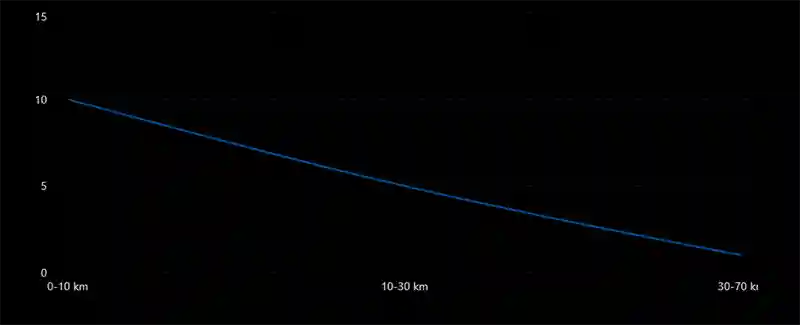
Most divergent earthquakes are shallow because crust near spreading zones is thin and hot.
How Scientists Study Divergent Boundaries
Scientists monitor divergent zones using:
- seismometers
- GPS systems
- underwater mapping
- satellite imaging
These tools help track:
- crust movement
- magma activity
- earthquake patterns
Learn more → earthquake monitoring technology
Why Divergent Boundaries Matter
Divergent boundaries:
- create new crust
- reshape oceans
- drive volcanic activity
- generate shallow earthquakes
They are a key part of plate tectonics and Earth’s geological evolution.
Could Oceans Continue Expanding?
Yes.
As divergent boundaries remain active:
- new crust continues forming
- plates keep spreading apart
- ocean basins slowly change shape
Earth’s surface is constantly evolving through tectonic movement.
A tectonic boundary where plates move apart.
Because crust stretches, fractures, and releases stress.
Usually smaller and shallower than subduction earthquakes.
The Mid-Atlantic Ridge.
Final Thoughts
Divergent boundaries are tectonic regions where Earth’s crust slowly pulls apart, creating earthquakes, volcanic activity, and entirely new crust. Although these earthquakes are usually smaller than giant subduction events, divergent boundaries play a major role in shaping oceans, continents, and Earth’s evolving surface.
Understanding divergent boundaries helps explain how tectonic forces continuously rebuild parts of the planet over geological time.