
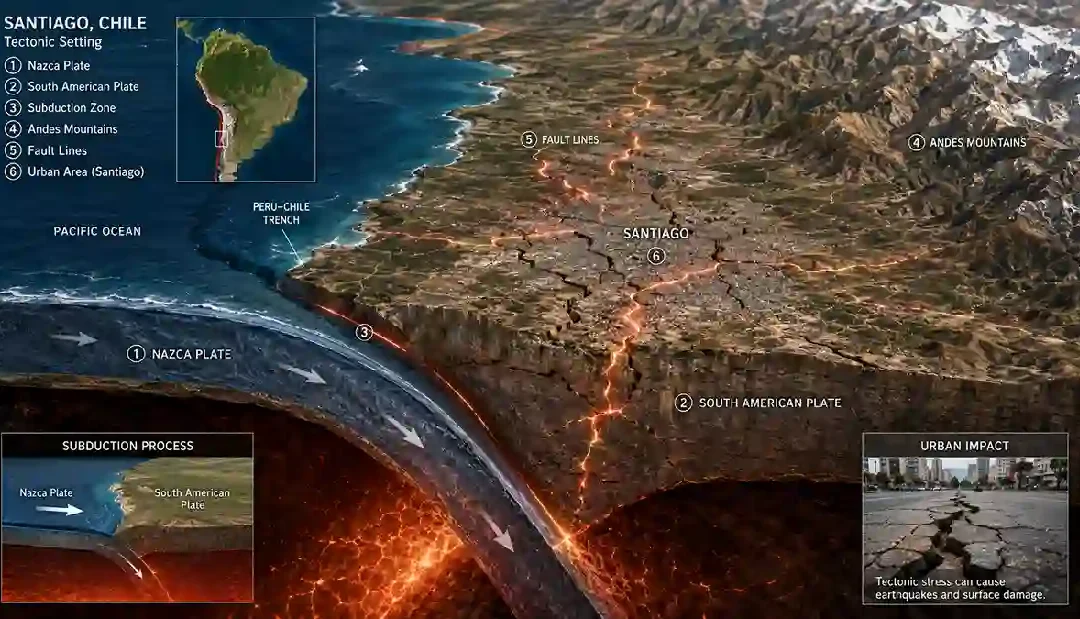
Santiago, the capital of Chile, sits near one of the most powerful earthquake systems on Earth. The region is shaped by the collision between the Nazca Plate and the South American Plate.
This process creates:
- some of the world’s strongest earthquakes
- frequent seismic activity
- massive tectonic stress along the Pacific coast
If you’re new to earthquakes, begin here → what is an earthquake
Santiago Chile Seismic Zones
| Zone | Risk Level | Main Cause |
|---|---|---|
| Offshore Subduction Zone | Extremely High | Plate diving |
| Central Chile Region | Very High | Megathrust earthquakes |
| Andes Mountains | High | Crustal deformation |
| Inland Fault Systems | Moderate–High | Local fault activity |
| Pacific Coast | Extremely High | Tectonic stress |
Chile is one of the most earthquake-active countries in the world. To understand how faults work → fault lines
Why Do Earthquakes Happen in Santiago Chile?
Santiago is affected by a powerful subduction system.
Here’s the simple explanation:
- The Nazca Plate moves eastward
- It dives beneath the South American Plate
- Massive pressure builds underground
- Plates lock together
- When they suddenly slip → a powerful earthquake occurs
These are known as megathrust earthquakes.
Learn more → causes of earthquakes
Four Major Earthquake Systems Affecting Santiago
Subduction Zone Megathrust Earthquakes (Main Source)

The offshore subduction zone is the main earthquake source.
- Plates collide beneath the ocean
- Capable of massive earthquakes (M8–M9+)
- Tsunami risk exists
Explore earthquake types
Central Chile Megathrust Zone
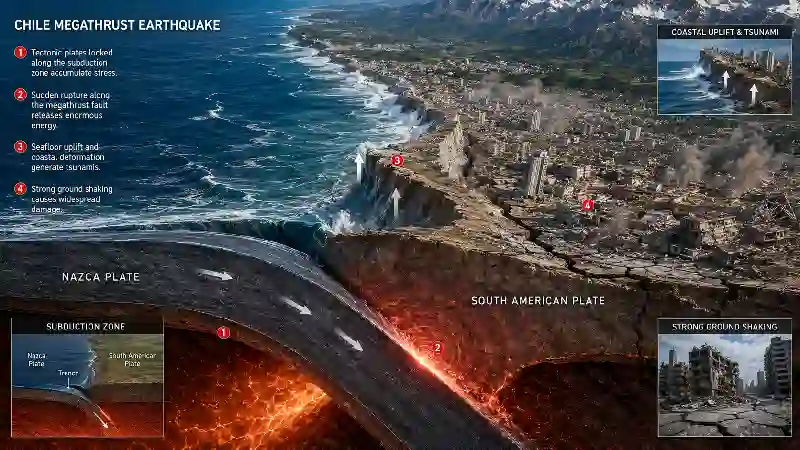
Central Chile experiences frequent large earthquakes.
- High tectonic stress
- Large rupture zones
- Significant seismic history
Andes Mountain Crustal Deformation
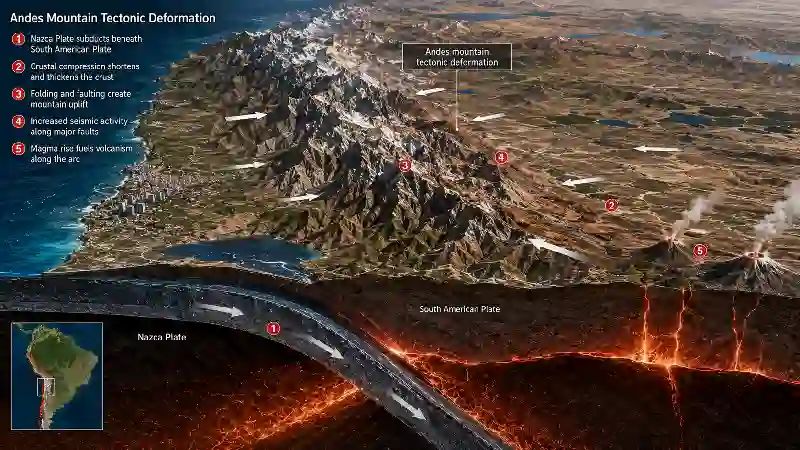
The Andes Mountains are shaped by tectonic compression.
- Crustal deformation
- Fault movement inland
- Moderate earthquakes
Santiago Basin Amplification
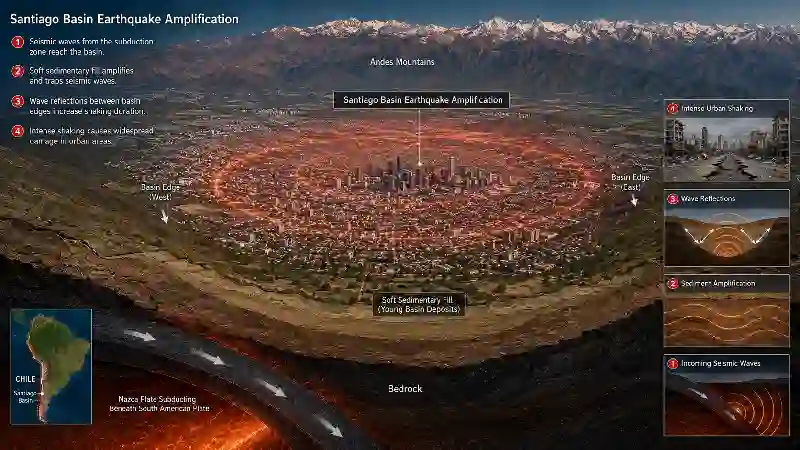
Santiago’s basin can amplify earthquake shaking.
- Sediment layers beneath the city
- Stronger shaking effects
- Increased urban impact
Recent Earthquake Activity in Santiago
Chile experiences frequent earthquakes.
Recent patterns show:
- Offshore subduction earthquakes
- Strong regional seismic activity
- Occasional earthquakes felt in Santiago
Large earthquakes remain a constant risk.
Notable Earthquakes Affecting Santiago
Chile has experienced some of the largest earthquakes in history.
- 1960 Valdivia Earthquake (M9.5)
The strongest earthquake ever recorded. - 2010 Maule Earthquake (M8.8)
A major earthquake affecting central Chile. - Frequent Central Chile Earthquakes
Ongoing seismic activity near Santiago.
Understand magnitude vs impact
Santiago vs Other Earthquake Regions
Santiago is among the most powerful seismic regions globally.
- Santiago → subduction + megathrust earthquakes
- Tokyo → similar subduction activity
- California → transform faults
- Mexico City → subduction + soil amplification
Chile produces some of the strongest earthquakes on Earth.
Can Earthquakes in Santiago Be Predicted?
No — earthquakes cannot be predicted precisely.
Scientists can:
- monitor tectonic plate movement
- track stress buildup
- detect seismic activity
Chile also has strong earthquake monitoring systems.
Learn more → Can earthquakes be predicted
Because it lies near a powerful subduction zone.
A large megathrust earthquake along the Chilean coast.
Yes — Chile experiences frequent seismic activity.
Yes — very large earthquakes are possible.
Final Thoughts
Santiago Chile, sits near one of the most powerful tectonic systems on Earth. With the Nazca Plate diving beneath South America, the region experiences some of the largest and most frequent earthquakes in the world.
Understanding Santiago earthquakes helps explain how subduction zones create Earth’s most extreme seismic events.