
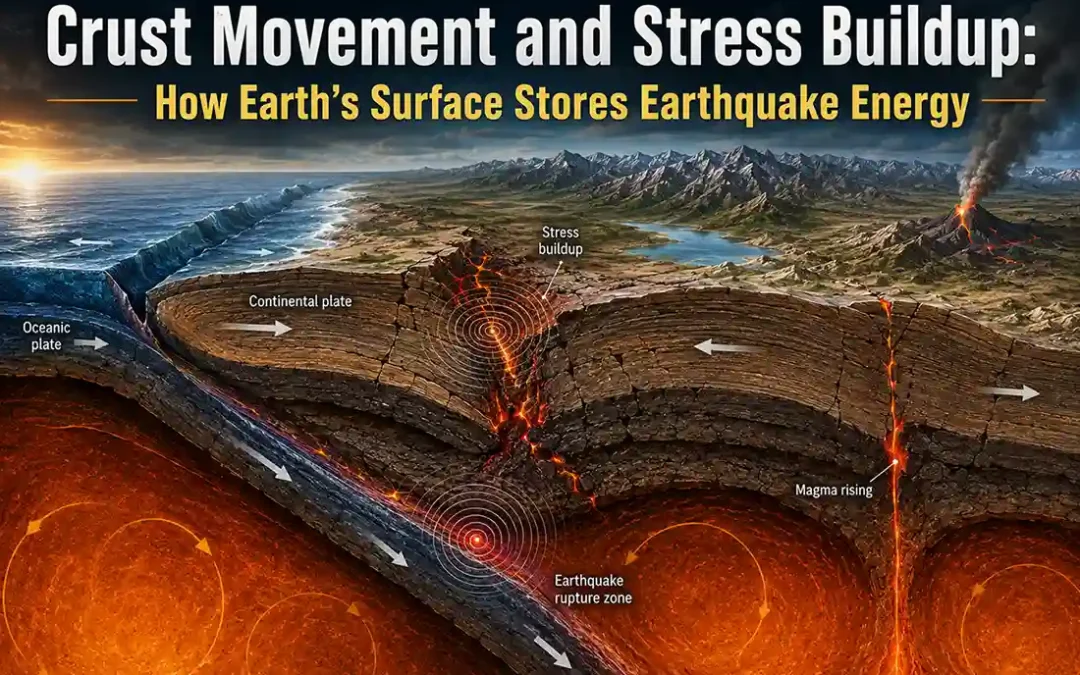
Earthquakes do not happen randomly. Before the ground suddenly shakes, Earth’s crust often spends years — or even centuries — slowly building stress underground. This process begins because tectonic plates are constantly moving.
As Earth’s crust shifts:
- rocks bend
- faults lock together
- pressure increases underground
Eventually, the stored stress becomes too large, and the rocks suddenly break or slip. That sudden release of energy creates an earthquake.
If you’re new to earthquakes, begin here → what is an earthquake
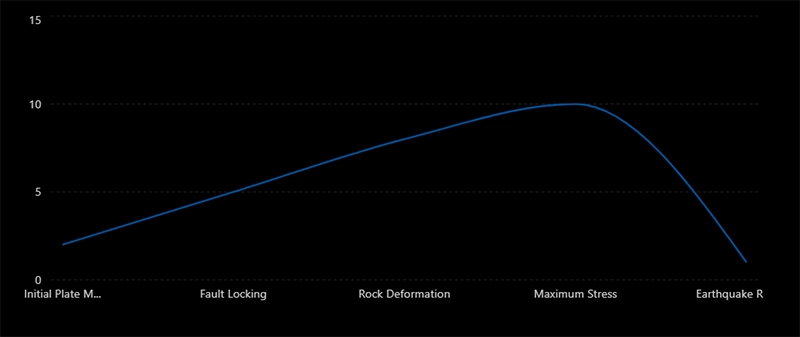
Main Stages of Stress Buildup Before Earthquakes
Stress Build-Up Before Earthquakes
Tectonic stress slowly increases until sudden fault rupture releases energy.
Why Earth’s Crust Moves
Earth’s outer shell is divided into tectonic plates
These plates slowly move because of:
- heat inside Earth
- mantle convection
- gravitational forces
Plate movement may seem tiny each year, but over long periods enormous tectonic stress can accumulate.
How Stress Builds Along Faults
As tectonic plates move:
- faults may become locked by friction
- rocks continue trying to move
- pressure builds slowly underground
This process is similar to bending a stick until it suddenly snaps. The longer the fault remains locked, the more stress may accumulate.
Rock Deformation Before Earthquakes
Before rupture:
- rocks often bend elastically
- crust slowly changes shape
- strain accumulates over time
This hidden deformation may continue for:
- decades
- centuries
- even longer
Scientists monitor crust deformation carefully in earthquake-prone regions.
Elastic Rebound Theory Explained
One of the most important earthquake concepts is Elastic rebound theory
This theory explains that:
- rocks slowly deform under stress
- energy accumulates underground
- faults suddenly rupture
- rocks snap back into new positions
That rapid rebound releases:
- seismic waves
- earthquake shaking
- tectonic energy
Learn more → earthquake energy release explained
Fault Locking vs Fault Slip
| Process | What Happens |
|---|---|
| Fault locking | Stress builds slowly |
| Fault slip | Earthquake occurs |
| Crust deformation | Rocks bend under pressure |
| Stress release | Seismic energy spreads |
Earthquakes are sudden releases of long-term tectonic stress.
Stress Buildup at Different Plate Boundaries
Different tectonic boundaries build stress differently.
Subduction Zones
At subduction zones:
- one plate sinks beneath another
- massive pressure accumulates
- giant megathrust earthquakes may occur
These zones produce some of Earth’s strongest earthquakes.
Transform Faults
At transform boundaries:
- plates slide sideways
- friction locks the fault
- shallow earthquakes occur after sudden slip
The San Andreas Fault is a famous example.
Divergent Boundaries
At divergent boundaries:
- crust stretches apart
- smaller fractures develop
- shallow earthquakes occur during spreading
Stress buildup here is usually lower than at subduction zones.
Why Stress Can Build for So Long
Tectonic plates move slowly, often only centimeters per year.
But faults may remain locked for:
- decades
- centuries
- even thousands of years
This allows:
- huge amounts of energy
- massive underground pressure
to accumulate before rupture occurs.
Crust Movement Measured With GPS
Scientists track crust movement using:
- GPS stations
- satellites
- seismic sensors
- laser measurements
These tools help measure:
- plate motion
- crust deformation
- fault movement rates
Learn more → earthquake monitoring technology
Why Shallow Stress Release Is Often More Dangerous
Shallow vs Deep Earthquake Impact
Shallow earthquakes often produce stronger surface shaking.
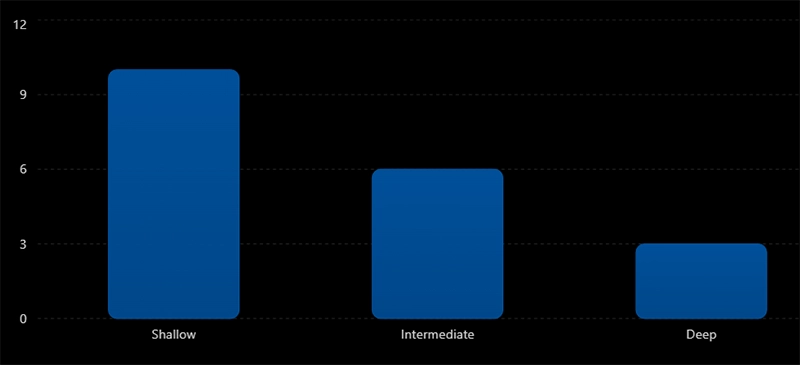
Shallow stress release often creates:
- stronger surface shaking
- more structural damage
- greater injury risk
Learn more → shallow vs deep earthquakes
Famous Earthquakes Caused by Long Stress Buildup
| Earthquake | Stress Type |
|---|---|
| 2011 Japan Tohoku | Subduction megathrust |
| 1906 San Francisco | Transform fault |
| 1960 Chile | Subduction zone |
| 2023 Turkey–Syria | Transform fault system |
Many giant earthquakes release centuries of accumulated tectonic stress.
Why Understanding Stress Buildup Matters
Studying crust movement helps scientists:
- identify active faults
- estimate seismic hazard zones
- improve earthquake forecasting models
- understand tectonic behavior
Stress buildup is one of the most important earthquake processes.
Can Scientists Predict Exactly When Stress Will Release?
Not yet.
Scientists can detect:
- fault movement
- crust deformation
- seismic activity patterns
But they still cannot predict:
- exact earthquake timing
- exact rupture location
Learn more → earthquake prediction methods
Could Stress Continue Building Today?
Yes.
Many major faults worldwide continue accumulating stress right now, including:
- San Andreas Fault
- Cascadia Subduction Zone
- North Anatolian Fault
- Himalayan collision zones
That’s why earthquake preparedness remains essential in active tectonic regions.
Slow tectonic plate movement and fault locking.
Friction prevents smooth movement between rocks.
The fault suddenly slips and releases earthquake energy.
Using GPS systems, satellites, and seismic monitoring tools.
Final Thoughts
Crust movement and tectonic stress buildup are the hidden processes that eventually create earthquakes. As tectonic plates slowly move and faults remain locked, enormous pressure accumulates underground until the crust suddenly ruptures and releases seismic energy.
Understanding stress buildup helps explain why earthquakes can occur after decades or centuries of silent tectonic pressure beneath Earth’s surface.