
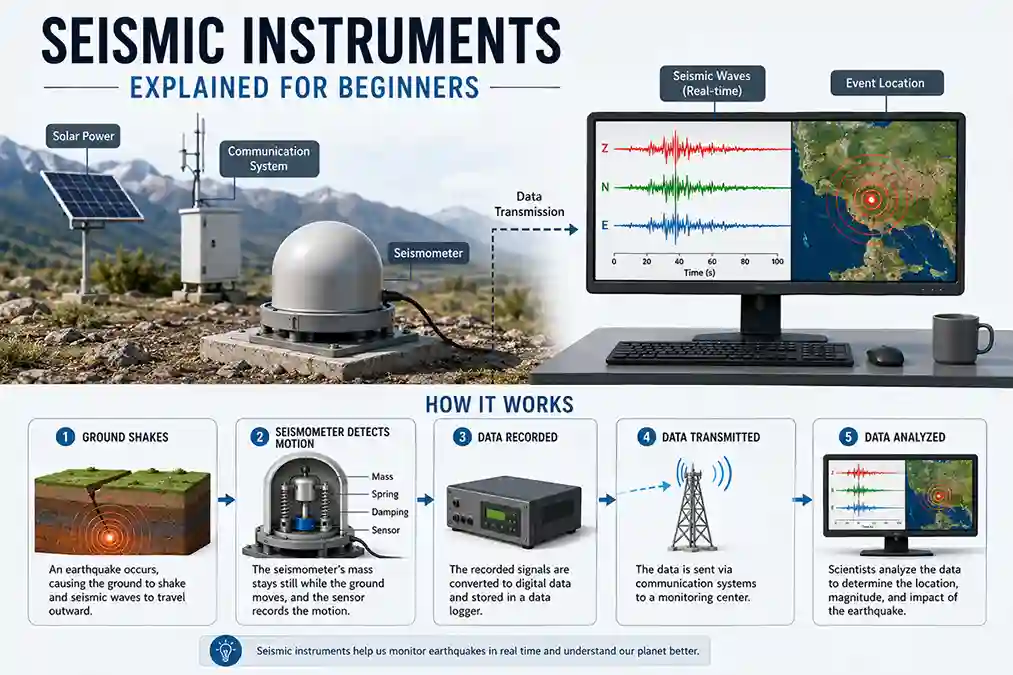
Scientists use seismic instruments to detect, measure, and study earthquakes. These tools record seismic waves traveling through Earth and help researchers understand earthquake location, magnitude, depth, and ground motion.
Modern seismic instruments are extremely sensitive and can detect tiny vibrations from:
- earthquakes
- volcanic activity
- landslides
- underground explosions
Without seismic monitoring equipment, scientists would know far less about how Earth’s crust moves and how earthquakes behave.
Today, global seismic networks continuously monitor tectonic activity around the world.
Learn more → earthquake wave types explained
Main Seismic Instruments
Most Important Seismic Instruments
Key instruments used in earthquake detection and seismic monitoring.
| Instrument | Importance |
|---|---|
| Seismometer | 10 |
| Seismograph | 9 |
| Accelerometer | 8 |
| GPS Monitoring | 7 |
| Ocean Sensors | 6 |
What Are Seismic Instruments?
Seismic instruments are scientific tools used to measure ground movement.
They help scientists:
- detect earthquakes
- study seismic waves
- monitor tectonic activity
- estimate earthquake magnitude
These instruments form the foundation of Modern seismology.
Seismometer Explained
The Seismometer is one of the most important seismic instruments.
Main Purpose
Measure tiny ground movements caused by seismic waves.
Modern seismometers are sensitive enough to detect:
- distant earthquakes
- small vibrations
- subtle tectonic movement
How Seismometers Work
Most seismometers use:
- a fixed mass
- motion sensors
- digital recording systems
When Earth moves:
- the instrument frame moves with the ground
- the suspended mass resists motion
- the difference is recorded as seismic movement
This allows scientists to measure wave strength and timing.
Seismograph Explained
A Seismograph records seismic waves detected by a seismometer.
Traditional seismographs created:
- wave patterns on paper rolls
Modern digital systems now:
- store data electronically
- transmit information instantly worldwide
The recorded seismic pattern is called a seismogram.
Seismic Wave Detection Process
| Step | What Happens |
|---|---|
| Earthquake occurs | Seismic waves begin |
| Waves travel underground | Ground motion spreads |
| Seismometer detects motion | Instrument records vibration |
| Seismograph stores data | Scientists analyze results |
This process helps locate earthquakes globally.
Accelerometers Explained
Accelerometers measure strong ground shaking.
These instruments are commonly installed in:
- skyscrapers
- bridges
- dams
- earthquake-prone cities
Main Purpose
Help engineers understand:
- building movement
- structural stress
- earthquake safety performance
Learn more → earthquake safety in buildings
Ocean-Bottom Seismic Sensors
Scientists also place instruments beneath oceans.
These sensors monitor:
- underwater earthquakes
- subduction zones
- tsunami-generating events
Ocean seismic systems are critical for Tsunami warning systems.
GPS Monitoring Systems
GPS systems help scientists track:
- tectonic plate movement
- crust deformation
- fault motion
These measurements show how stress builds before earthquakes.
Learn more → crust movement and stress buildup
What Seismic Instruments Measure
What Seismic Instruments Measure
Different types of seismic monitoring data collected during earthquakes.
| Measurement | Importance |
|---|---|
| Ground motion | 10 |
| Wave arrival times | 9 |
| Earthquake magnitude | 9 |
| Fault movement | 7 |
| Crust deformation | 7 |
Global Seismic Networks
Countries around the world operate Seismic monitoring networks. These systems share earthquake data internationally.
Major monitoring organizations include:
- USGS (United States)
- Japan Meteorological Agency
- European seismic centers
- global tsunami warning centers
Earthquakes are monitored continuously worldwide.
How Seismic Instruments Help Society
Seismic instruments help:
- detect earthquakes quickly
- improve early warning systems
- guide emergency response
- support safer engineering
They also help scientists study:
- Earth’s interior
- tectonic plate motion
- volcanic activity
Learn more → earthquake monitoring technology
Seismic Instruments and Earthquake Early Warning
Some countries use seismic instruments for earthquake early warning systems
These systems detect:
- fast-moving P waves
before - stronger shaking arrives
This may provide:
- a few seconds of warning
- enough time for protective action
Learn more → earthquake early warning systems
The seismometer is the primary earthquake detection instrument.
It records seismic wave data detected by seismic sensors.
A seismogram is the recorded graph of seismic wave motion.
They help scientists detect earthquakes and study Earth’s tectonic activity.
Conclusion
Seismic instruments are essential tools for understanding earthquakes and monitoring Earth’s constantly moving crust. From seismometers and seismographs to GPS systems and ocean sensors, these technologies help scientists detect seismic waves, study tectonic movement, and improve earthquake preparedness worldwide.
Modern seismic monitoring continues to play a major role in protecting communities and advancing earthquake science.
Start learning here → What is an earthquake?