
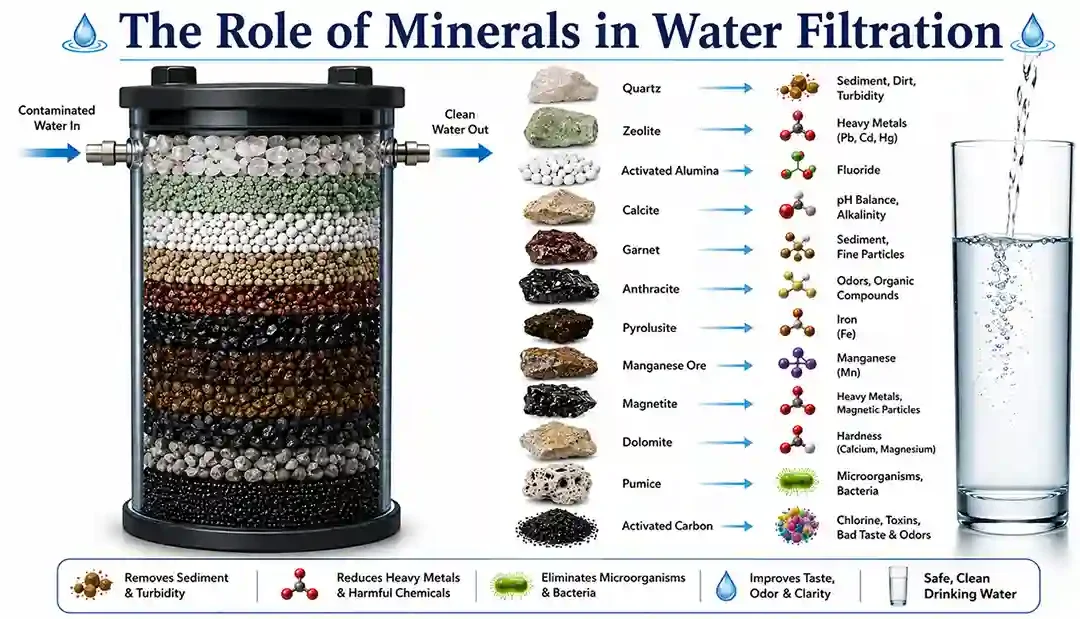
Clean water is essential for human health, agriculture, and industry. Natural minerals play a major role in modern water treatment by removing suspended particles, heavy metals, harmful chemicals, unpleasant odors, and excess minerals from water. Many municipal treatment plants and household filtration systems rely on naturally occurring mineral materials because they are durable, efficient, and environmentally friendly.
Minerals in water filtration improve drinking water quality through physical filtration, chemical adsorption, ion exchange, and catalytic oxidation. Different minerals target specific contaminants, making them essential components of modern water purification systems.
Understanding minerals in water filtration highlights the close relationship between geology, environmental science, hydrogeology, chemistry, and public health.
This topic should be studied together with Mineral Solubility, Mineralogy, Geochemistry, and Minerals in Paint.
Why Water Filtration Depends on Minerals
Natural minerals remove contaminants through several mechanisms.
Filtration minerals help:
- Remove suspended sediments
- Eliminate heavy metals
- Reduce fluoride
- Remove iron and manganese
- Improve taste and odor
- Adjust water pH
- Reduce water hardness
- Produce safe drinking water
Different minerals perform different purification functions.
Major Minerals Used in Water Filtration
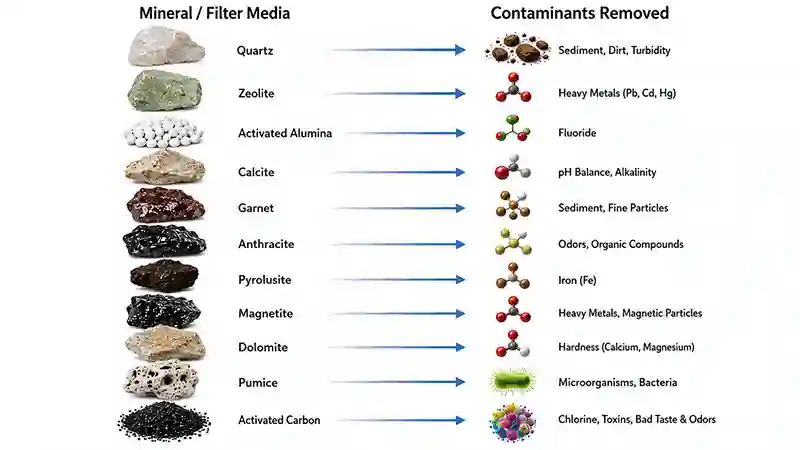
Quartz Sand
Common uses:
- Sand filtration
- Sediment removal
Importance:
Quartz is one of the most widely used filtration media for removing suspended particles.
Zeolite
Common uses:
- Ammonium removal
- Heavy metal removal
- Water softening
Importance:
Zeolite naturally performs ion exchange, removing undesirable dissolved ions.
Activated Alumina
Common uses:
- Fluoride removal
- Arsenic removal
Importance:
Activated alumina has a high surface area that efficiently adsorbs contaminants.
Calcite
Common uses:
- pH adjustment
- Neutralizing acidic water
Importance:
Calcite raises water pH and reduces corrosion.
Garnet
Common uses:
- Multimedia filters
- Fine particle removal
Importance:
Its high density improves filtration efficiency.
Anthracite
Common uses:
- Water filtration beds
- Turbidity reduction
Importance:
Anthracite provides excellent flow while trapping fine particles.
Pyrolusite (Manganese Dioxide)
Common uses:
- Iron removal
- Manganese removal
- Hydrogen sulfide oxidation
Importance:
Pyrolusite acts as a catalytic oxidation medium.
Magnetite
Common uses:
- Heavy metal removal
- Industrial wastewater treatment
Importance:
Magnetite can adsorb various dissolved contaminants.
Dolomite
Common uses:
- Hardness adjustment
- Water remineralization
Importance:
Dolomite supplies calcium and magnesium to treated water.
Pumice
Common uses:
- Mechanical filtration
- Lightweight filtration media
Importance:
Its porous structure traps suspended solids.
Activated Carbon (Mineral-Based Filtration Media)
Common uses:
- Taste improvement
- Odor removal
- Organic contaminant adsorption
Importance:
Activated carbon has an extremely large surface area for adsorption.
Minerals by Water Treatment Application
| Water Treatment Application | Major Minerals |
|---|---|
| Sediment Removal | Quartz Sand, Garnet |
| Heavy Metal Removal | Zeolite, Magnetite |
| Fluoride Removal | Activated Alumina |
| Iron & Manganese Removal | Pyrolusite |
| Water Softening | Zeolite |
| pH Adjustment | Calcite, Dolomite |
| Taste & Odor Removal | Activated Carbon |
| Multimedia Filtration | Anthracite, Garnet |
From Mine to Water Filter
Filtration minerals undergo several processing stages.
- Minerals are mined.
- They are crushed and graded.
- Impurities are removed.
- Filtration media are packaged.
- Minerals are installed in filtration systems.
- Water flows through the filtration layers and contaminants are removed.
This process connects geology directly to clean drinking water.
How Minerals Purify Water
Different minerals use different purification mechanisms.
Mechanical Filtration
- Quartz sand
- Garnet
- Anthracite
Ion Exchange
- Zeolite
Adsorption
- Activated alumina
- Activated carbon
Catalytic Oxidation
- Pyrolusite
Neutralization
- Calcite
- Dolomite
Combining multiple minerals creates highly efficient water filtration systems.
Geological Importance
Hydrogeologists and environmental geologists study minerals used in water treatment.
Research includes:
- Natural filtration materials
- Groundwater chemistry
- Water purification technologies
- Mineral adsorption processes
- Sustainable water resources
Their work improves access to safe drinking water.
Laboratory Investigation
Water filtration minerals are evaluated using:
- ICP-MS
- X-Ray Fluorescence (XRF)
- X-Ray Diffraction (XRD)
- Atomic Absorption Spectroscopy (AAS)
- ICP-OES
- Water quality analysis
These methods assess mineral composition and treatment performance.
Applications
Water filtration minerals are widely used in:
- Drinking water treatment
- Municipal water plants
- Industrial wastewater treatment
- Swimming pools
- Aquaculture
- Household water filters
- Desalination pretreatment
- Environmental remediation
Advantages of Studying Minerals in Water Filtration
Understanding filtration minerals helps:
- Improve drinking water quality
- Protect public health
- Reduce waterborne contaminants
- Develop sustainable filtration systems
- Improve industrial water treatment
- Support environmental conservation
Limitations
Despite their effectiveness, filtration minerals have limitations.
- Filtration media require periodic replacement.
- Some contaminants require multiple treatment stages.
- Adsorption capacity eventually becomes exhausted.
- Mining filtration minerals impacts the environment.
- Treatment efficiency depends on water chemistry.
For a broader understanding, study this topic together with:
- Hydrogeology
- Environmental Geology
- Water Resources Engineering
- Mineralogy
- Geochemistry
- Environmental Science
- Civil Engineering
- Public Health
Comparison Table
| Mineral | Primary Function | Main Contaminant Removed |
| Quartz Sand | Mechanical Filtration | Sediment |
| Zeolite | Ion Exchange | Ammonium & Heavy Metals |
| Activated Alumina | Adsorption | Fluoride |
| Calcite | Neutralization | Acidity |
| Garnet | Fine Filtration | Suspended Solids |
| Anthracite | Multimedia Filtration | Turbidity |
| Pyrolusite | Catalytic Oxidation | Iron & Manganese |
| Magnetite | Adsorption | Heavy Metals |
| Dolomite | Remineralization | Low Hardness |
| Activated Carbon | Adsorption | Taste & Odor |
Summary Table
| Feature | Minerals in Water Filtration |
| Main Purpose | Water Purification and Treatment |
| Major Minerals | Quartz, Zeolite, Activated Alumina, Calcite |
| Treatment Methods | Filtration, Adsorption, Ion Exchange |
| Study Methods | ICP-MS, XRF, XRD, ICP-OES |
| Geological Importance | Hydrogeology and Environmental Geology |
Minerals in water filtration are naturally occurring geological materials used to remove contaminants, improve water quality, and produce safe drinking water.
Quartz sand, zeolite, activated alumina, calcite, garnet, anthracite, pyrolusite, dolomite, magnetite, and activated carbon are among the most widely used filtration materials.
Zeolite naturally exchanges ions, making it highly effective at removing ammonium, heavy metals, and hardness-causing ions from water.
Activated alumina adsorbs fluoride, arsenic, and other dissolved contaminants onto its highly porous surface.
Minerals remove physical, chemical, and biological contaminants while improving water safety, taste, and overall quality.
Final Thoughts
Minerals are essential components of modern water filtration systems. Natural materials such as quartz, zeolite, garnet, calcite, activated alumina, and pyrolusite help remove sediments, heavy metals, excess fluoride, iron, manganese, and many other contaminants from water. Their unique physical and chemical properties make them indispensable for municipal treatment plants, industrial facilities, and household filtration systems.
As demand for clean water continues to grow, mineral-based filtration technologies will remain a cornerstone of sustainable water treatment. Understanding the relationship between geology and water purification supports healthier communities, safer drinking water, and better environmental management.
Continue Learning
Continue exploring related topics: