
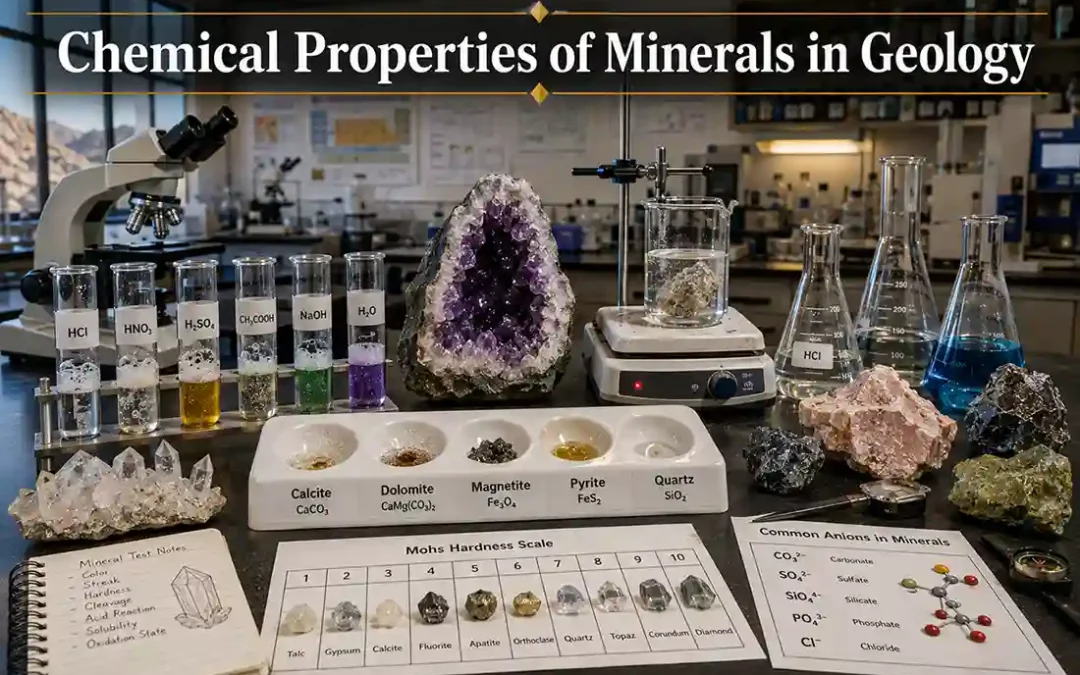
Minerals are not only identified by physical appearance — they also have important chemical properties that help scientists understand their composition, behavior, and formation.
Chemical properties describe:
- what minerals are made of
- how they react with substances
- how they change over time
- how stable they are under different conditions
These properties are essential in:
- geology
- mining
- environmental science
- industrial mineral processing
By studying mineral chemistry, scientists can classify minerals and better understand Earth’s crust and geological processes.
Learn more → what-is-a-mineral
Important Chemical Properties of Minerals
Major Chemical Properties of Minerals
Chemical behaviors commonly studied in mineralogy and geology.
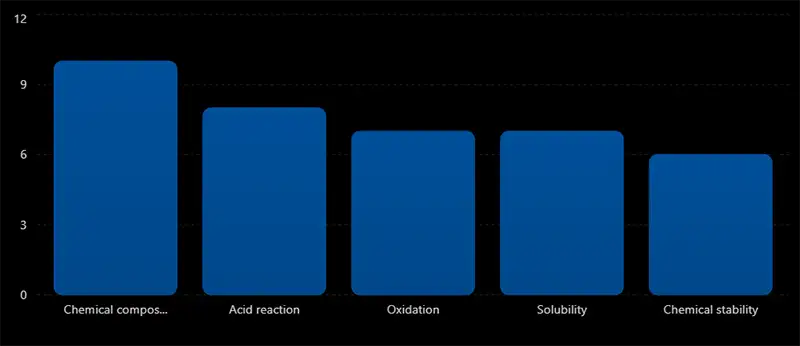
Chemical Composition
Every mineral has a chemical composition. This means minerals contain specific chemical elements arranged in fixed patterns.
Examples
- Quartz = SiO₂
- Calcite = CaCO₃
- Halite = NaCl
Chemical composition is one of the main features that defines a mineral.
Mineral Groups Based on Chemistry
Minerals are often classified into groups based on their chemical makeup.
Major Mineral Groups
- silicates
- carbonates
- oxides
- sulfides
- halides
- sulfates
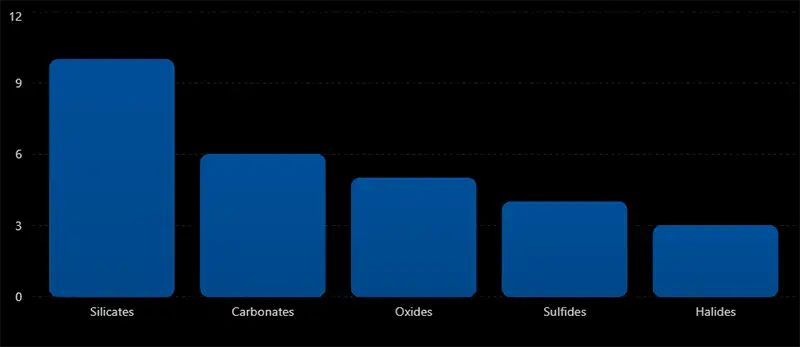
Among these, silicates are the most common minerals in Earth’s crust.
Common Mineral Chemical Groups
Common Mineral Chemical Groups
Major mineral groups classified by chemical composition.
Acid Reaction
Some minerals react with acids. For example, calcite fizzes when hydrochloric acid is applied. This happens because carbonate minerals release carbon dioxide gas.
Geologists use acid testing to identify:
- calcite
- limestone
- carbonate-rich rocks
Oxidation in Minerals
Oxidation occurs when minerals react with oxygen.
This process is especially common in:
- iron-rich minerals
- sulfide minerals
Examples
- Pyrite may oxidize into iron oxides
- Iron minerals may form rust-colored coatings
Oxidation plays a major role in:
- weathering
- soil formation
- environmental chemistry
Solubility
Some minerals dissolve easily in water. Example: Halite (rock salt) is highly soluble. Other minerals are much more resistant to water and chemical weathering.
Solubility affects:
- cave formation
- groundwater chemistry
- mineral deposits
Chemical Stability
Minerals vary in Chemical stability. Some minerals remain stable for millions of years.
Others break down quickly when exposed to:
- water
- oxygen
- heat
- acids
Example
Quartz is highly stable and resistant to weathering.
Stability of Common Minerals
| Mineral | Chemical Stability |
|---|---|
| Quartz | Very high |
| Feldspar | Moderate |
| Calcite | Lower |
| Halite | Very low in water |
Stable minerals often survive long geological processes.
Silicate Minerals Explained
Silicates contain silicon and oxygen. These minerals form most of Earth’s crust.
Common Silicates
- Quartz
- Feldspar
- Mica
- Olivine
Silicates are extremely important in:
- igneous rocks
- metamorphic rocks
- crust formation
Chemical Weathering of Minerals
Chemical weathering changes minerals over time through reactions with:
- water
- oxygen
- acids
- carbon dioxide
This process helps form:
- soils
- clay minerals
- dissolved mineral ions
Chemical weathering reshapes Earth’s surface slowly over time.
Why Chemical Properties Matter
Chemical properties help scientists:
- identify minerals
- classify mineral groups
- understand rock formation
- locate ore deposits
- study environmental processes
These properties are also important in:
- mining
- engineering
- industrial chemistry
Physical vs Chemical Properties
| Physical Properties | Chemical Properties |
|---|---|
| Hardness | Chemical composition |
| Luster | Acid reactions |
| Streak | Oxidation |
| Cleavage | Solubility |
Geologists often study both together for accurate mineral analysis.
Chemical Properties in Everyday Life
Mineral chemistry affects:
- batteries
- construction materials
- fertilizers
- electronics
- water quality
Many industries depend on minerals with specific chemical properties.
They describe mineral composition and how minerals react chemically.
It helps define and classify minerals scientifically.
Carbonate minerals like calcite react visibly with acid.
Silicate minerals are the most abundant.
Final Thoughts
The chemical properties of minerals help scientists understand how minerals form, react, weather, and interact with Earth’s environment.
From chemical composition and acid reactions to oxidation and stability, mineral chemistry is essential for geology, mining, environmental science, and industrial applications.
Understanding mineral chemistry provides a deeper understanding of Earth’s materials and geological processes.
Start learning here → characteristics of minerals