
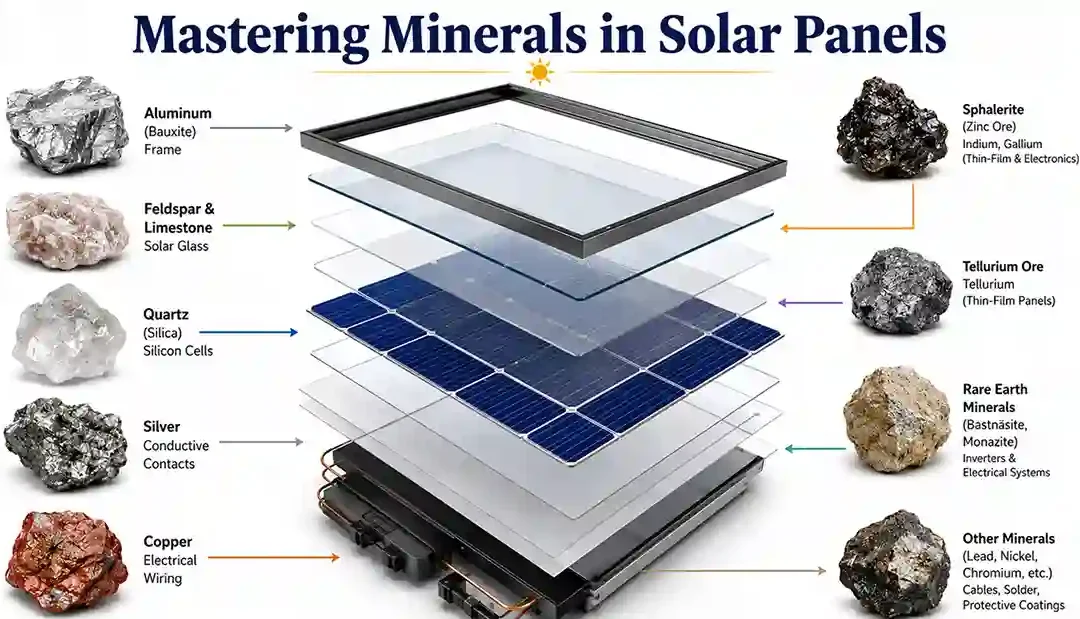
Solar panels convert sunlight into electricity, making them one of the most important technologies in the global transition toward clean and renewable energy. While they appear to be simple sheets of glass and metal, solar panels are actually built from a wide variety of minerals that provide electrical conductivity, structural strength, light transmission, and efficient energy conversion.
Minerals in solar panels supply the raw materials for photovoltaic (PV) cells, glass, electrical wiring, frames, and electronic components. Quartz provides silicon for solar cells, silver carries electrical current, copper transports electricity, and aluminum gives the panel its lightweight frame. Advanced solar technologies also rely on critical minerals such as indium, gallium, tellurium, and selenium.
Understanding these minerals reveals the close relationship between geology, mining, renewable energy, and sustainable development.
This topic should be studied together with Critical Minerals and Mineralogy.
Why Solar Panels Depend on Minerals
Solar panels require minerals with specific physical and chemical properties.
These minerals provide:
- High electrical conductivity
- Efficient light absorption
- Optical transparency
- Corrosion resistance
- Mechanical strength
- Weather resistance
- Long operational life
Together, they allow solar panels to produce electricity for 25–30 years or more.
Major Minerals Used in Solar Panels
Quartz
Common mineral:
- Quartz
Uses:
- Source of silicon
- Solar glass production
Importance:
Quartz is refined into ultra-pure silicon, the primary material used in most photovoltaic cells.
Silicon
Source:
- Refined from quartz
Uses:
- Photovoltaic cells
Importance:
Silicon converts sunlight directly into electricity through the photovoltaic effect.
Silver
Uses:
- Conductive grid lines
- Electrical contacts
Importance:
Silver provides excellent electrical conductivity, maximizing energy collection.
Copper
Common source mineral:
- Chalcopyrite
Uses:
- Electrical wiring
- Cables
- Junction boxes
Importance:
Copper efficiently transports electricity generated by the solar cells.
Aluminum
Common source:
- Bauxite
Uses:
- Solar panel frame
- Mounting structures
Importance:
Aluminum is lightweight, durable, and corrosion-resistant.
Glass Minerals
Common minerals:
- Quartz
- Feldspar
- Limestone
- Dolomite
Uses:
- Protective solar glass
Importance:
These minerals produce durable, transparent glass that protects photovoltaic cells.
Indium
Common source:
- Sphalerite (by-product)
Uses:
- Thin-film solar cells
- Transparent conductive coatings
Importance:
Improves electrical performance in advanced photovoltaic technologies.
Gallium
Common source:
- Bauxite
- Sphalerite (by-product)
Uses:
- High-efficiency photovoltaic cells
Importance:
Gallium improves solar cell efficiency, especially in space and concentrated solar applications.
Tellurium
Common source:
- Copper refining by-products
Uses:
- Cadmium telluride (CdTe) solar panels
Importance:
Essential for one of the world's leading thin-film solar technologies.
Selenium
Uses:
- Thin-film photovoltaic materials
Importance:
Enhances the performance of certain advanced solar cells.
Rare Earth Elements
Important elements include:
- Neodymium
- Dysprosium
Uses:
- High-efficiency motors
- Inverters
- Grid connection equipment
Importance:
Support the broader solar energy system rather than the photovoltaic cells themselves.
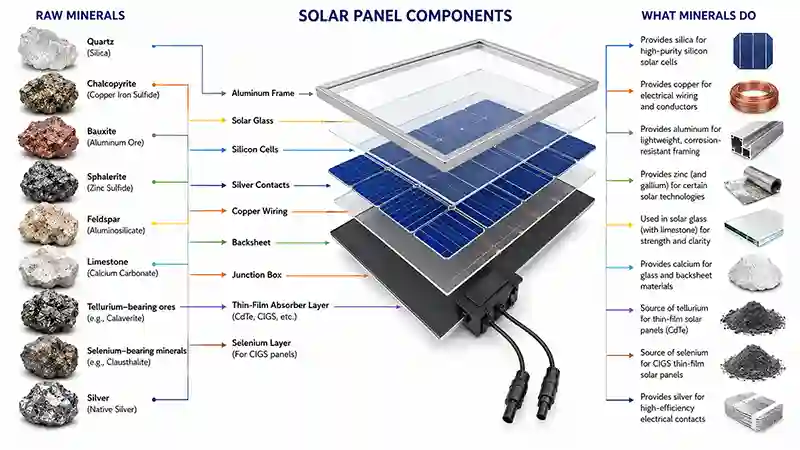
Minerals by Solar Panel Component
| Solar Panel Component | Main Minerals |
|---|---|
| Solar Cells | Quartz (Silicon) |
| Conductive Contacts | Silver |
| Wiring | Copper |
| Frame | Aluminum |
| Protective Glass | Quartz, Feldspar, Limestone, Dolomite |
| Thin-Film Cells | Tellurium, Indium, Gallium, Selenium |
| Junction Box | Copper, Aluminum |
| Inverter System | Copper, Rare Earth Elements |
Types of Solar Panels and Their Minerals
Monocrystalline Silicon Panels
Main minerals:
- Quartz (Silicon)
- Silver
- Copper
- Aluminum
Most efficient and widely used.
Polycrystalline Silicon Panels
Main minerals:
- Quartz
- Silver
- Copper
Less expensive than monocrystalline panels.
Thin-Film Solar Panels
Main minerals:
- Tellurium
- Indium
- Gallium
- Selenium
Lightweight and flexible but generally less efficient.
Perovskite Solar Cells
Emerging materials include:
- Lead-bearing minerals
- Tin-bearing minerals
These next-generation cells are under active research for higher efficiency and lower production costs.
From Mine to Solar Panel
The production of solar panels involves several stages:
- Geological exploration
- Mining
- Ore processing
- Mineral refining
- Silicon purification
- Solar cell manufacturing
- Panel assembly
- Installation
- Recycling
Each stage contributes to the production of reliable renewable energy systems.
Environmental Challenges
The rapid expansion of solar energy creates several resource challenges.
These include:
- Increased demand for critical minerals
- Energy-intensive mineral refining
- Mining impacts
- Water consumption
- End-of-life panel disposal
Responsible mining and solar panel recycling reduce these environmental impacts.
Recycling Solar Panel Minerals
Recycling can recover valuable materials such as:
- Silicon
- Silver
- Copper
- Aluminum
- Glass
Recovering these materials reduces mining demand and supports a circular economy.
Geological Importance
Solar panel minerals are becoming increasingly important in economic geology.
Geologists study these resources to:
- Discover new mineral deposits
- Estimate reserves
- Improve sustainable mining
- Secure critical mineral supplies
- Support renewable energy development
Many governments classify several solar panel minerals as strategic or critical resources.
Laboratory Investigation
Scientists analyze solar panel minerals using:
- X-Ray Diffraction (XRD)
- X-Ray Fluorescence (XRF)
- Scanning Electron Microscopy (SEM)
- Electron Probe Microanalysis (EPMA)
- ICP-MS
- Raman Spectroscopy
These methods determine purity, crystal structure, and chemical composition.
Applications
Solar panel minerals are essential in:
- Residential solar systems
- Commercial solar farms
- Utility-scale power plants
- Spacecraft solar arrays
- Portable solar chargers
- Off-grid power systems
- Renewable energy storage systems
Advantages of Studying Solar Panel Minerals
Understanding solar panel minerals helps scientists and engineers:
- Improve solar efficiency
- Discover new mineral resources
- Support renewable energy growth
- Develop sustainable mining practices
- Improve recycling technologies
- Secure future clean-energy supply chains
Limitations
Despite their importance, solar panel minerals face several challenges.
- Some critical minerals are produced in limited regions.
- Mining and refining require significant energy.
- Recycling infrastructure continues to develop.
- Demand is expected to increase as solar installations expand worldwide.
For a broader understanding, study this topic together with:
- Critical Minerals
- Economic Minerals
- Renewable Energy Minerals
- Solar Energy
- Mineral Resources
- Sustainable Mining
- Environmental Geology
- Mineralogy
Comparison Table
| Mineral | Main Function | Example Source Mineral |
| Quartz | Silicon production | Quartz |
| Silicon | Photovoltaic cells | Refined Quartz |
| Silver | Electrical contacts | Native Silver |
| Copper | Wiring | Chalcopyrite |
| Aluminum | Frame | Bauxite |
| Indium | Thin-film cells | Sphalerite |
| Gallium | High-efficiency cells | Bauxite |
| Tellurium | CdTe solar cells | Copper by-products |
| Selenium | Thin-film cells | Selenium-bearing ores |
| Feldspar | Solar glass | Feldspar |
Summary Table
| Feature | Minerals in Solar Panels |
| Main Purpose | Convert Sunlight into Electricity |
| Key Minerals | Quartz, Silicon, Silver, Copper, Aluminum |
| Critical Minerals | Indium, Gallium, Tellurium, Selenium |
| Study Methods | XRD, XRF, SEM, ICP-MS |
| Geological Importance | Renewable Energy and Critical Mineral Exploration |
Quartz is the most important mineral because it is refined into silicon, the primary material used in most photovoltaic cells.
Silver forms highly conductive electrical contacts that collect and transport electricity generated by solar cells.
Thin-film solar technologies commonly use tellurium, indium, gallium, and selenium to create lightweight, efficient photovoltaic materials.
Yes. Valuable materials such as silicon, silver, copper, aluminum, and glass can be recovered and reused through specialized recycling processes.
Many of these minerals are essential for renewable energy technologies and may have limited global production or strategic importance.
Final Thoughts
Solar panels rely on a diverse range of minerals that transform sunlight into clean, renewable electricity. From quartz-derived silicon cells and silver conductors to aluminum frames and advanced thin-film materials, each mineral contributes unique properties that maximize efficiency and durability.
As the world expands renewable energy generation, the responsible exploration, mining, processing, and recycling of solar panel minerals will become increasingly important. Understanding these minerals highlights the essential role geology plays in building a sustainable energy future.
Continue Learning
Continue exploring related topics: