
Introduction
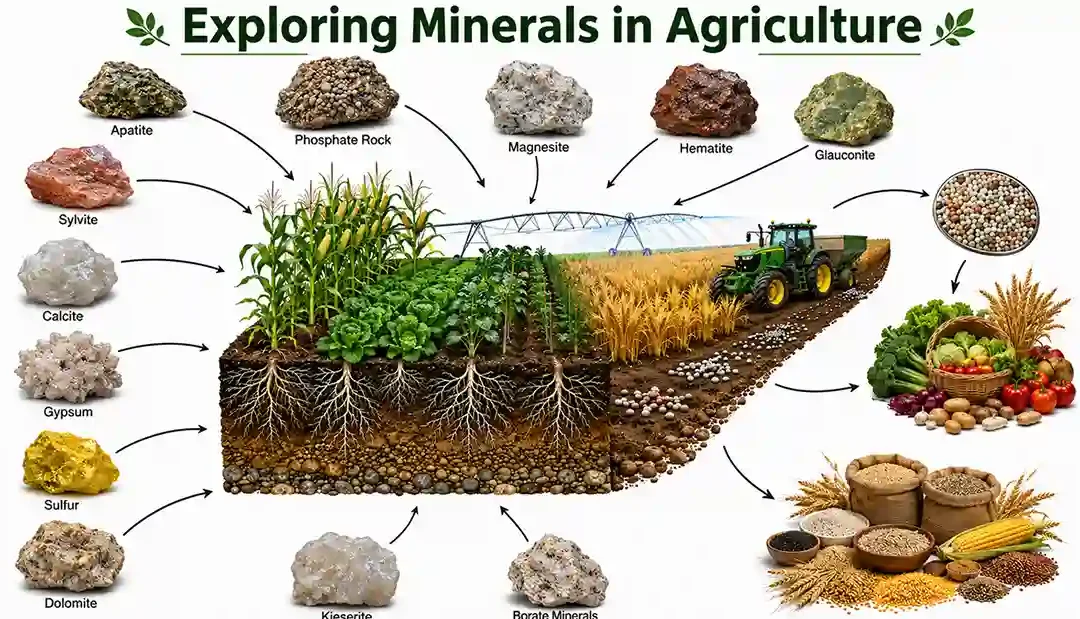
Agriculture depends on minerals to maintain fertile soils, produce healthy crops, and sustain global food production. Every plant requires mineral nutrients for growth, while farmers rely on mineral fertilizers and soil amendments to replenish nutrients removed during harvesting. Without these geological resources, modern agriculture could not produce enough food for the world's growing population.
Minerals in agriculture improve soil fertility, enhance crop yields, support plant metabolism, regulate soil pH, strengthen root systems, and increase resistance to diseases and environmental stress. They are also essential for livestock nutrition, irrigation management, and sustainable farming practices.
Understanding minerals in agriculture demonstrates the close relationship between geology, soil science, agronomy, environmental science, and food security.
This topic should be studied together with Minerals in Food, Mineralogy, Geochemistry, and Industrial Minerals Explained.
Why Agriculture Depends on Minerals
Plants require mineral nutrients throughout their life cycle.
Agricultural minerals help:
- Improve soil fertility
- Increase crop productivity
- Support root development
- Enhance photosynthesis
- Improve water retention
- Correct soil acidity
- Supply essential nutrients
- Promote sustainable farming
Healthy soils depend on balanced mineral availability.
Major Minerals Used in Agriculture
Phosphate Rock (Apatite)
Common agricultural uses:
- Phosphate fertilizers
- Root development
- Flower and seed production
Importance:
Phosphorus is one of the three primary nutrients required for plant growth.
Sylvite (Potash)
Common agricultural uses:
- Potassium fertilizers
- Fruit development
- Water regulation
Importance:
Potassium improves crop quality and disease resistance.
Limestone (Calcite)
Common agricultural uses:
- Soil pH correction
- Liming acidic soils
Importance:
Limestone improves nutrient availability and soil structure.
Gypsum
Common agricultural uses:
- Soil conditioning
- Calcium source
- Saline soil improvement
Importance:
Gypsum improves soil drainage and root growth.
Sulfur
Common agricultural uses:
- Sulfur fertilizers
- Soil acidification
- Fungicides
Importance:
Sulfur is an essential nutrient for protein synthesis.
Dolomite
Common agricultural uses:
- Magnesium fertilizer
- Soil liming
Importance:
Dolomite supplies both calcium and magnesium.
Magnesite
Common agricultural uses:
- Magnesium fertilizers
Importance:
Magnesium is essential for chlorophyll production.
Borate Minerals
Common agricultural uses:
- Boron fertilizers
Importance:
Boron supports flowering and fruit development.
Glauconite
Common agricultural uses:
- Slow-release potassium fertilizer
- Soil conditioner
Importance:
Glauconite naturally releases nutrients over time.
Kieserite
Common agricultural uses:
- Magnesium sulfate fertilizer
Importance:
Kieserite provides highly available magnesium and sulfur.
Hematite
Common agricultural uses:
- Iron fertilizers
- Micronutrient supplements
Importance:
Iron supports chlorophyll synthesis and photosynthesis.
Zinc Minerals
Common agricultural uses:
- Zinc fertilizers
Importance:
Zinc improves enzyme activity and crop development.
Minerals by Agricultural Application
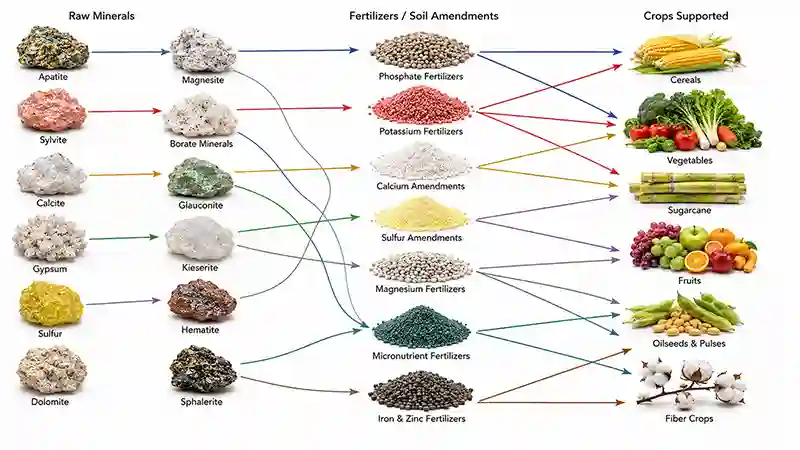
| Agricultural Application | Major Minerals |
|---|---|
| Phosphate Fertilizers | Apatite |
| Potassium Fertilizers | Sylvite, Glauconite |
| Soil Liming | Calcite, Dolomite |
| Soil Conditioning | Gypsum |
| Magnesium Fertilizers | Dolomite, Magnesite, Kieserite |
| Sulfur Fertilizers | Sulfur |
| Micronutrient Fertilizers | Hematite, Zinc Minerals, Borates |
| Crop Nutrition | Phosphate, Potash, Magnesium |
From Mine to Farm
Agricultural minerals undergo several processing stages before reaching farms.
- Minerals are mined from deposits.
- Ores are crushed and concentrated.
- Fertilizer-grade materials are processed.
- Fertilizers are blended and packaged.
- Farmers apply minerals to fields.
- Crops absorb nutrients through their roots.
This cycle links geology directly to food production.
Soil Fertility and Mineral Nutrition
Plants require both macronutrients and micronutrients.
Primary Nutrients
- Nitrogen
- Phosphorus
- Potassium
Secondary Nutrients
- Calcium
- Magnesium
- Sulfur
Micronutrients
- Iron
- Zinc
- Copper
- Boron
- Manganese
- Molybdenum
Balanced mineral nutrition leads to healthy crop growth and higher yields.
Geological Importance
Agricultural geologists study mineral resources that improve farming.
Research areas include:
- Fertilizer mineral deposits
- Soil mineralogy
- Weathering processes
- Nutrient cycling
- Sustainable resource management
Their work helps improve global food security.
Laboratory Investigation
Agricultural minerals are analyzed using:
- ICP-MS
- X-Ray Fluorescence (XRF)
- X-Ray Diffraction (XRD)
- Atomic Absorption Spectroscopy (AAS)
- ICP-OES
- Soil nutrient analysis
These techniques measure mineral composition and fertilizer quality.
Applications
Agricultural minerals are widely used in:
- Crop production
- Fertilizer manufacturing
- Soil improvement
- Greenhouse farming
- Precision agriculture
- Organic farming
- Livestock nutrition
- Sustainable agriculture
Advantages of Studying Minerals in Agriculture
Understanding agricultural minerals helps:
- Increase crop yields
- Improve soil fertility
- Reduce nutrient deficiencies
- Support sustainable farming
- Enhance food security
- Improve fertilizer efficiency
Limitations
Despite their benefits, agricultural minerals present several challenges.
- Excess fertilizer may pollute water.
- Mining impacts the environment.
- Soil nutrient depletion requires continuous management.
- Some fertilizers are expensive.
- Climate change affects nutrient availability.
For a broader understanding, study this topic together with:
- Agricultural Geology
- Soil Science
- Agronomy
- Mineralogy
- Geochemistry
- Environmental Science
- Plant Science
- Hydrology
Comparison Table
| Mineral | Agricultural Use | Main Benefit |
| Apatite | Phosphate Fertilizer | Root Growth |
| Sylvite | Potassium Fertilizer | Crop Quality |
| Calcite | Soil Liming | pH Control |
| Gypsum | Soil Conditioner | Better Drainage |
| Sulfur | Fertilizer | Protein Formation |
| Dolomite | Soil Amendment | Calcium & Magnesium |
| Magnesite | Magnesium Fertilizer | Chlorophyll Production |
| Borate Minerals | Boron Fertilizer | Flowering |
| Hematite | Iron Fertilizer | Photosynthesis |
| Glauconite | Slow-Release Fertilizer | Long-Term Nutrition |
Summary Table
| Feature | Minerals in Agriculture |
| Main Purpose | Soil Fertility and Crop Production |
| Major Minerals | Apatite, Sylvite, Calcite, Gypsum |
| Micronutrient Minerals | Iron, Zinc, Boron |
| Study Methods | ICP-MS, XRF, XRD, ICP-OES |
| Geological Importance | Agricultural Geology and Soil Science |
Minerals in agriculture are naturally occurring geological materials used to improve soil fertility, supply plant nutrients, and increase crop productivity.
Phosphate rock, potash, limestone, gypsum, sulfur, dolomite, magnesium minerals, and micronutrient minerals such as zinc and boron are among the most important agricultural minerals.
Phosphate rock provides phosphorus, an essential nutrient required for root development, flowering, and seed production.
Limestone neutralizes acidic soils, improves soil structure, and increases nutrient availability for crops.
Minerals maintain soil fertility, improve crop health, increase food production, and support long-term agricultural sustainability.
Final Thoughts
Minerals are the geological foundation of modern agriculture. They enrich soils, provide essential plant nutrients, improve fertilizer performance, and help farmers produce healthy crops that feed the world's population. From phosphate and potash fertilizers to limestone, gypsum, and micronutrient minerals, these natural resources support every stage of agricultural production.
As global food demand continues to rise, efficient use of mineral resources, sustainable soil management, and responsible fertilizer practices will become increasingly important. Understanding the connection between geology and agriculture helps ensure productive farms, healthy ecosystems, and long-term food security.
Continue Learning
Continue exploring related topics: