
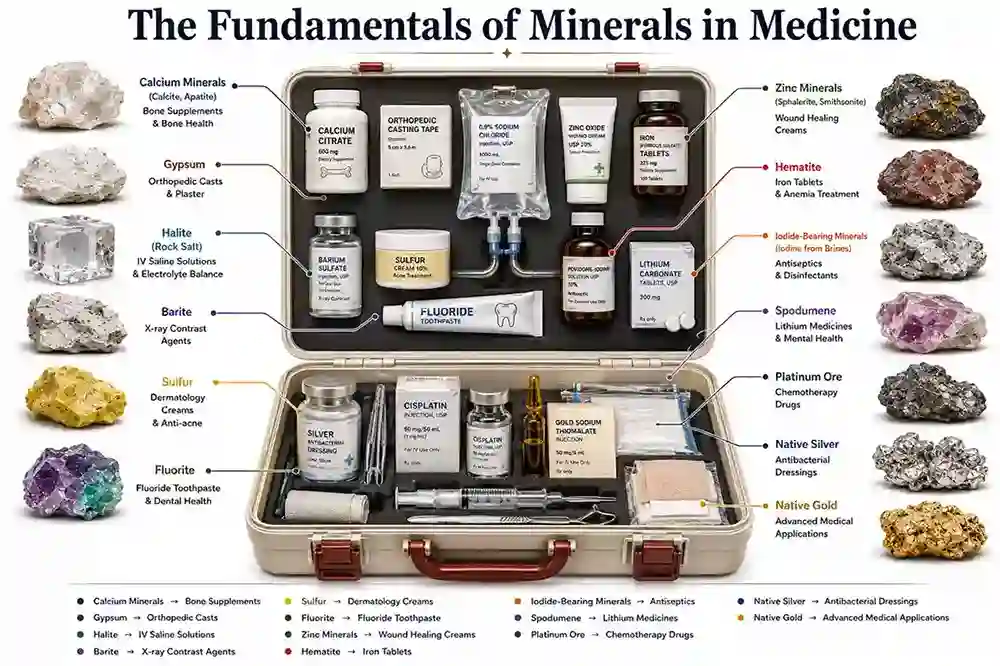
Medicine depends on minerals far more than most people realize. Many life-saving drugs, diagnostic agents, medical devices, and nutritional supplements either contain minerals directly or are manufactured using mineral-derived materials. From calcium tablets that strengthen bones to platinum-based chemotherapy drugs that treat cancer, minerals play an essential role in modern healthcare.
Minerals in medicine support disease prevention, diagnosis, treatment, rehabilitation, and medical research. Some minerals become active pharmaceutical ingredients, while others are used to manufacture medical equipment, imaging agents, dental materials, prosthetics, and hospital supplies.
Understanding minerals in medicine demonstrates the close relationship between geology, mineralogy, chemistry, pharmacy, and medical science.
This topic should be studied together with Mineral in Human Health, Mineralogy, X-Ray Diffraction in Mineralogy, Geochemistry, and Minerals in Glass.
Why Medicine Depends on Minerals
Modern healthcare relies on minerals for countless applications.
Minerals help:
- Manufacture medicines
- Produce nutritional supplements
- Diagnose diseases
- Treat infections
- Build medical implants
- Manufacture surgical equipment
- Produce dental materials
- Support radiation therapy
Without mineral resources, many modern medical technologies would not exist.
Major Minerals Used in Medicine

Calcium
Common medical uses:
- Calcium supplements
- Osteoporosis treatment
- Antacid tablets
Importance:
Calcium is widely used to maintain healthy bones and support nerve and muscle function.
Gypsum
Common medical uses:
- Orthopedic casts
- Medical plaster
- Surgical molds
Importance:
Gypsum hardens quickly, making it ideal for immobilizing broken bones.
Halite (Sodium Chloride)
Common medical uses:
- Intravenous saline solutions
- Oral rehydration therapy
- Medical irrigation fluids
Importance:
Saline solutions restore body fluids and electrolytes.
Barite
Common medical uses:
- Barium sulfate contrast agents
- Gastrointestinal X-ray imaging
Importance:
Barite enables doctors to visualize the digestive system during medical imaging.
Sulfur
Common medical uses:
- Skin creams
- Acne treatment
- Antifungal medications
Importance:
Sulfur compounds have long been used to treat skin disorders.
Magnesium
Common medical uses:
- Magnesium supplements
- Antacids
- Laxatives
Importance:
Magnesium supports muscles, nerves, and cardiovascular health.
Zinc
Common medical uses:
- Wound healing creams
- Dietary supplements
- Immune support
Importance:
Zinc promotes tissue repair and immune function.
Iron
Common medical uses:
- Iron supplements
- Treatment of iron-deficiency anemia
Importance:
Iron restores healthy red blood cell production.
Iodine
Common medical uses:
- Antiseptics
- Thyroid medications
- Contrast media
Importance:
Iodine is essential for thyroid health and infection control.
Fluorite
Common medical uses:
- Fluoride toothpaste
- Dental treatments
Importance:
Fluoride strengthens tooth enamel and reduces cavities.
Silver
Common medical uses:
- Antibacterial wound dressings
- Burn treatment
- Medical coatings
Importance:
Silver naturally inhibits bacterial growth.
Gold
Common medical uses:
- Rheumatoid arthritis treatment
- Dentistry
- Medical research
Importance:
Gold compounds have specialized pharmaceutical applications.
Platinum
Common medical uses:
- Cancer chemotherapy drugs
- Medical devices
Importance:
Platinum compounds are widely used in cancer treatment.
Lithium
Common medical uses:
- Mood stabilization
- Bipolar disorder treatment
Importance:
Lithium compounds remain among the most effective treatments for bipolar disorder.
Minerals by Medical Application
| Medical Application | Major Minerals |
|---|---|
| Bone Health | Calcium, Phosphorus |
| Intravenous Fluids | Halite |
| Diagnostic Imaging | Barite, Iodine |
| Skin Treatments | Sulfur, Zinc |
| Dental Care | Fluorite, Calcium |
| Cancer Therapy | Platinum |
| Mental Health | Lithium |
| Wound Care | Silver |
| Nutritional Supplements | Iron, Magnesium, Zinc |
From Mine to Medicine
Medical minerals follow a highly controlled production process.
- Minerals are extracted from mines.
- Ores are concentrated and refined.
- Pharmaceutical-grade minerals are purified.
- Active ingredients are manufactured.
- Medicines undergo laboratory testing.
- Finished medical products are distributed to hospitals and pharmacies.
Strict quality control ensures safety and effectiveness.
Medical Imaging and Mineral Resources
Several diagnostic technologies rely on minerals.
Examples include:
- Barium sulfate for gastrointestinal imaging
- Iodine-based contrast agents for CT scans
- Gadolinium compounds for MRI contrast
- Radioactive minerals used in nuclear medicine
These materials improve disease diagnosis without invasive surgery.
Geological Importance
Medical geology studies how Earth's minerals influence human health.
Researchers investigate:
- Natural mineral resources for medicines
- Trace elements and disease
- Water chemistry
- Pharmaceutical mineral deposits
- Environmental exposure to beneficial and harmful minerals
Medical geology connects Earth science with healthcare.
Laboratory Investigation
Medical minerals are analyzed using:
- ICP-MS
- Atomic Absorption Spectroscopy (AAS)
- X-Ray Diffraction (XRD)
- X-Ray Fluorescence (XRF)
- ICP-OES
- Pharmaceutical quality control testing
These techniques ensure minerals meet strict medical standards.
Applications
Minerals are widely used in:
- Pharmaceutical manufacturing
- Medical imaging
- Dentistry
- Orthopedic surgery
- Cancer treatment
- Nutritional supplements
- Wound care
- Hospital equipment
- Biomedical engineering
Advantages of Studying Minerals in Medicine
Understanding medicinal minerals helps:
- Improve healthcare
- Develop safer medicines
- Discover new pharmaceutical materials
- Enhance diagnostic technology
- Support biomedical innovation
- Improve patient outcomes
Limitations
Despite their importance, medicinal minerals present several challenges.
- Pharmaceutical-grade purification is expensive.
- Some minerals can become toxic at high doses.
- Mining impacts the environment.
- Rare medical minerals may have limited supply.
- Strict regulations govern medical use.
For a broader understanding, study this topic together with:
- Medical Geology
- Pharmaceutical Science
- Mineralogy
- Geochemistry
- Biomedical Engineering
- Materials Science
- Clinical Medicine
- Environmental Geology
Comparison Table
| Mineral | Medical Use | Common Products |
| Calcium | Bone Health | Supplements |
| Gypsum | Orthopedic Casts | Medical Plaster |
| Halite | IV Fluids | Saline Solution |
| Barite | Imaging | Barium Contrast |
| Sulfur | Skin Care | Creams |
| Zinc | Wound Healing | Ointments |
| Iron | Anemia Treatment | Iron Tablets |
| Platinum | Chemotherapy | Cancer Drugs |
| Silver | Antibacterial | Wound Dressings |
| Lithium | Mental Health | Mood Stabilizers |
Summary Table
| Feature | Minerals in Medicine |
| Main Purpose | Disease Prevention, Diagnosis, and Treatment |
| Major Minerals | Calcium, Halite, Barite, Sulfur |
| Precious Medical Minerals | Silver, Gold, Platinum |
| Study Methods | ICP-MS, XRF, XRD, ICP-OES |
| Geological Importance | Medical Geology and Pharmaceutical Minerals |
Minerals in medicine are naturally occurring mineral resources or mineral-derived compounds used to diagnose, prevent, or treat diseases and to manufacture medical products.
Calcium, gypsum, halite, barite, sulfur, magnesium, zinc, iron, iodine, silver, gold, platinum, fluorite, and lithium are among the most important minerals used in healthcare.
Barite is processed into barium sulfate, a contrast agent that helps doctors examine the digestive system using X-ray imaging.
Platinum compounds are key ingredients in several chemotherapy drugs used to treat different types of cancer.
Minerals are essential for medicines, diagnostic imaging, implants, dental care, nutritional supplements, surgical tools, and many other medical technologies.
Final Thoughts
Minerals are indispensable to modern medicine, supporting everything from routine nutritional supplements to advanced cancer therapies and diagnostic imaging. They begin as natural geological resources, undergo extensive purification and processing, and ultimately become safe, effective medical products that improve millions of lives every year.
The connection between geology and medicine continues to grow as researchers discover new mineral-based materials for pharmaceuticals, biomedical devices, and advanced healthcare technologies. Understanding this relationship highlights the critical role Earth's mineral resources play in protecting and improving human health.
Continue Learning
Continue exploring related topics: