
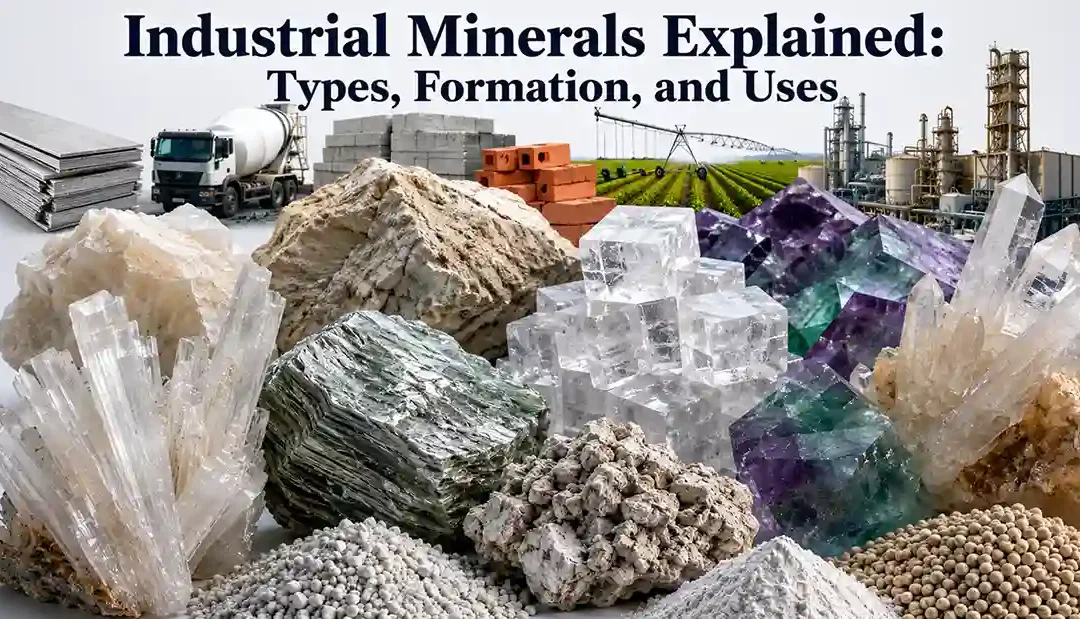
Industrial minerals are among the most important natural resources used by modern society. Unlike metallic minerals, industrial minerals are generally used for their physical and chemical properties rather than for extracting metals.
They are essential for:
- construction materials
- agriculture
- manufacturing
- chemical industries
- ceramics and glass
- environmental applications
Every day, people use products derived from industrial minerals without realizing it.
What Are Industrial Minerals?
Industrial minerals are naturally occurring non-metallic minerals and rocks that are mined for their industrial, agricultural, or construction uses.
Unlike metal ores, industrial minerals are valued for properties such as:
- hardness
- chemical composition
- whiteness
- absorbency
- insulation
- durability
They are often processed but not smelted like metallic ores.
Characteristics of Industrial Minerals
Industrial minerals are typically:
- non-metallic
- abundant
- widely distributed
- economically valuable
- used directly or after simple processing
Many industrial minerals are essential raw materials for modern industries.
Industrial Minerals vs Metallic Minerals
| Feature | Industrial Minerals | Metallic Minerals |
|---|---|---|
| Main Value | Physical Properties | Metal Content |
| Extraction | Processing | Smelting |
| Examples | Gypsum, Talc | Copper, Gold |
| Uses | Construction, Industry | Metal Production |
Major Types of Industrial Minerals
Industrial minerals can be grouped into several categories.
Construction Minerals
- limestone
- gypsum
- sand
- gravel
Agricultural Minerals
- phosphate
- potash
- limestone
Chemical Minerals
- halite
- sulfur
- fluorite
Ceramic and Glass Minerals
- feldspar
- quartz
- kaolin
Limestone
Limestone is one of the world's most important industrial minerals.
Main uses include:
- cement production
- construction aggregate
- steel manufacturing
- soil treatment
Gypsum
Gypsum is widely used in:
- drywall production
- plaster
- cement manufacturing
- agriculture
Learn more → gypsum mineral explained
Halite
Halite, commonly known as rock salt, is used for:
- food processing
- chemical manufacturing
- road de-icing
- water treatment
Learn more → halite mineral explained
Talc
Talc is the softest mineral on Earth.
Major uses include:
- cosmetics
- paper manufacturing
- plastics
- ceramics
Learn more → talc mineral explained
Phosphate Minerals
Phosphate minerals are essential for agriculture.
Common phosphate mineral: Apatite
Uses include:
- fertilizers
- animal feed supplements
- chemical products
Learn more → apatite mineral explained
Quartz
Quartz is one of the most versatile industrial minerals.
Formula:
Applications include:
- glass manufacturing
- electronics
- semiconductors
- construction materials
Learn more → quartz mineral explained
Feldspar
Feldspar is essential for:
- ceramics
- glass production
- tiles
- sanitary ware
It is one of the most abundant mineral groups in Earth's crust.
Learn more → feldspar mineral explained
Kaolin
Kaolin is a clay mineral used in:
- ceramics
- paper coating
- paints
- pharmaceuticals
Its fine texture and white color make it highly valuable.
Learn more → kaolinite mineral explained
Formation of Industrial Mineral Deposits
Industrial minerals form through various geological processes.
Sedimentary Processes
Limestone, phosphate, and halite.
Evaporite Processes
Halite and gypsum.
Hydrothermal Processes
Fluorite and barite.
Weathering Processes
Kaolin and bauxite.
Metamorphic Processes
Talc and graphite.
Industrial Minerals and Modern Society
Industrial minerals support:
- infrastructure
- agriculture
- manufacturing
- healthcare
- environmental protection
Virtually every industry depends on industrial minerals in some way.
Major Industrial Minerals and Uses
| Mineral | Main Use |
|---|---|
| Limestone | Cement |
| Gypsum | Drywall |
| Halite | Salt Production |
| Talc | Cosmetics |
| Quartz | Glass |
| Feldspar | Ceramics |
| Phosphate | Fertilizers |
| Kaolin | Paper & Ceramics |
Major Industrial Mineral-Producing Countries
Important producers include:
- China
- United States
- India
- Brazil
- Germany
- Canada
These countries produce a wide variety of industrial mineral resources.
Why Industrial Minerals Matter
Industrial minerals are crucial because they:
- support construction
- improve agricultural productivity
- enable manufacturing
- supply chemical industries
- support renewable energy technologies
Modern civilization could not function without them.
Economic Importance of Industrial Minerals
| Sector | Minerals Used |
|---|---|
| Construction | Limestone, Gypsum |
| Agriculture | Phosphate, Potash |
| Manufacturing | Talc, Feldspar |
| Electronics | Quartz |
| Chemicals | Halite, Fluorite |
Industrial minerals are non-metallic minerals and rocks mined for their physical and chemical properties rather than metal content.
Common examples include limestone, gypsum, halite, talc, quartz, feldspar, phosphate, and kaolin.
They are used in construction, agriculture, manufacturing, chemicals, ceramics, glass, and electronics.
Industrial minerals are used directly for their properties, while metallic minerals are mined to extract metals.
They provide essential raw materials for infrastructure, agriculture, industry, and modern technology.
Final Thoughts
Industrial minerals are the hidden foundation of modern civilization. From limestone used in buildings and roads to quartz used in electronics and phosphate used in agriculture, these resources support nearly every aspect of daily life.
Understanding industrial minerals helps reveal how geology contributes directly to construction, food production, manufacturing, and technological advancement. They remain among the most economically important resources on Earth.
Continue learning with → economic-geology-explained, mineral-resources-explained, and apatite-mineral-explained.