
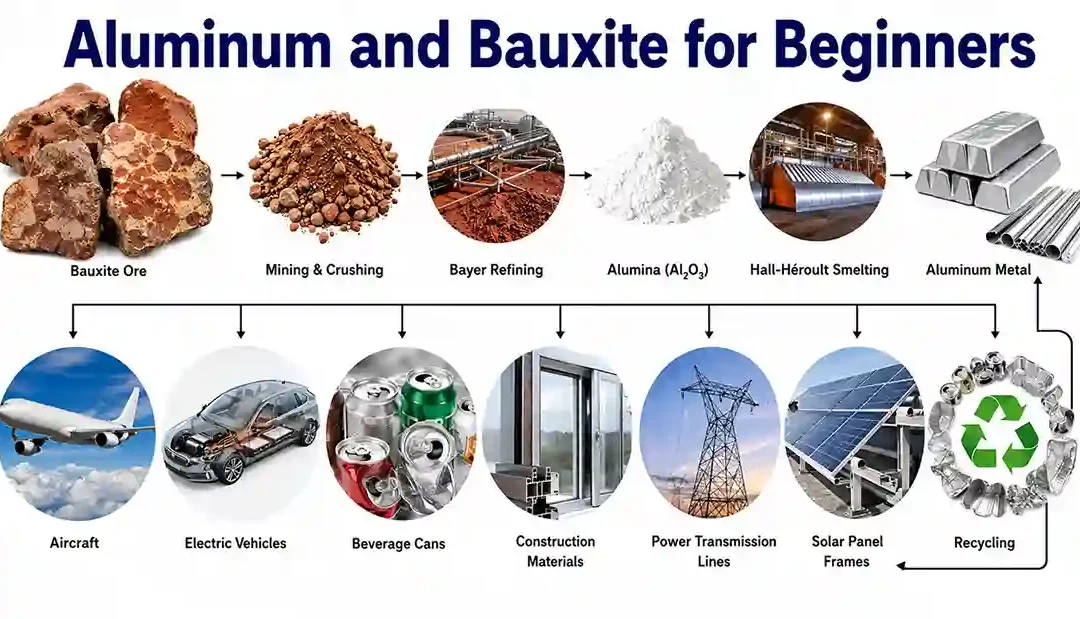
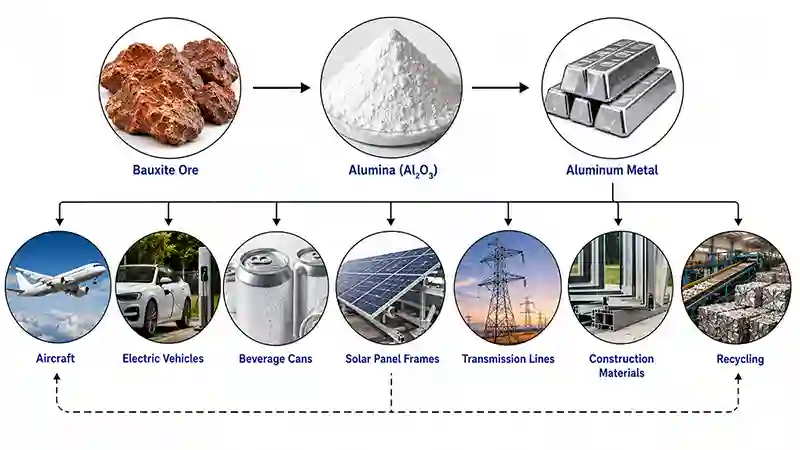
Aluminum is one of the world's most widely used metals because it is lightweight, corrosion-resistant, recyclable, and highly versatile. However, aluminum does not occur naturally as pure metal. Instead, it is produced from bauxite, the primary ore of aluminum. Bauxite is refined into alumina (aluminum oxide), which is then smelted to produce metallic aluminum.
Aluminum and bauxite refers to the complete journey from bauxite mining and alumina refining to aluminum production and its use in transportation, construction, renewable energy, packaging, aerospace, and electronics.
Understanding aluminum and bauxite demonstrates the strong relationship between geology, mining engineering, metallurgy, materials science, and sustainable industrial development.
This topic should be studied together with Graphite in Batteries, Mineralogy, Rare Earth Elements in Technology, Cobalt Mining Explained, and Semiconductor Minerals.
Why Aluminum Depends on Bauxite
Bauxite is the primary source of aluminum because it contains aluminum-bearing minerals that can be economically processed.
Aluminum is widely valued because it provides:
- Lightweight strength
- Excellent corrosion resistance
- High recyclability
- Good electrical conductivity
- High thermal conductivity
- Easy fabrication
- Long service life
- Excellent strength-to-weight ratio
These properties make aluminum one of the world's most important industrial metals.
Major Stages of Aluminum Production
Geological Exploration
Common activities:
- Geological mapping
- Geochemical surveys
- Resource drilling
- Deposit evaluation
Importance:
Exploration identifies economically viable bauxite deposits.
Bauxite Mining
Common methods:
- Open-pit mining
- Surface excavation
Importance:
Most bauxite deposits occur near the Earth's surface and are mined using open-pit methods.
Crushing and Preparation
Common processes:
- Crushing
- Washing
- Screening
Importance:
Ore is prepared for efficient alumina extraction.
Bayer Process
Common products:
- Alumina (Al₂O₃)
Importance:
Bauxite is chemically refined into high-purity alumina using the Bayer process.
Hall-Héroult Smelting
Common products:
- Primary aluminum metal
Importance:
Alumina is converted into metallic aluminum by electrolytic reduction.
Fabrication
Common products:
- Aluminum sheets
- Extrusions
- Foils
- Cast products
Importance:
Aluminum is manufactured into products for numerous industries.
Recycling
Common activities:
- Scrap collection
- Melting
- Reuse
Importance:
Recycling aluminum saves energy and reduces the need for new mining.
Environmental Management
Common activities:
- Land rehabilitation
- Water management
- Tailings management
- Red mud disposal
Importance:
Responsible mining and refining reduce environmental impacts.
Global Distribution
Common destinations:
- Construction industry
- Automotive manufacturers
- Aerospace companies
- Packaging industry
Importance:
Aluminum products are distributed worldwide for industrial and consumer applications.
Major Uses of Aluminum
| Industry | Aluminum Application |
|---|---|
| Construction | Buildings and Bridges |
| Transportation | Cars, Trains, Aircraft |
| Aerospace | Aircraft Structures |
| Renewable Energy | Solar Panel Frames |
| Electrical Industry | Transmission Cables |
| Packaging | Beverage Cans and Foil |
| Consumer Goods | Household Products |
| Marine Industry | Boats and Ships |
From Bauxite Ore to Aluminum Products
The production of aluminum involves several stages.
- Bauxite deposits are explored.
- Bauxite is mined.
- Ore is crushed and cleaned.
- Alumina is extracted using the Bayer process.
- Aluminum metal is produced by the Hall-Héroult process.
- Aluminum is cast into ingots and fabricated.
- Finished products are manufactured.
- Aluminum is recycled and reused.
This process connects geology directly to modern industrial manufacturing.
How Aluminum Supports Modern Industries
Aluminum contributes to numerous sectors.
Transportation
- Electric vehicles
- Automobiles
- Rail systems
Aerospace
- Aircraft frames
- Spacecraft components
Renewable Energy
- Solar panel frames
- Wind turbine components
- Power transmission
Construction
- Windows
- Roofing
- Structural systems
Consumer Products
- Beverage cans
- Kitchen utensils
- Electronic devices
These applications make aluminum one of the world's most valuable industrial metals.
Geological Importance
Economic geologists investigate bauxite deposits that supply the aluminum industry.
Research includes:
- Lateritic bauxite deposits
- Karst bauxite deposits
- Resource estimation
- Ore quality assessment
- Sustainable mining
These studies help secure long-term aluminum production.
Laboratory Investigation
Bauxite and alumina are analyzed using:
- X-Ray Fluorescence (XRF)
- X-Ray Diffraction (XRD)
- ICP-MS
- ICP-OES
- Scanning Electron Microscopy (SEM)
- Chemical composition analysis
These techniques determine aluminum content, mineral composition, and refining suitability.
Applications
Aluminum is widely used in:
- Electric vehicles
- Aircraft
- Buildings
- Bridges
- Solar energy systems
- Wind turbines
- Power transmission
- Beverage packaging
- Consumer electronics
- Industrial machinery
Advantages of Studying Aluminum and Bauxite
Understanding aluminum and bauxite helps:
- Explain aluminum production
- Understand mineral processing
- Improve resource management
- Support sustainable manufacturing
- Promote aluminum recycling
- Advance renewable energy technologies
Limitations
Despite their importance, aluminum production presents several challenges.
- Bauxite mining can disturb ecosystems.
- Alumina refining produces red mud that requires careful management.
- Aluminum smelting consumes significant electrical energy.
- High-quality bauxite resources are unevenly distributed globally.
- Environmental management is essential throughout mining and refining.
For a broader understanding, study this topic together with:
- Economic Geology
- Mineralogy
- Mining Engineering
- Metallurgy
- Materials Science
- Environmental Geology
- Renewable Energy Engineering
- Sustainability
Comparison Table
| Industry | Role of Aluminum | Main Benefit |
| Construction | Structural Material | Lightweight and Durable |
| Transportation | Vehicle Components | Improved Fuel Efficiency |
| Aerospace | Aircraft Structures | High Strength-to-Weight Ratio |
| Renewable Energy | Solar Frames | Corrosion Resistance |
| Electrical Industry | Conductors | Good Electrical Conductivity |
| Packaging | Beverage Cans | Lightweight and Recyclable |
| Marine Industry | Boat Structures | Corrosion Resistance |
| Consumer Goods | Household Products | Versatility |
Summary Table
| Feature | Aluminum and Bauxite |
| Main Purpose | Production of Aluminum Metal |
| Primary Ore | Bauxite |
| Intermediate Product | Alumina (Al₂O₃) |
| Major Industries | Construction, Transportation, Aerospace, Renewable Energy |
| Study Methods | XRF, XRD, ICP-MS, SEM |
| Geological Importance | One of the World's Most Important Industrial Mineral Resources |
Bauxite is the primary ore of aluminum and consists mainly of aluminum-bearing minerals such as gibbsite, boehmite, and diaspore.
Bauxite is first refined into alumina using the Bayer process. The alumina is then converted into aluminum metal through the Hall-Héroult electrolytic smelting process.
Aluminum is lightweight, corrosion-resistant, strong, recyclable, and has good electrical and thermal conductivity, making it suitable for many industries.
Yes. Aluminum is one of the most recyclable metals and can be recycled repeatedly with only a fraction of the energy needed to produce primary aluminum.
Bauxite is important because it is the world's primary source of aluminum, a metal essential for transportation, construction, renewable energy, packaging, and countless everyday products.
Final Thoughts
Aluminum and bauxite are fundamental to modern industry and sustainable development. From bauxite mining and alumina refining to aluminum production and recycling, this supply chain supports transportation, renewable energy, aerospace, construction, and consumer manufacturing. As demand for lightweight, recyclable materials continues to grow, aluminum will remain one of the world's most valuable industrial metals.
Understanding aluminum and bauxite highlights the essential connection between geology, mining, metallurgy, engineering, and the circular economy.
Continue Learning
Continue exploring related topics: