
Graphite is one of the most essential minerals used in modern rechargeable batteries. Although lithium often receives the most attention, graphite is the primary material used in the anode of almost every commercial lithium-ion battery. Without graphite, electric vehicles (EVs), smartphones, laptops, and large-scale energy storage systems would not operate efficiently.
Graphite in batteries refers to the use of natural or synthetic graphite as the anode material in rechargeable batteries. Graphite's layered crystal structure allows lithium ions to move in and out during charging and discharging, making it ideal for energy storage.
Understanding graphite demonstrates the close relationship between geology, mineralogy, materials science, electrochemistry, and clean energy technologies.
This topic should be studied together with Semiconductor Minerals, Mineralogy, Battery Minerals Explained, Silicon in Technology, and Lithium for EV Batteries.
Why Batteries Depend on Graphite
Graphite is widely used because it provides:
- Excellent electrical conductivity
- Stable electrochemical performance
- High lithium-ion storage capacity
- Long battery cycle life
- Lightweight design
- Good thermal stability
- Reliable charging and discharging
- High efficiency in lithium-ion batteries
Without graphite, modern lithium-ion batteries would lose much of their performance and reliability.
Major Applications of Graphite in Batteries
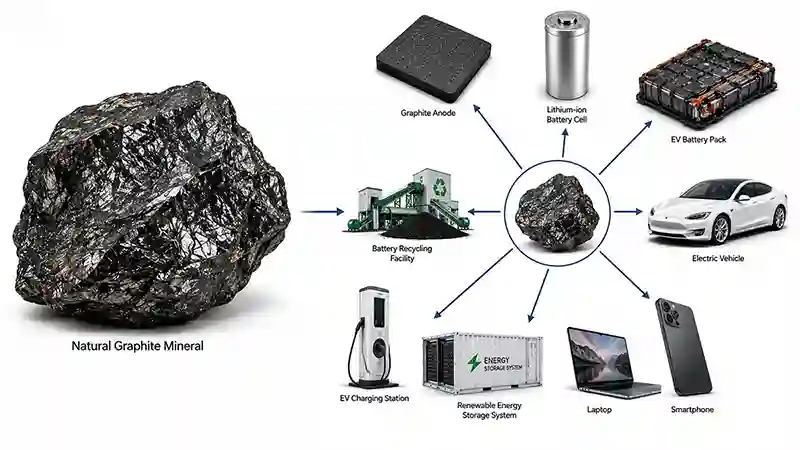
Lithium-Ion Battery Anodes
Common uses:
- Battery anodes
- Lithium-ion cells
- Rechargeable batteries
Importance:
Graphite stores lithium ions during charging and releases them during discharging.
Electric Vehicles (EVs)
Common uses:
- EV battery packs
- Electric cars
- Electric buses
Importance:
Graphite enables long driving ranges and efficient battery performance.
Battery Energy Storage Systems
Common uses:
- Grid-scale batteries
- Residential battery storage
- Renewable energy storage
Importance:
Graphite supports reliable storage of solar and wind energy.
Consumer Electronics
Common uses:
- Smartphones
- Laptops
- Tablets
- Wearable devices
Importance:
Graphite helps deliver compact, lightweight, rechargeable batteries.
Power Tools
Common uses:
- Cordless drills
- Industrial tools
- Construction equipment
Importance:
Graphite improves battery durability and power output.
Electric Bicycles and Scooters
Common uses:
- Battery packs
- Portable mobility systems
Importance:
Graphite enables lightweight rechargeable transportation.
Renewable Energy Storage
Common uses:
- Solar battery systems
- Wind energy storage
Importance:
Graphite helps store renewable electricity for later use.
Battery Recycling
Common uses:
- Graphite recovery
- Material reuse
- Circular economy
Importance:
Recovered graphite reduces the demand for newly mined material.
Next-Generation Batteries
Common uses:
- Silicon-graphite anodes
- Advanced lithium-ion batteries
Importance:
Graphite remains a key material for future battery technologies.
Industrial Battery Systems
Common uses:
- Backup power
- Data centers
- Telecommunications
Importance:
Graphite supports reliable industrial energy storage.
Graphite by Battery Application
| Battery Application | Role of Graphite |
|---|---|
| Lithium-Ion Batteries | Anode Material |
| Electric Vehicles | Energy Storage |
| Battery Packs | Lithium Storage |
| Consumer Electronics | Rechargeable Power |
| Grid Storage | Renewable Energy Storage |
| Power Tools | High-Power Batteries |
| E-Bikes | Portable Energy |
| Battery Recycling | Material Recovery |
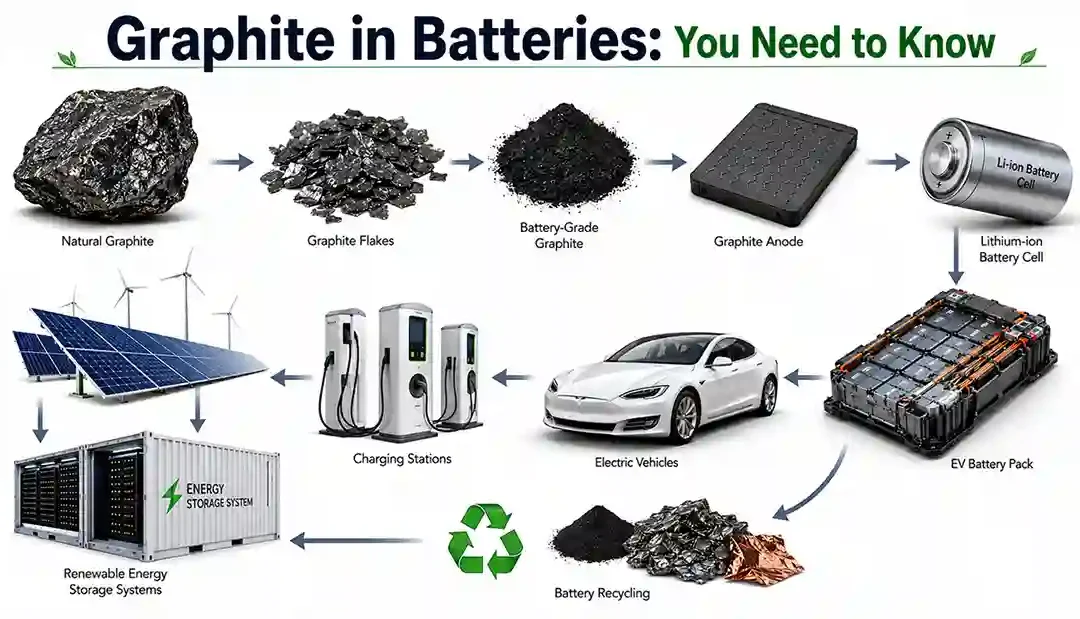
From Graphite Ore to Battery Anode
Graphite passes through several stages before becoming part of a rechargeable battery.
- Graphite ore is mined.
- Ore is crushed and concentrated.
- Graphite is purified.
- Battery-grade graphite is produced.
- Graphite anodes are manufactured.
- Battery cells are assembled.
- Batteries are installed in electric vehicles and electronic devices.
- Used batteries are recycled to recover valuable materials.
This process connects geology directly to modern battery technology.
How Graphite Supports Modern Batteries
Graphite performs several essential functions.
Lithium Storage
- Stores lithium ions during charging
- Releases lithium ions during discharging
Battery Performance
- High electrical conductivity
- Stable electrochemical behavior
Electric Transportation
- Electric cars
- Electric buses
- Electric trucks
Renewable Energy
- Solar energy storage
- Wind energy storage
Consumer Electronics
- Smartphones
- Laptops
- Portable electronics
Together, these applications make graphite one of the world's most important battery minerals.
Geological Importance
Economic geologists study graphite deposits that supply the battery industry.
Research includes:
- Graphite exploration
- Flake graphite deposits
- Vein graphite deposits
- Amorphous graphite resources
- Resource estimation
- Sustainable mining
These studies ensure a reliable supply of graphite for the growing battery market.
Laboratory Investigation
Graphite materials are analyzed using:
- X-Ray Fluorescence (XRF)
- X-Ray Diffraction (XRD)
- Raman Spectroscopy
- ICP-MS
- Scanning Electron Microscopy (SEM)
- Particle Size Analysis
These techniques evaluate graphite purity, crystal structure, particle size, and suitability for battery anodes.
Applications
Graphite in batteries is widely used in:
- Electric vehicles
- Hybrid vehicles
- Battery energy storage systems
- Smartphones
- Laptops
- Tablets
- Electric bicycles
- Power tools
- Renewable energy storage
- Industrial backup power systems
Advantages of Studying Graphite in Batteries
Understanding graphite helps:
- Explain lithium-ion battery technology
- Improve battery performance
- Support electric mobility
- Advance renewable energy storage
- Strengthen critical mineral supply chains
- Promote battery recycling
Limitations
Despite its importance, graphite presents several challenges.
- High-purity battery-grade graphite requires extensive processing.
- Mining operations can have environmental impacts.
- Demand is increasing rapidly with EV adoption.
- Synthetic graphite production consumes significant energy.
- Recycling capacity continues to expand globally.
For a broader understanding, study this topic together with:
- Economic Geology
- Mineralogy
- Electrochemistry
- Materials Science
- Battery Engineering
- Mining Engineering
- Environmental Geology
- Sustainability
Comparison Table
| Battery Technology | Role of Graphite | Main Benefit |
| Lithium-Ion Batteries | Anode Material | Efficient Lithium Storage |
| Electric Vehicles | Battery Performance | Long Driving Range |
| Consumer Electronics | Rechargeable Batteries | Compact Energy Storage |
| Grid Storage | Renewable Integration | Reliable Electricity Storage |
| Power Tools | High-Power Batteries | Durable Performance |
| E-Bikes | Portable Batteries | Lightweight Mobility |
| Battery Recycling | Material Recovery | Resource Conservation |
| Future Batteries | Silicon-Graphite Anodes | Improved Energy Density |
Summary Table
| Feature | Graphite in Batteries |
| Main Purpose | Lithium-Ion Battery Anode Material |
| Source | Natural and Synthetic Graphite |
| Major Applications | EVs, Consumer Electronics, Energy Storage |
| Study Methods | XRF, XRD, Raman, SEM |
| Geological Importance | Critical Battery Mineral |
Graphite is used because it can safely store and release lithium ions, making it the preferred anode material in most lithium-ion batteries.
Both are essential. Lithium carries the charge between electrodes, while graphite forms the anode where lithium ions are stored during charging.
Battery-grade graphite is produced from natural graphite deposits through purification or manufactured as synthetic graphite from carbon-rich materials.
Yes. Graphite can be recovered from used lithium-ion batteries and reused in new battery materials, supporting a circular economy.
Graphite is considered a critical mineral because nearly all commercial lithium-ion batteries depend on it for efficient energy storage and long-term performance.
Final Thoughts
Graphite is the backbone of modern lithium-ion battery technology. Its ability to store lithium ions efficiently makes it indispensable for electric vehicles, renewable energy storage, consumer electronics, and industrial battery systems. As global demand for clean transportation and renewable electricity grows, graphite will remain one of the world's most strategically important battery minerals.
Understanding graphite in batteries highlights the vital connection between geology, mining, materials science, electrochemistry, and the transition to a sustainable energy future.
Continue Learning
Continue exploring related topics: