
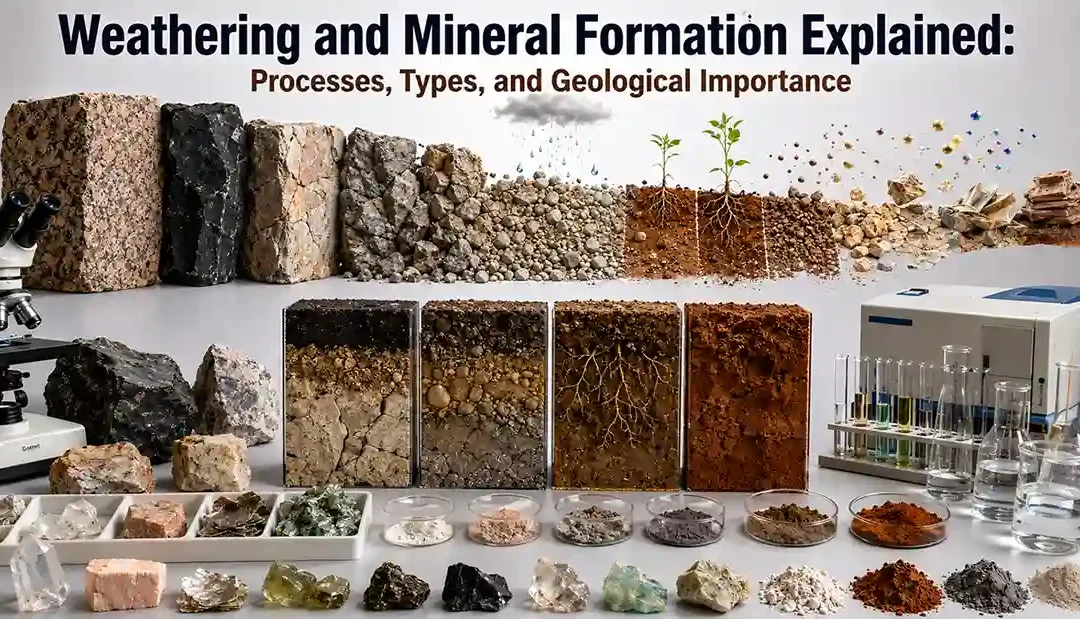
Weathering is one of the most important geological processes shaping Earth's surface. It breaks down rocks and minerals through physical, chemical, and biological processes, producing sediments, soils, dissolved ions, and new minerals. While physical weathering breaks rocks into smaller fragments, chemical weathering alters mineral composition, allowing unstable minerals to transform into more stable secondary minerals under surface conditions.
Mineral formation during weathering is responsible for producing clay minerals, iron oxides, hydroxides, and other secondary minerals that dominate soils and sedimentary environments. These newly formed minerals influence agriculture, groundwater chemistry, engineering properties, and the global carbon cycle.
Understanding weathering and mineral formation is fundamental to mineralogy, geomorphology, soil science, environmental geology, sedimentology, and economic geology.
This topic should be studied together with Mineral Weathering, Mineral Alteration Processes, Mineral Stability, and Sedimentary Rocks Explained.
What Is Weathering?
Weathering is the breakdown and alteration of rocks and minerals at or near Earth's surface without transporting the material.
Weathering occurs through:
- Physical processes
- Chemical reactions
- Biological activity
Unlike erosion, weathering happens in place.
What Is Mineral Formation During Weathering?
As primary minerals become unstable under surface conditions, they undergo chemical reactions that produce secondary minerals.
Examples include:
- Feldspar → Kaolinite
- Olivine → Serpentine
- Biotite → Chlorite
- Pyrite → Goethite
- Magnetite → Hematite
These newly formed minerals are more stable in Earth's surface environment.
Types of Weathering
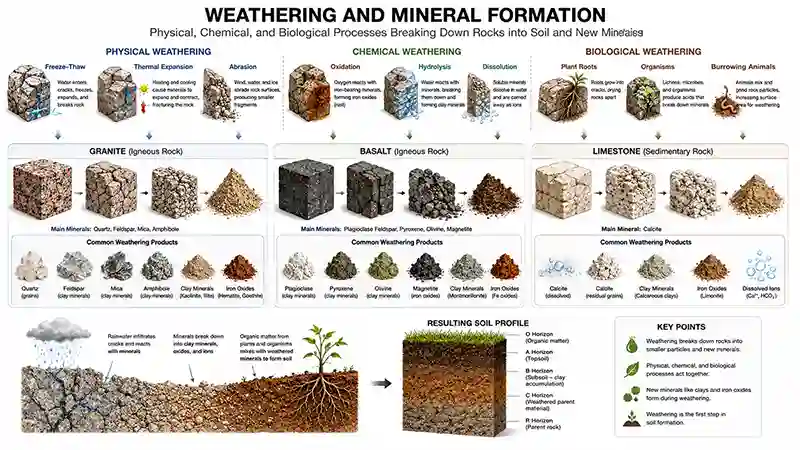
Weathering is generally divided into three major categories.
Physical Weathering
Physical weathering breaks rocks into smaller fragments without changing their chemical composition.
Common processes include:
- Freeze-thaw action
- Thermal expansion
- Salt crystallization
- Pressure release
- Abrasion
The minerals remain chemically unchanged.
Chemical Weathering
Chemical weathering changes the mineral composition through chemical reactions.
Common reactions include:
- Hydrolysis
- Oxidation
- Carbonation
- Dissolution
- Hydration
This process creates new minerals.
Biological Weathering
Living organisms contribute to weathering through:
- Plant roots
- Microorganisms
- Lichens
- Burrowing animals
Biological activity accelerates both physical and chemical weathering.
Major Chemical Weathering Reactions
Hydrolysis
Hydrolysis is the most important weathering reaction affecting silicate minerals.
Example:
Potassium Feldspar → Kaolinite + Dissolved Silica
This reaction produces clay minerals.
Oxidation
Iron-bearing minerals react with oxygen.
Examples:
- Magnetite → Hematite
- Pyrite → Goethite
These reactions produce reddish iron oxides.
Carbonation
Carbon dioxide dissolved in rainwater forms weak carbonic acid.
This reacts with:
- Calcite
- Dolomite
Producing dissolved bicarbonate ions.
Dissolution
Some minerals dissolve directly in water.
Examples:
- Halite
- Gypsum
- Calcite
Highly soluble minerals weather rapidly.
Hydration
Water molecules enter mineral structures.
Example:
- Anhydrite → Gypsum
Hydration changes both mineral composition and crystal structure.
Primary Minerals vs Secondary Minerals
Primary Minerals
Primary minerals crystallize directly from magma.
Examples:
- Quartz
- Feldspar
- Olivine
- Pyroxene
- Amphibole
- Biotite
Secondary Minerals
Secondary minerals form during weathering.
Examples:
- Kaolinite
- Smectite
- Illite
- Chlorite
- Goethite
- Hematite
- Gibbsite
These minerals dominate soils and weathered rock profiles.
Common Mineral Transformations
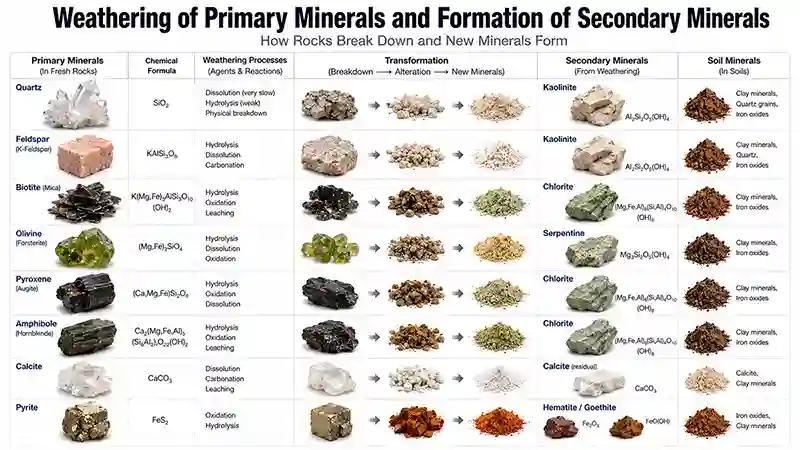
| Primary Mineral | Secondary Mineral |
|---|---|
| Feldspar | Kaolinite |
| Biotite | Chlorite |
| Olivine | Serpentine |
| Pyroxene | Clay Minerals |
| Amphibole | Chlorite |
| Magnetite | Hematite |
| Pyrite | Goethite |
| Calcite | Dissolved Calcium Ions |
Factors Affecting Weathering
Several factors influence weathering intensity.
Climate
Warm, humid climates promote rapid chemical weathering.
Cold or dry climates favor physical weathering.
Rock Composition
Minerals differ in weathering resistance.
Highly resistant:
- Quartz
- Zircon
Less resistant:
- Olivine
- Pyroxene
- Feldspar
Surface Area
Smaller grains weather faster because more surface is exposed.
Water Availability
Water is essential for most chemical weathering reactions.
Time
Longer exposure results in greater weathering and more complete mineral transformation.
Weathering and Soil Formation
Weathering is the first stage of soil development.
Weathered minerals produce:
- Clay minerals
- Iron oxides
- Organic-rich soil horizons
These materials support plant growth and nutrient cycling.
Weathering and the Rock Cycle
Weathering connects all major parts of the rock cycle.
Sequence:
- Igneous rocks form.
- Rocks weather.
- Sediments accumulate.
- Sediments lithify.
- Metamorphism occurs.
- Melting generates new magma.
Minerals are continuously recycled throughout this cycle.
Economic Importance
Weathering produces economically valuable materials.
Examples include:
- Bauxite
- Kaolin
- Laterite nickel deposits
- Iron-rich soils
- Heavy mineral placers
Many industrial minerals originate through prolonged weathering.
Laboratory Identification
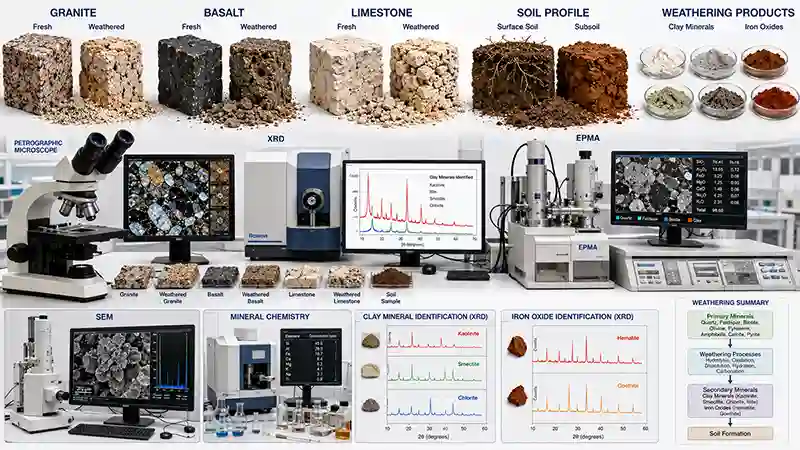
Weathering products are studied using:
- Petrographic Microscopy
- X-Ray Diffraction (XRD)
- Electron Microprobe Analysis (EPMA)
- Scanning Electron Microscopy (SEM)
- Raman Spectroscopy
- X-Ray Fluorescence (XRF)
These techniques identify primary and secondary minerals and reveal weathering pathways.
Importance of Weathering and Mineral Formation
Studying weathering helps geologists:
- Understand soil development
- Interpret past climates
- Reconstruct landscape evolution
- Explain sediment composition
- Evaluate groundwater chemistry
- Explore weathering-related mineral deposits
Weathering is one of the most important surface processes shaping Earth.
Applications
Weathering and mineral formation studies are important in:
- Mineralogy
- Soil science
- Environmental geology
- Sedimentology
- Economic geology
- Engineering geology
- Agriculture
- Hydrogeology
Advantages of Studying Weathering
Studying weathering allows scientists to:
- Understand mineral stability
- Predict soil formation
- Evaluate rock durability
- Explore industrial minerals
- Reconstruct ancient climates
- Improve land-use planning
Limitations
Interpreting weathering products may be difficult because:
- Multiple weathering processes often occur simultaneously.
- Secondary minerals may replace earlier weathering products.
- Climate changes may overprint older weathering profiles.
- Laboratory analyses are often required for fine-grained clay minerals.
For comprehensive interpretation, combine weathering studies with:
- Mineral Weathering
- Mineral Alteration Processes
- Mineral Stability
- Hydrothermal Alteration
- Sedimentary Rocks Explained
- Petrographic Microscopy
- Mineral Chemistry Analysis
Comparison Table
| Weathering Type | Main Process | Typical Products |
| Physical | Mechanical Breakdown | Rock Fragments |
| Chemical | Mineral Transformation | Clay Minerals, Iron Oxides |
| Biological | Organic Activity | Soil Minerals, Weathered Rock |
Summary Table
| Feature | Weathering and Mineral Formation |
| Main Process | Breakdown and Transformation of Minerals |
| Major Weathering Types | Physical, Chemical, Biological |
| Common Secondary Minerals | Kaolinite, Smectite, Hematite, Goethite |
| Common Study Methods | Petrography, XRD, EPMA, SEM |
| Geological Importance | Soil Formation, Sediment Production, Landscape Evolution |
Weathering is the breakdown and alteration of rocks and minerals at Earth's surface through physical, chemical, and biological processes without transporting the material.
Primary minerals crystallize directly from magma, while secondary minerals form later through weathering or alteration. Clay minerals and iron oxides are common secondary minerals.
Olivine, pyroxene, amphibole, and calcium-rich feldspar weather relatively quickly because they are less stable under surface conditions.
Quartz has a strong silicon-oxygen crystal structure and is chemically stable under most surface conditions, making it one of the most weathering-resistant minerals.
Geologists use petrographic microscopy, X-ray diffraction (XRD), electron microprobe analysis (EPMA), scanning electron microscopy (SEM), Raman spectroscopy, and X-ray fluorescence (XRF) to identify weathered minerals and secondary mineral products.
Final Thoughts
Weathering is a continuous process that transforms Earth's rocks into soils, sediments, and new mineral assemblages. Through physical breakdown and chemical alteration, unstable primary minerals gradually evolve into stable secondary minerals such as clay minerals, hematite, goethite, and serpentine. These transformations control soil fertility, sediment composition, landscape development, and the global cycling of chemical elements.
By combining field observations with petrographic microscopy, X-ray diffraction, mineral chemistry, and geochemical analysis, geologists can reconstruct weathering histories, evaluate environmental change, and better understand Earth's surface processes. The study of weathering and mineral formation remains essential for mineralogy, sedimentology, environmental science, agriculture, and economic geology.
Continue Learning
Continue exploring Earth's surface processes with these related guides: