
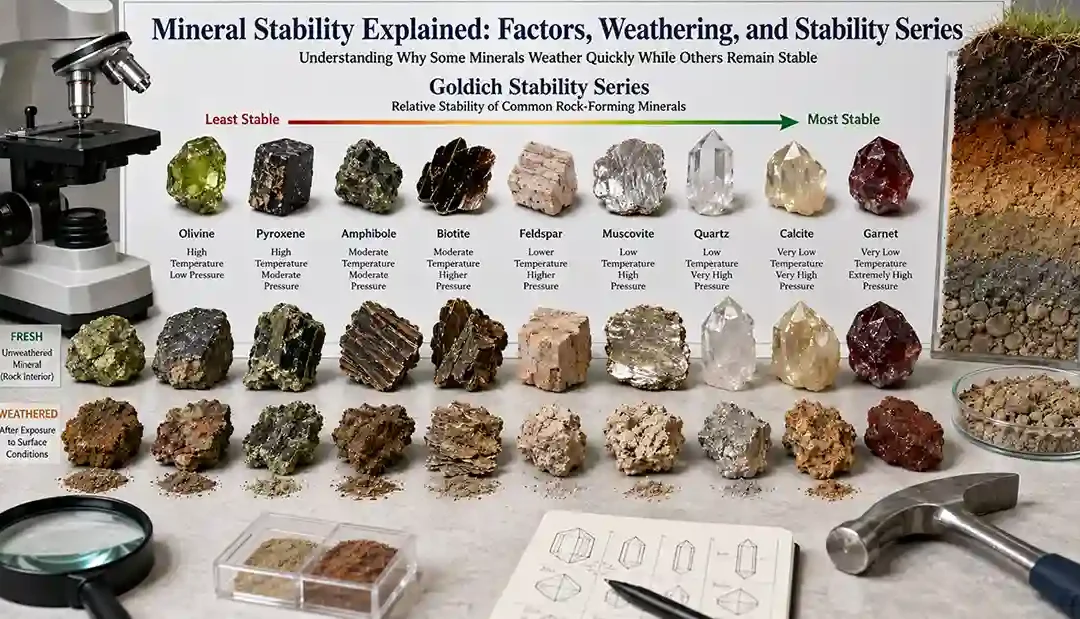
Mineral stability describes how resistant a mineral is to physical and chemical changes under Earth's surface conditions. Although many minerals form deep within the Earth at high temperatures and pressures, they may become unstable when exposed to the cooler, wetter, and oxygen-rich environment at the surface. Over time, these unstable minerals break down into new minerals through weathering and alteration.
Understanding mineral stability helps geologists explain why some minerals, such as quartz, survive millions of years of weathering, while others, such as olivine, rapidly decompose. Mineral stability is fundamental in geology, soil science, sedimentology, and economic geology because it influences landscape development, sediment composition, and ore formation.
If you are studying mineralogy, this topic should be learned together with Crystal Growth in minerals and How to Identify Minerals.
What Is Mineral Stability?
Mineral stability is the ability of a mineral to resist chemical and physical changes under a given set of environmental conditions.
A stable mineral:
- Resists chemical weathering
- Maintains its crystal structure
- Survives transportation
- Persists in soils and sediments
An unstable mineral alters into new minerals over time.
Why Are Some Minerals More Stable?
Mineral stability depends largely on the conditions under which the mineral originally formed.
Minerals formed at:
- High temperatures
- High pressures
often become unstable at Earth's surface.
In contrast, minerals that form under low-temperature conditions are generally more stable in surface environments.
Factors Affecting Mineral Stability
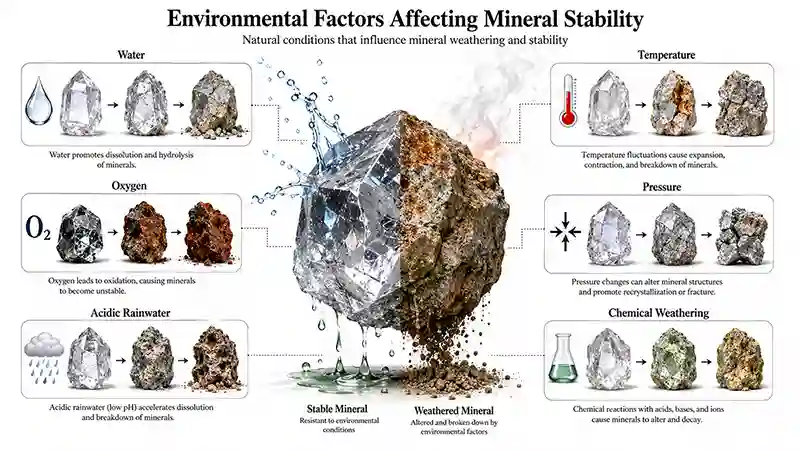
Several factors determine how stable a mineral will be.
Chemical Composition
Minerals rich in iron and magnesium generally weather faster than silica-rich minerals.
Crystal Structure
Strongly bonded crystal structures resist weathering better than weakly bonded structures.
Temperature
High temperatures promote mineral formation, while lower temperatures often favor weathering.
Water
Water accelerates chemical weathering through dissolution and hydrolysis.
Oxygen
Oxidation causes many iron-bearing minerals to become unstable.
Acidity (pH)
Acidic water dissolves some minerals much faster than neutral water.
The Goldich Stability Series
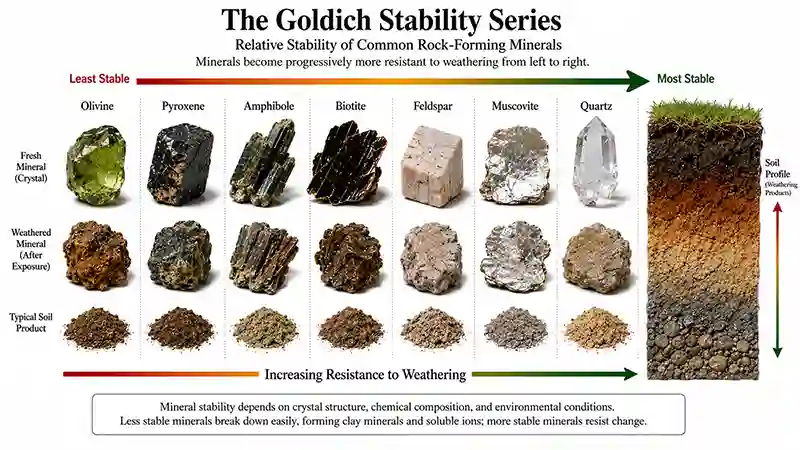
The Goldich Stability Series ranks common silicate minerals according to their resistance to chemical weathering at Earth's surface. It is essentially the reverse of Bowen's Reaction Series.
Minerals that crystallize first from magma are generally the least stable at the surface.
Goldich Stability Series
| Least Stable | Most Stable |
|---|---|
| Olivine | Quartz |
| Pyroxene | Muscovite |
| Amphibole | Potassium Feldspar |
| Biotite | Sodium Feldspar |
| Calcium Feldspar |
Quartz is one of the most stable common minerals under surface conditions.
Why Is Quartz So Stable?
Quartz owes its exceptional stability to:
- Strong silicon-oxygen bonds
- Three-dimensional crystal framework
- High resistance to chemical attack
- Low solubility in water
As a result, quartz commonly accumulates in beaches, deserts, and river sediments.
Why Does Olivine Weather Quickly?
Olivine forms at very high temperatures deep within the Earth.
At the surface it reacts rapidly with:
- Water
- Oxygen
- Carbon dioxide
It commonly alters into:
- Serpentine
- Clay minerals
- Iron oxides
This rapid weathering makes olivine one of the least stable common silicate minerals.
Mineral Stability and Weathering
Weathering is directly related to mineral stability.
Stable Minerals
Examples:
- Quartz
- Zircon
- Muscovite
These survive long-distance transportation.
Moderately Stable Minerals
Examples:
- Feldspar
- Amphibole
- Garnet
These weather more slowly.
Unstable Minerals
Examples:
- Olivine
- Pyroxene
- Nepheline
These alter rapidly under surface conditions.
Stable Minerals in Sedimentary Rocks
The most common stable detrital minerals include:
- Quartz
- Zircon
- Tourmaline
- Rutile
These minerals often survive multiple cycles of erosion and deposition.
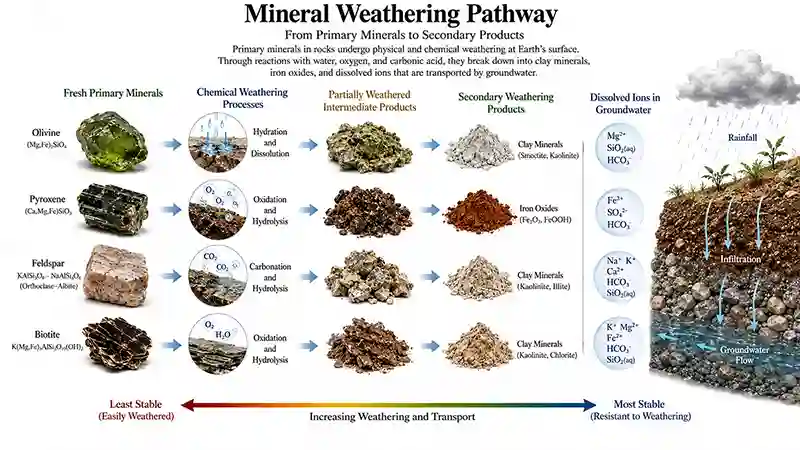
Mineral Alteration Products
Weathering transforms unstable minerals into new minerals.
Examples include:
| Original Mineral | Weathering Product |
| Olivine | Serpentine, Clay |
| Feldspar | Kaolinite |
| Biotite | Chlorite, Clay |
| Pyroxene | Clay Minerals |
| Amphibole | Chlorite |
These secondary minerals dominate many soils.
Stability Under Different Conditions
Mineral stability changes with environmental conditions.
For example:
- Calcite is stable in dry environments.
- Calcite dissolves readily in acidic groundwater.
- Quartz remains stable under most surface conditions.
This illustrates that stability depends on the surrounding environment.
Importance of Mineral Stability
Understanding mineral stability helps geologists:
- Interpret weathering processes
- Study soil formation
- Reconstruct ancient environments
- Evaluate sediment maturity
- Explore ore deposits
- Understand landscape evolution
It is also important in engineering geology because unstable minerals can weaken rocks over time.
Applications
Mineral stability is applied in:
- Mineral identification
- Sedimentology
- Petrology
- Soil science
- Economic geology
- Environmental geology
- Civil engineering
Advantages of Studying Mineral Stability
Studying stability allows scientists to:
- Predict weathering behavior
- Understand rock durability
- Evaluate construction materials
- Interpret geological history
- Assess long-term environmental change
Limitations
Mineral stability cannot be predicted from composition alone because:
- Climate varies.
- Water chemistry changes.
- Pressure and temperature differ.
- Biological activity influences weathering.
For reliable interpretation, combine stability studies with:
- Mineral Weathering
- Crystal Structure Explained
- Crystal Growth in Minerals
- Mineral Hardness Test
- How to Identify Minerals
- Optical Properties of Minerals
- Chemical Properties of Minerals
Comparison Table
| Stable Minerals | Less Stable Minerals |
| Quartz | Olivine |
| Zircon | Pyroxene |
| Muscovite | Amphibole |
| Tourmaline | Calcium Feldspar |
| Rutile | Biotite |
Summary Table
| Feature | Mineral Stability |
| Main Concept | Resistance to Weathering |
| Most Stable Mineral | Quartz |
| Least Stable Common Mineral | Olivine |
| Key Model | Goldich Stability Series |
| Main Controls | Chemistry, Crystal Structure, Environment |
Mineral stability is the ability of a mineral to resist physical and chemical changes under specific environmental conditions.
The Goldich Stability Series ranks silicate minerals according to their resistance to chemical weathering, from least stable (olivine) to most stable (quartz).
Quartz has a strong three-dimensional silicon-oxygen crystal framework that resists chemical weathering and dissolution.
Olivine, pyroxene, amphibole, and calcium-rich feldspars are among the least stable common minerals at Earth's surface.
Mineral stability helps explain weathering, soil formation, sediment composition, landscape evolution, and the long-term geological cycle.
Final Thoughts
Mineral stability is a key concept in mineralogy because it explains why some minerals survive Earth's surface conditions while others quickly alter into new materials. The Goldich Stability Series provides a simple framework for understanding how minerals respond to weathering, linking their stability to the conditions under which they originally crystallized.
By studying mineral stability, geologists can better interpret weathering processes, sediment transport, soil formation, and the evolution of Earth's crust. Combined with crystal structure, chemical composition, hardness, and other mineral properties, stability offers valuable insight into the life cycle of minerals from their formation deep within the Earth to their eventual transformation at the surface.
Continue Learning
Expand your mineralogy knowledge with these related guides: