
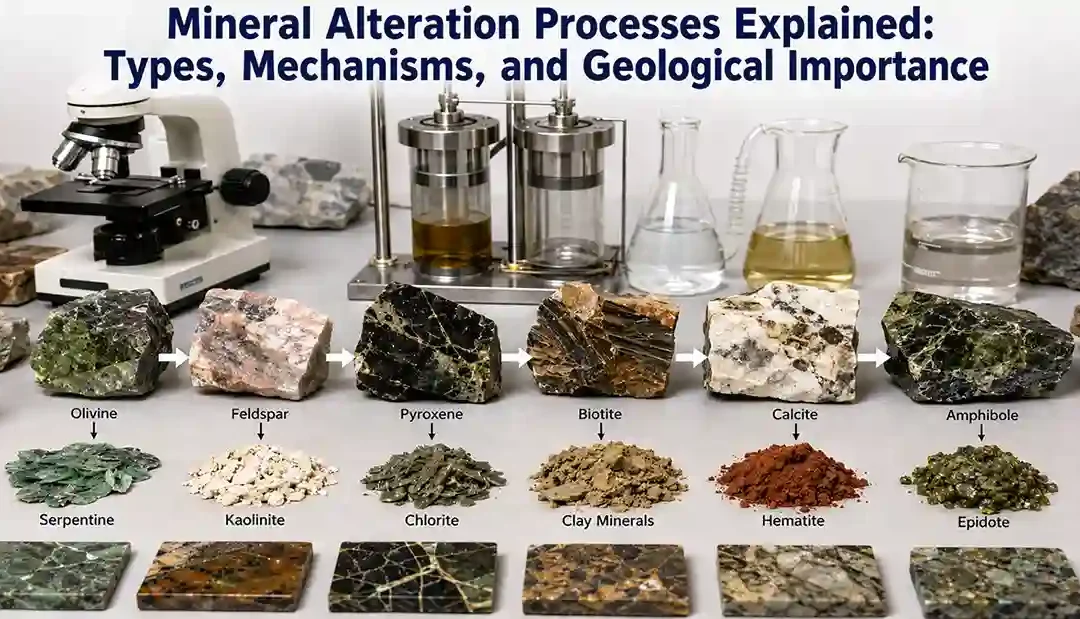
Mineral alteration is the process by which one mineral changes into another due to changes in temperature, pressure, fluid composition, or environmental conditions. Unlike simple physical weathering, alteration involves chemical reactions that modify a mineral's composition, crystal structure, or both. These transformations occur throughout Earth's crust and play a major role in rock evolution, ore deposit formation, hydrothermal systems, and weathering.
Mineral alteration is common in igneous, sedimentary, and metamorphic environments. Groundwater, hydrothermal fluids, atmospheric oxygen, carbon dioxide, and biological activity all contribute to altering minerals over geological time. For example, feldspar commonly alters to clay minerals, while olivine transforms into serpentine under suitable conditions.
Understanding alteration processes allows geologists to reconstruct geological history, identify ore-forming systems, evaluate engineering materials, and explore mineral resources.
This topic is closely related to Mineral Weathering, Mineral Stability, and Mineral Chemistry Analysis.
What Is Mineral Alteration?
Mineral alteration is the chemical or mineralogical transformation of an existing mineral into a new mineral or mineral assemblage.
Alteration may involve:
- Chemical reactions
- Dissolution
- Recrystallization
- Ion exchange
- Hydration
- Oxidation
The original mineral is gradually replaced or modified while maintaining or changing its crystal structure.
Why Does Mineral Alteration Occur?
Minerals become unstable when environmental conditions differ from those under which they originally formed.
Common causes include:
- Increasing temperature
- Changing pressure
- Hydrothermal fluids
- Groundwater
- Oxygen
- Carbon dioxide
- Biological activity
These factors drive chemical reactions that create new, more stable minerals.
Major Types of Mineral Alteration
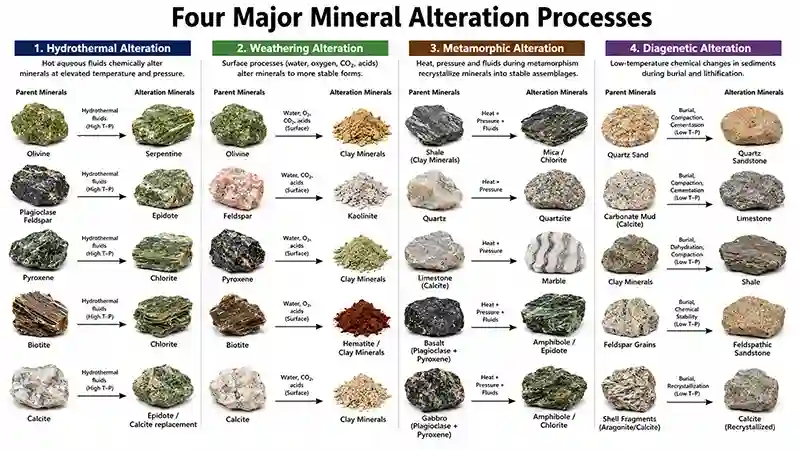
Several alteration processes occur naturally.
Hydrothermal Alteration
Hydrothermal alteration occurs when hot, chemically active fluids react with minerals.
Common alteration minerals include:
- Sericite
- Chlorite
- Epidote
- Quartz
- Calcite
- Kaolinite
Hydrothermal alteration is closely associated with many ore deposits.
Weathering Alteration
Weathering alters minerals through reactions with water, oxygen, and atmospheric gases.
Common products include:
- Clay minerals
- Iron oxides
- Dissolved ions
This process dominates near Earth's surface.
Metamorphic Alteration
Heat and pressure transform existing minerals into new minerals without melting the rock.
Examples include:
- Chlorite
- Garnet
- Kyanite
- Sillimanite
- Andalusite
These minerals indicate metamorphic conditions.
Diagenetic Alteration
Diagenesis occurs after sediment deposition.
Common changes include:
- Cementation
- Recrystallization
- Clay mineral formation
- Dolomitization
These processes modify sedimentary rocks during burial.
Common Alteration Mechanisms
Minerals alter through several chemical reactions.
Hydration
Water enters a mineral structure.
Example:
- Anhydrite → Gypsum
Hydrolysis
Water reacts with silicate minerals.
Example:
- Feldspar → Kaolinite
Oxidation
Iron-bearing minerals react with oxygen.
Examples:
- Magnetite → Hematite
- Pyrite → Iron oxides
Carbonation
Carbon dioxide reacts with minerals.
Examples:
- Olivine
- Pyroxene
- Calcite
Carbonation commonly forms carbonate minerals.
Dissolution
Minerals dissolve into groundwater.
Examples:
- Halite
- Gypsum
- Calcite
Common Mineral Alteration Examples
| Original Mineral | Alteration Product |
|---|---|
| Feldspar | Kaolinite |
| Olivine | Serpentine |
| Pyroxene | Chlorite |
| Amphibole | Chlorite, Epidote |
| Biotite | Chlorite |
| Magnetite | Hematite |
| Pyrite | Goethite, Limonite |
| Calcite | Dissolved Calcium or Recrystallized Calcite |
These transformations are common in geological environments worldwide.
Hydrothermal Alteration Zones
Hydrothermal systems often develop distinct alteration zones.
Common zones include:
- Potassic alteration
- Phyllic alteration
- Argillic alteration
- Advanced argillic alteration
- Propylitic alteration
These zones are widely used during mineral exploration because they often surround valuable ore deposits.
Alteration Minerals
Common alteration minerals include:
- Kaolinite
- Illite
- Smectite
- Sericite
- Chlorite
- Epidote
- Serpentine
- Hematite
- Goethite
- Calcite
These minerals provide important evidence of geological processes.
Importance in Ore Exploration
Mineral alteration is one of the most valuable exploration tools.
Geologists use alteration patterns to locate:
- Porphyry copper deposits
- Epithermal gold deposits
- Skarn deposits
- Volcanogenic massive sulfide deposits
Characteristic alteration minerals often indicate nearby mineralization.
Laboratory Methods for Studying Alteration
Scientists investigate alteration using:
- Petrographic Microscopy
- X-Ray Diffraction (XRD)
- Electron Microprobe Analysis (EPMA)
- Scanning Electron Microscopy (SEM)
- Raman Spectroscopy
- X-Ray Fluorescence (XRF)
These techniques identify both primary and secondary minerals.
Applications
Mineral alteration studies are important in:
- Mineralogy
- Petrology
- Economic geology
- Mining exploration
- Hydrothermal research
- Environmental geology
- Engineering geology
- Planetary geology
Advantages of Studying Mineral Alteration
Understanding alteration helps geologists:
- Interpret geological history
- Identify ore deposits
- Evaluate weathering
- Understand fluid-rock interactions
- Reconstruct metamorphic conditions
- Improve exploration programs
Limitations
Alteration processes are often complex because multiple reactions may occur simultaneously.
Interpretation should combine alteration studies with:
- Mineral Weathering
- Mineral Stability
- Mineral Chemistry Analysis
- Petrographic Microscopy
- X-Ray Diffraction in Mineralogy
- Electron Microprobe Analysis
- How to Identify Minerals
Using multiple analytical techniques provides the most reliable interpretation.
Comparison Table
| Alteration Type | Main Cause | Common Products |
| Hydrothermal | Hot Fluids | Sericite, Chlorite, Epidote |
| Weathering | Water & Atmosphere | Clay Minerals, Iron Oxides |
| Metamorphic | Heat & Pressure | Garnet, Chlorite, Kyanite |
| Diagenetic | Burial & Groundwater | Calcite, Dolomite, Clay Minerals |
Summary Table
| Feature | Mineral Alteration Processes |
| Main Concept | Transformation of Existing Minerals |
| Major Types | Hydrothermal, Weathering, Metamorphic, Diagenetic |
| Common Products | Clay Minerals, Chlorite, Serpentine, Hematite |
| Common Study Methods | XRD, EPMA, SEM, Petrographic Microscopy |
| Geological Importance | Ore Formation, Rock Evolution, Weathering |
Mineral alteration is the chemical transformation of one mineral into another due to changes in temperature, pressure, fluids, or environmental conditions.
The most common causes are hydrothermal fluids, groundwater, weathering, metamorphism, oxidation, hydration, and chemical reactions between minerals and fluids.
Hydrothermal alteration occurs when hot, chemically active fluids react with minerals, producing new minerals such as sericite, chlorite, epidote, and quartz.
Alteration helps geologists understand geological history, locate ore deposits, interpret fluid-rock interactions, and study weathering and metamorphism.
Common techniques include petrographic microscopy, X-ray diffraction (XRD), electron microprobe analysis (EPMA), scanning electron microscopy (SEM), Raman spectroscopy, and X-ray fluorescence (XRF).
Final Thoughts
Mineral alteration processes are fundamental to understanding how Earth's minerals respond to changing geological environments. Through weathering, hydrothermal activity, metamorphism, and diagenesis, primary minerals are transformed into new mineral assemblages that record the history of fluid circulation, temperature changes, pressure conditions, and chemical reactions.
By combining field observations with laboratory techniques such as petrographic microscopy, XRD, EPMA, SEM, and spectroscopy, geologists can accurately identify alteration minerals, reconstruct geological processes, and discover valuable mineral deposits. Mineral alteration remains one of the most important subjects in mineralogy, petrology, economic geology, and resource exploration.
Continue Learning
Continue exploring mineralogy with these related guides: