
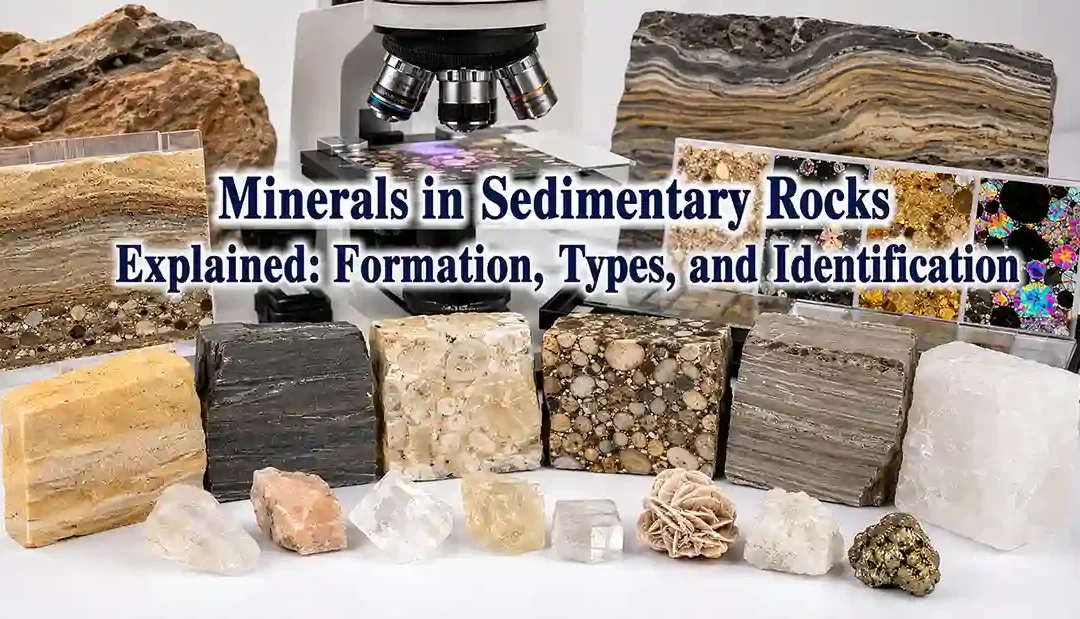
Sedimentary rocks form through the accumulation, transportation, deposition, and lithification of sediments or through the direct precipitation of minerals from water. Unlike igneous rocks that crystallize from magma, sedimentary rocks commonly contain minerals that have survived weathering, been transported by rivers, wind, glaciers, or oceans, or formed directly during chemical and biological processes.
The minerals present in sedimentary rocks provide valuable information about the source of the sediments, the depositional environment, climate, weathering intensity, and geological history. Quartz, feldspar, clay minerals, calcite, dolomite, gypsum, halite, and pyrite are among the most common sedimentary minerals.
Studying sedimentary minerals is essential in sedimentology, petroleum geology, environmental geology, hydrogeology, and economic geology.
This topic should be studied together with Mineral Weathering, and Mineral Stability.
What Are Minerals in Sedimentary Rocks?
Minerals in sedimentary rocks are the crystals and mineral grains that make up sedimentary deposits.
These minerals may originate from:
- Weathered igneous rocks
- Weathered metamorphic rocks
- Older sedimentary rocks
- Chemical precipitation
- Biological activity
Some minerals survive transportation, while others form after deposition.
How Do Sedimentary Minerals Form?
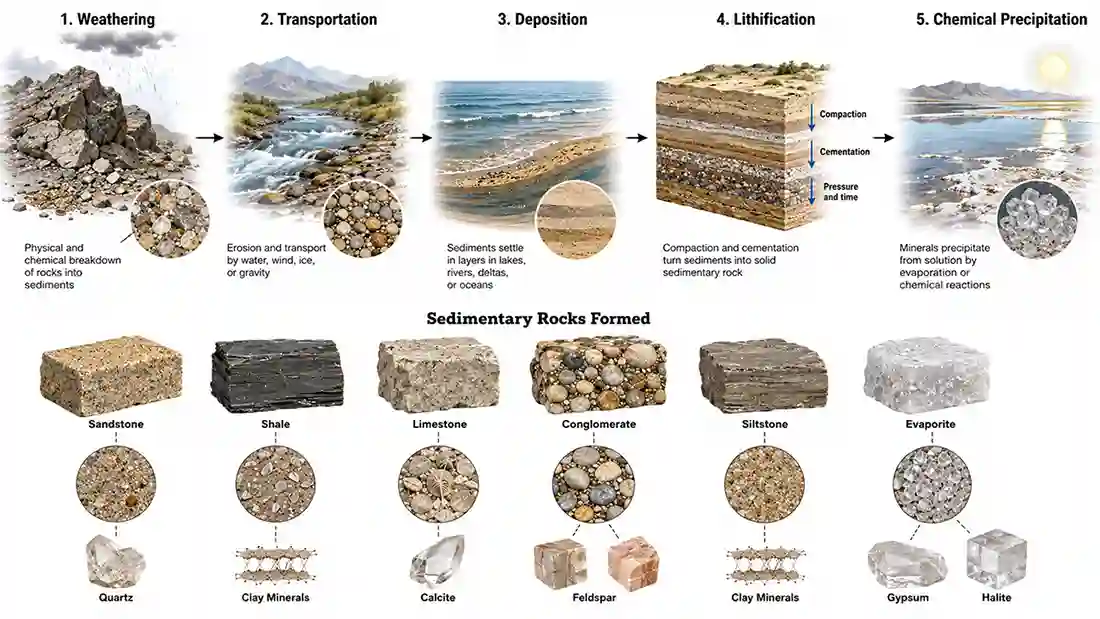
Sedimentary minerals form through several processes.
Weathering
Existing rocks break down into mineral grains.
Transportation
Water, wind, glaciers, and gravity transport sediments.
Deposition
Sediments accumulate in rivers, lakes, deserts, and oceans.
Lithification
Compaction and cementation convert loose sediments into sedimentary rock.
Chemical Precipitation
Some minerals crystallize directly from mineral-rich water.
Factors Affecting Mineral Composition
Several factors control which minerals occur in sedimentary rocks.
Source Rock
The parent rock determines the original mineral supply.
Weathering
Chemically unstable minerals are destroyed, while stable minerals survive.
Climate
Humid climates favor clay formation.
Arid climates promote evaporite minerals.
Transportation Distance
Long transport removes unstable minerals and enriches quartz.
Depositional Environment
Marine, river, lake, desert, and glacial environments produce different mineral assemblages.
Common Minerals in Sedimentary Rocks
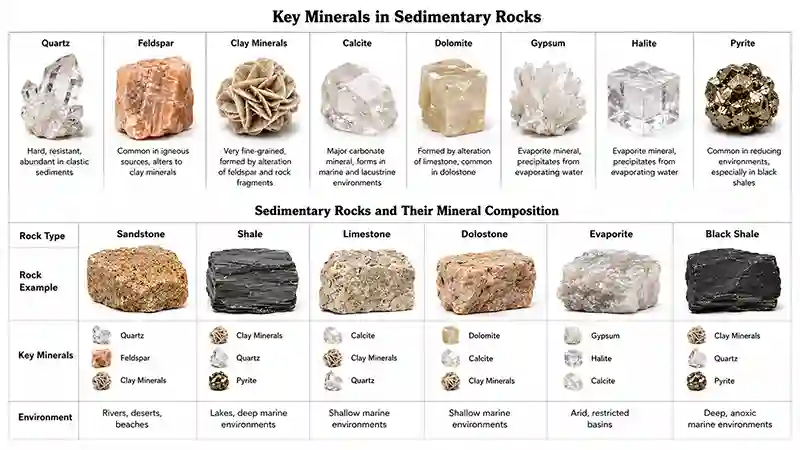
Quartz
Quartz is the most abundant detrital mineral in sedimentary rocks.
Characteristics:
- Very stable
- Hardness 7
- Resistant to weathering
- Common in mature sandstones
Quartz survives multiple cycles of erosion and deposition.
Feldspar
Feldspar is less stable than quartz.
Characteristics:
- Weathers to clay minerals
- Common in arkose sandstone
- Indicates limited weathering and short transport
Clay Minerals
Clay minerals form through chemical weathering.
Common types include:
- Kaolinite
- Illite
- Smectite
- Chlorite
Clay minerals dominate shale and mudstone.
Calcite
Calcite commonly forms through biological and chemical precipitation.
Common rocks:
- Limestone
- Chalk
Calcite also acts as a cement in many sandstones.
Dolomite
Dolomite forms through the alteration of limestone or direct precipitation.
Common rock:
- Dolostone
Gypsum
Gypsum forms by evaporation of saline water.
Common environments:
- Salt lakes
- Coastal lagoons
- Restricted marine basins
Halite
Halite is another important evaporite mineral.
Characteristics:
- Highly soluble
- Cubic crystals
- Forms in arid environments
Pyrite
Pyrite commonly develops in oxygen-poor sedimentary environments.
Typical environments:
- Black shale
- Coal beds
- Marine sediments
Accessory Minerals
Many sedimentary rocks contain small amounts of:
- Zircon
- Rutile
- Tourmaline
- Magnetite
- Garnet
- Monazite
These heavy minerals help determine sediment provenance.
Detrital vs Chemical Minerals
Sedimentary minerals are grouped into two major categories.
Detrital Minerals
Derived from pre-existing rocks.
Examples:
- Quartz
- Feldspar
- Zircon
- Garnet
- Magnetite
These minerals are transported as solid particles.
Chemical Minerals
Form by precipitation from solution.
Examples:
- Calcite
- Dolomite
- Gypsum
- Halite
- Chert
These minerals crystallize directly from water.
Minerals in Common Sedimentary Rocks
| Sedimentary Rock | Major Minerals |
|---|---|
| Sandstone | Quartz, Feldspar |
| Arkose | Feldspar, Quartz |
| Shale | Clay Minerals, Quartz |
| Limestone | Calcite |
| Dolostone | Dolomite |
| Conglomerate | Quartz, Feldspar, Rock Fragments |
| Gypsum Rock | Gypsum |
| Rock Salt | Halite |
| Chert | Microcrystalline Quartz |
Mineral Stability in Sedimentary Rocks
Mineral stability strongly influences sediment composition.
Highly stable minerals:
- Quartz
- Zircon
- Tourmaline
- Rutile
Less stable minerals:
- Feldspar
- Olivine
- Pyroxene
- Amphibole
This relationship follows the Goldich Stability Series.
Mineral Identification
Geologists identify sedimentary minerals using:
- Grain size
- Grain shape
- Color
- Hardness
- Cleavage
- Acid reaction
- Optical properties
- Chemical composition
Laboratory techniques include:
- Petrographic Microscopy
- X-Ray Diffraction (XRD)
- Electron Microprobe Analysis (EPMA)
- Scanning Electron Microscopy (SEM)
Importance of Minerals in Sedimentary Rocks
Studying sedimentary minerals helps geologists:
- Interpret depositional environments
- Reconstruct paleoclimate
- Determine sediment source areas
- Evaluate petroleum reservoirs
- Locate industrial minerals
- Understand weathering history
Mineral composition records Earth's surface processes over geological time.
Applications
Sedimentary minerals are important in:
- Sedimentology
- Petroleum geology
- Hydrogeology
- Environmental geology
- Economic geology
- Engineering geology
- Basin analysis
Advantages of Studying Sedimentary Minerals
Studying sedimentary minerals allows scientists to:
- Identify sediment sources
- Interpret ancient environments
- Understand weathering processes
- Evaluate groundwater reservoirs
- Explore mineral resources
- Improve geological mapping
Limitations
Mineral interpretation may be complicated because:
- Weathering alters original minerals.
- Diagenesis changes mineral composition.
- Cementation may obscure primary textures.
- Fine-grained rocks require laboratory analysis.
For comprehensive interpretation, combine sedimentary mineral studies with:
- Mineral Weathering
- Mineral Stability
- Petrographic Microscopy
- Mineral Grain Structure
- X-Ray Diffraction in Mineralogy
- Sedimentary Rocks Explained
- How to Identify Minerals
Comparison Table
| Mineral | Origin | Common Sedimentary Rocks |
| Quartz | Detrital | Sandstone |
| Feldspar | Detrital | Arkose |
| Clay Minerals | Weathering Product | Shale |
| Calcite | Chemical/Biological | Limestone |
| Dolomite | Chemical | Dolostone |
| Gypsum | Chemical (Evaporite) | Gypsum Rock |
| Halite | Chemical (Evaporite) | Rock Salt |
| Pyrite | Diagenetic | Black Shale |
Summary Table
| Feature | Minerals in Sedimentary Rocks |
| Main Formation Processes | Weathering, Deposition, Precipitation |
| Dominant Minerals | Quartz, Clay Minerals, Calcite |
| Major Categories | Detrital and Chemical |
| Common Study Methods | Petrography, XRD, SEM, EPMA |
| Geological Importance | Depositional Environment and Basin History |
The most common minerals are quartz, feldspar, clay minerals, calcite, dolomite, gypsum, halite, and pyrite.
Quartz is highly resistant to chemical weathering and mechanical abrasion, allowing it to survive long transport and repeated sedimentary cycles.
Detrital minerals are mineral grains eroded from pre-existing rocks and transported before being deposited in sedimentary environments.
Calcite, dolomite, gypsum, halite, and chert commonly form through direct precipitation from mineral-rich water.
They are identified using field observations, petrographic microscopy, X-ray diffraction (XRD), electron microprobe analysis (EPMA), and other laboratory techniques.
Final Thoughts
Minerals in sedimentary rocks provide valuable evidence of Earth's surface processes, from weathering and erosion to transportation, deposition, and diagenesis. Stable minerals such as quartz preserve records of long-distance transport, while chemically precipitated minerals like calcite, gypsum, and halite reveal ancient marine, lake, and evaporitic environments.
By combining mineral identification with petrographic microscopy, X-ray diffraction, geochemistry, and sedimentological analysis, geologists can reconstruct ancient environments, evaluate natural resources, and understand the evolution of sedimentary basins. Studying sedimentary minerals is fundamental to sedimentology, petroleum geology, environmental science, and economic geology.
Continue Learning
Continue exploring sedimentary geology with these related guides: