
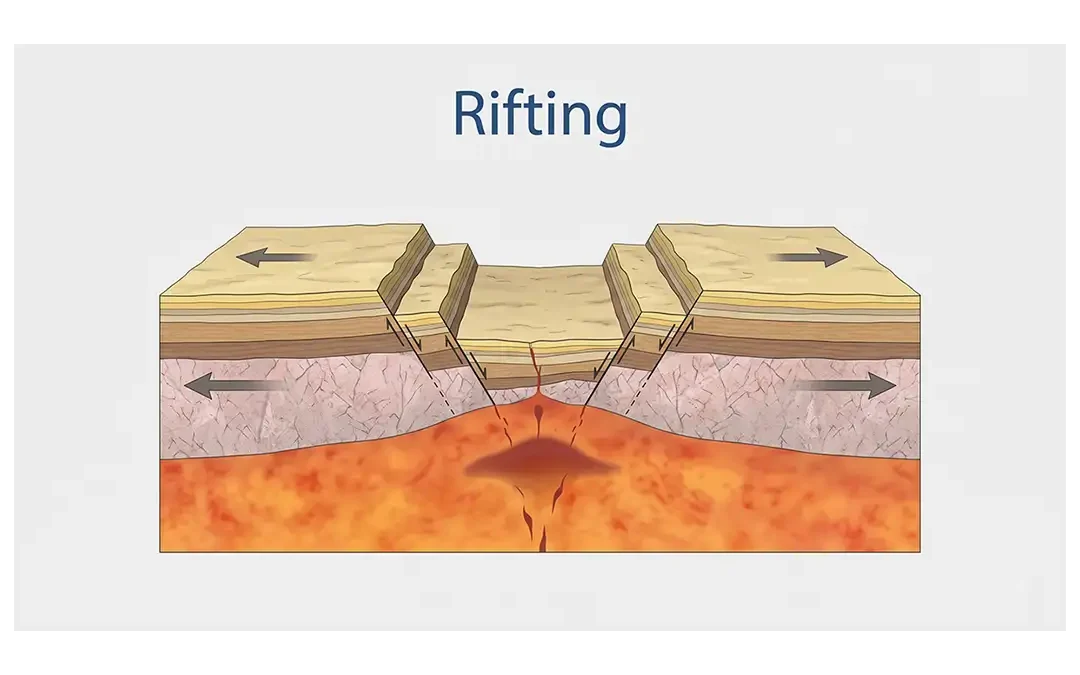
Rifting is a geological process in which the Earth's lithosphere is stretched and pulled apart. As the crust extends, it becomes thinner and may develop faults, earthquakes, volcanic activity, and elongated depressions called rift valleys. Rifting commonly occurs where tectonic plates move away from each other.
Rifting is especially important because prolonged continental rifting can eventually split a continent and lead to the formation of a new ocean basin. Understanding rifting helps explain continental breakup, divergent plate boundaries, earthquakes, volcanism, and the development of new oceanic crust.
What Is Rifting?
Rifting is the process by which the Earth's lithosphere undergoes horizontal extension, causing the crust to stretch, thin, and break along faults. It is mainly associated with tectonic forces that pull the crust apart.
When extension continues, normal faults commonly develop in the crust. Blocks of rock may move downward between these faults, creating elongated depressions known as rift valleys. Magma can also rise through fractures in the crust, producing volcanic activity.
Rifting can occur within continental crust or along oceanic regions. Continental rifting is particularly significant because continued extension can eventually lead to continental breakup and the development of a new ocean basin.
A rift refers to the geological zone or structure produced by this extensional activity, whereas rifting refers to the process itself.
What Causes Rifting?
Rifting develops when the lithosphere experiences extensional forces that cause it to stretch and thin. Several geological processes can contribute to this extension.
Tensional Forces
Tensional forces pull rocks apart. When these forces act on the lithosphere over a sufficiently large area, the crust can stretch and develop fractures and faults.
Plate Tectonics
Rifting is commonly associated with divergent plate boundaries, where tectonic plates move away from one another. As the plates separate, the lithosphere is extended and may eventually break apart.
Upwelling of Hot Mantle Material
Hot material from the mantle can rise toward the base of the lithosphere. This upwelling can contribute to heating, weakening, and uplift of the overlying crust. In some regions, it is associated with extensive volcanic activity and crustal extension.
Crustal Stretching and Thinning
As extension continues, the continental crust becomes thinner. Faulting accommodates some of this stretching, while the continued movement can eventually lead to major crustal breakup.
How Does Rifting Occur?
Rifting generally develops progressively rather than occurring as a single event. The process can be described through several stages.
1. Lithosphere begins to stretch:
Extensional forces act on the crust and cause it to deform.
2. Crust becomes thinner:
Continued stretching reduces the thickness of the continental crust.
3. Normal faults develop:
As the crust extends, normal faults form. Blocks of crust can move downward along these faults.
4. A rift valley or depression forms:
Faulting and downward movement can create a long, narrow depression within the continental crust.
5. Magma may rise through fractures:
As the crust becomes thinner and fractured, magma can move upward from the mantle. This can produce volcanic activity.
6. Continued extension may lead to ocean formation:
If rifting continues for a long period, continental crust can eventually split apart. New oceanic crust may then form between the separated continental blocks through seafloor spreading.
Thus, rifting can represent an early stage in the development of a new ocean basin.
Stages of Rifting
Rifting can be understood as a progressive sequence from initial stretching to possible continental breakup.
Initial Crustal Stretching
The process begins when extensional forces cause the continental lithosphere to stretch. At this stage, the crust may experience uplift, deformation, and the development of fractures and faults.
The amount of stretching can vary from one region to another. Some rifting systems may remain relatively limited, while others can continue toward complete continental breakup.
Development of Rift Valleys
As extension increases, normal faults become more prominent. Some blocks of crust move downward relative to neighboring blocks, creating elongated depressions.
These depressions may develop into rift valleys. Earthquakes are common because movement occurs along active faults.
Advanced Continental Rifting
During advanced rifting, the continental crust becomes increasingly thin and fractured. Volcanic activity may become more significant, particularly where magma rises through fractures.
The rift zone can widen as extension continues, separating the continental blocks on either side.
Breakup and Formation of a New Ocean Basin
If continental rifting continues far enough, the continental crust may eventually break apart. Once separation is established, magma can rise and solidify to form new oceanic crust.
Continued seafloor spreading can then create an ocean basin between the formerly connected continental regions.
Types of Rifting
Rifting can be broadly discussed in terms of where the extensional process occurs and what type of crust is involved.
Continental Rifting
Continental rifting occurs when continental lithosphere is stretched and begins to break apart. It commonly produces normal faults, rift valleys, earthquakes, and volcanic activity.
The East African Rift is a major modern example of continental rifting. If extension continues over geological time, continental rifting can eventually result in the formation of a new ocean basin.
Oceanic Rifting
Oceanic rifting occurs where oceanic lithosphere is pulled apart, particularly along divergent plate boundaries such as mid-ocean ridges.
At these locations, magma rises from the mantle and cools to form new oceanic crust. This process is closely associated with seafloor spreading.
Features Formed by Rifting
Rifting can produce a variety of geological features because stretching, faulting, earthquakes, and volcanism occur together in many rift systems.
Rift Valleys
Rift valleys are elongated depressions formed mainly through faulting and downward movement of crustal blocks. They are characteristic features of many continental rift systems.
Normal Faults
Normal faults develop when the crust is extended. The rock block above the fault plane moves downward relative to the block below it.
Horsts and Grabens
A graben is a relatively down-dropped block bounded by faults, while a horst is a relatively uplifted block between faults. Alternating horsts and grabens can create distinctive landscapes in areas affected by crustal extension.
Volcanic Features
Rifting can allow magma to rise through fractures in the crust. As a result, volcanic cones, lava flows, fissures, and other volcanic features may develop.
Earthquake Zones
Movement along faults within rift systems can generate earthquakes. Active continental rifts are therefore commonly associated with significant seismic activity.
New Ocean Basins
When continental rifting progresses to complete breakup, continued extension can lead to the development of new oceanic crust and eventually a new ocean basin.
Examples of Rifting Around the World
Several major geological regions provide examples of rifting and its effects.
East African Rift
The East African Rift is one of the world's most prominent examples of active continental rifting. The African continent is undergoing extension across a broad region, producing faulting, earthquakes, volcanic activity, and elongated valleys.
The system provides an important example of how continental lithosphere can be stretched and progressively deformed.
Red Sea Rift
The Red Sea represents a more advanced stage of continental breakup. Arabia and Africa are moving apart, and new oceanic crust has developed in parts of the Red Sea.
It demonstrates how continental rifting can transition toward seafloor spreading and the development of an ocean basin.
Mid-Atlantic Ridge
The Mid-Atlantic Ridge is a major divergent plate boundary where oceanic plates move apart. Magma rises and forms new oceanic crust, making it a major example of oceanic extension and seafloor spreading.
The ridge extends through the Atlantic Ocean and contributes to the gradual widening of the ocean basin.
Basin and Range Province
The Basin and Range Province in the western United States is a region characterized by extensive crustal stretching and normal faulting. The landscape contains numerous mountain ranges and intervening basins formed through long-term extension.
It provides an important example of continental crust undergoing significant deformation without necessarily progressing to complete continental breakup.
Rifting and Plate Tectonics
Rifting is closely connected to plate tectonics because it commonly occurs where the lithosphere experiences extension.
At divergent plate boundaries, tectonic plates move away from each other. This movement stretches the lithosphere and can produce rifting. In continental regions, the process may begin with crustal stretching and faulting before progressing toward continental breakup.
Rifting can also be influenced by processes occurring within the mantle. Hot mantle material may rise beneath an area of extension, contributing to melting and volcanic activity.
If continental rifting continues until the continent breaks apart, the separated blocks can become parts of different tectonic plates. Continued divergence may then produce new oceanic crust through seafloor spreading.
Rifting vs Continental Rifts
Although the terms rifting and continental rift are closely related, they do not mean exactly the same thing.
| Rifting | Continental Rift |
|---|---|
| A geological process | A geological region or structure |
| Involves stretching and extension of the lithosphere | Develops where continental crust is being stretched |
| Includes deformation, faulting, and crustal thinning | May contain rift valleys, faults, volcanoes, and earthquake zones |
| Describes what is happening | Describes the geological feature or zone |
In simple terms, rifting is the process, while a continental rift is the region where continental rifting occurs.
Rifting vs Seafloor Spreading
Rifting and seafloor spreading are related but distinct geological processes.
Rifting involves the stretching and separation of lithosphere. It can occur within continental crust during the early stages of continental breakup.
Seafloor spreading occurs when new oceanic crust forms as magma rises at a divergent oceanic boundary and solidifies.
Continental rifting can therefore precede seafloor spreading. If a continental rift continues until the continent breaks apart, the resulting boundary can develop into an oceanic spreading center.
Why Is Rifting Important?
Rifting is important because it plays a major role in the evolution of continents and oceans.
First, rifting helps explain continental breakup. Continents that are currently separated may once have been connected, and rifting is one of the processes responsible for their separation.
Second, rifting contributes to the formation of new ocean basins. When continental extension continues through complete breakup, new oceanic crust can develop between the separated continental blocks.
Rifting is also important for understanding earthquakes and volcanic activity. Normal faulting can produce earthquakes, while fractures in the crust can provide pathways for magma to reach the surface.
Finally, studying rifting provides valuable evidence for understanding plate tectonics, crustal deformation, mantle processes, and the long-term evolution of Earth's surface.
Rifting is the geological process in which the Earth's lithosphere is stretched and pulled apart. It can cause crustal thinning, normal faulting, earthquakes, volcanic activity, and eventually continental breakup.
Rifting is mainly caused by extensional or tensional forces that stretch the lithosphere. It is commonly associated with divergent plate movements and may also involve rising hot mantle material.
Rifting occurs in regions where the lithosphere is undergoing extension. Major examples include the East African Rift, the Red Sea region, and mid-ocean ridges.
During continental rifting, the crust stretches and becomes thinner. Normal faults develop, earthquakes and volcanic activity may occur, and a rift valley can form. Continued extension may eventually split the continent apart.
Rifting can produce rift valleys, fault scarps, grabens, horsts, volcanic features, and elongated basins. In advanced stages, it can contribute to the formation of new ocean basins.
Conclusion
Rifting is a major geological process involving the stretching and thinning of the Earth's lithosphere. It commonly develops when extensional forces pull the crust apart, leading to normal faulting, earthquakes, volcanic activity, and the formation of rift valleys.
Rifting can occur in several stages, beginning with crustal stretching and progressing through faulting and thinning to possible continental breakup. If extension continues after continental breakup, new oceanic crust can form through seafloor spreading, eventually producing a new ocean basin.
Examples such as the East African Rift, Red Sea, Mid-Atlantic Ridge, and Basin and Range Province demonstrate different aspects of crustal extension. By studying these regions, geologists can better understand plate tectonics, continental evolution, earthquakes, volcanism, and the formation of Earth's oceans.