
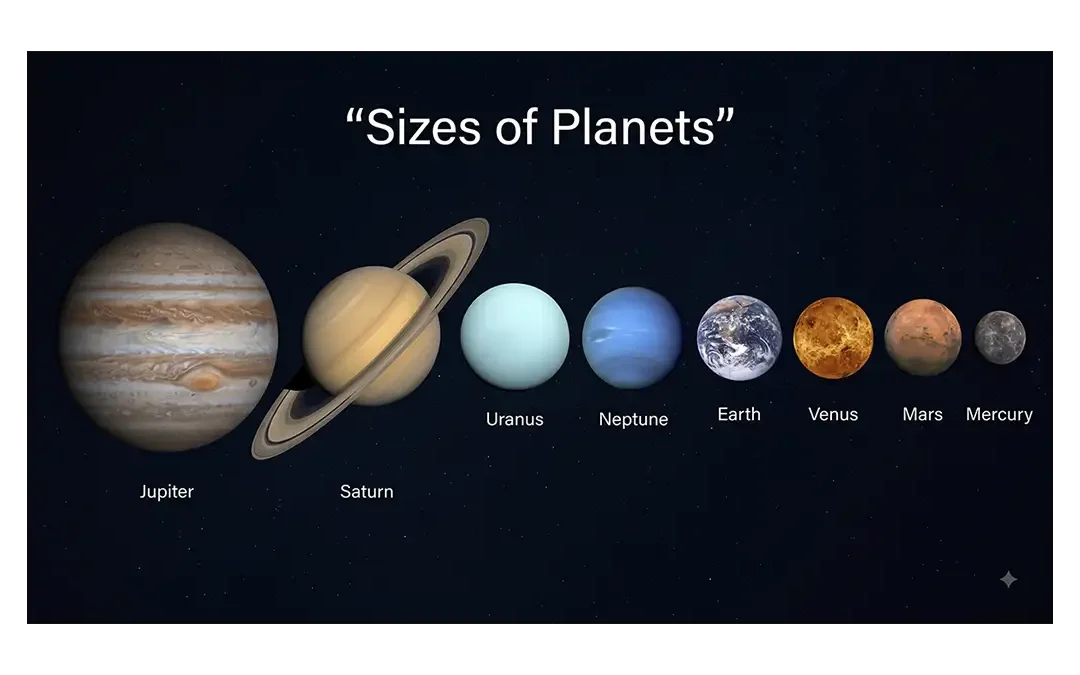
The sizes of planets vary greatly, from tiny Mercury to enormous Jupiter. Although all eight planets orbit the Sun, they are very different in diameter, volume, mass, and composition. Comparing their sizes helps us understand how different the planets are from one another.
In this guide, we will compare the eight planets from largest to smallest, look at their sizes relative to Earth, and explain why the planets have different sizes.
What Determines the Size of a Planet?
When we talk about the size of a planet, we can measure it in several ways, including diameter, radius, volume, and mass. For a simple size comparison, diameter is one of the easiest measurements to understand because it tells us how wide a planet is from one side to the other through its center.
Planetary size is closely related to how a planet formed and what materials it contains. The planets in our Solar System formed from material in the early disk of gas and dust around the young Sun. However, different regions of this disk had different conditions and available materials.
The inner planets—Mercury, Venus, Earth, and Mars—are relatively small and rocky. The outer giant planets—Jupiter, Saturn, Uranus, and Neptune—became much larger and accumulated large amounts of gas, ice, and other materials during their formation.
It is also important to distinguish size from mass. A planet can have a large diameter without being equally large in mass because its density and composition also matter. For example, Saturn is much larger than Earth but has a much lower average density.
Sizes of Planets in Order
The eight planets can be arranged from largest to smallest by diameter:
- Jupiter
- Saturn
- Uranus
- Neptune
- Earth
- Venus
- Mars
- Mercury
Here is a simple comparison using mean diameter values:
| Rank | Planet | Mean Diameter | Approx. Diameter Compared With Earth |
|---|---|---|---|
| 1 | Jupiter | 140,000 km | 10.9× |
| 2 | Saturn | 117,000 km | 9.1× |
| 3 | Uranus | 50,700 km | 4.0× |
| 4 | Neptune | 49,200 km | 3.9× |
| 5 | Earth | 12,756 km | 1× |
| 6 | Venus | 12,104 km | 0.95× |
| 7 | Mars | 6,779 km | 0.53× |
| 8 | Mercury | 4,879 km | 0.38× |
The exact values can vary slightly depending on whether a source uses mean diameter, equatorial diameter, or another measurement. The ranking itself remains the same. OpenStax provides mean planetary diameters and Earth-relative values that support this comparison.
The difference between the largest and smallest planets is enormous. Jupiter's mean diameter is about 29 times that of Mercury's.
Largest Planet: Jupiter
Jupiter is the largest planet in the Solar System. Its mean diameter is about 140,000 kilometers, making it nearly 11 times wider than Earth. NASA gives Jupiter a radius of about 69,911 kilometers and describes its diameter as about 11 times Earth's.
Jupiter is a gas giant, composed mainly of hydrogen and helium. Its enormous size comes from the large amount of material it accumulated during the formation of the Solar System.
Jupiter is also much more massive than Earth. Its mass is about 318 times Earth's mass, even though its diameter is about 11 times Earth's. This difference shows why diameter and mass should not be treated as the same measurement.
Jupiter's huge size makes it the clear largest planet, followed by Saturn.
Smallest Planet: Mercury
Mercury is the smallest of the eight planets. Its mean diameter is about 4,879 kilometers, which is only about 38% of Earth's diameter.
Mercury is a rocky planet and has a large metallic core relative to its overall size. It is also the smallest terrestrial planet. OpenStax identifies Mercury as the smallest planet, with a diameter of about 4,878 kilometers in its planetary data.
Although Mercury is much smaller than Earth, it is still a planet with a solid surface, a metallic core, and a thin exosphere.
NASA estimates Mercury's radius at about 2,440 kilometers, compared with Earth's radius of about 6,371 kilometers.
Planet Size Comparison With Earth
Earth provides a useful reference for understanding the sizes of planets. When Earth's diameter is treated as 1, the other planets can be compared with it.
Jupiter has a diameter about 10.9 times Earth's, while Saturn is about 9.1 times Earth's diameter. Uranus and Neptune are roughly four times Earth's diameter.
Earth and Venus are much closer in size. Venus has a mean diameter of about 12,104 kilometers, compared with Earth's 12,756 kilometers, so Venus is about 95% as wide as Earth.
Mars is considerably smaller, with a diameter of about 6,779 kilometers, or about 53% of Earth's diameter. Mercury is smaller still, at about 38% of Earth's diameter.
This comparison shows that the eight planets can be divided into two broad groups based on their physical characteristics: the smaller rocky planets and the much larger outer giant planets.
Why Are the Planets Different Sizes?
The planets are different sizes because they formed under different conditions and accumulated different amounts and types of material.
During the early formation of the Solar System, a disk of material surrounded the young Sun. As material came together through gravity, planetesimals and growing planetary bodies formed. The conditions varied with distance from the Sun, affecting what materials were available for planets to collect.
The four inner planets—Mercury, Venus, Earth, and Mars—formed in the hotter region closer to the Sun. They are primarily rocky and metallic and remained relatively small.
Farther from the Sun, the giant planets were able to accumulate much larger amounts of material. Jupiter and Saturn became gas giants dominated by hydrogen and helium, while Uranus and Neptune contain much larger proportions of heavier materials often described as ices in planetary science.
The amount of material a planet accumulated, its composition, and its formation history therefore all contributed to its final size.
Planet Size Comparison Chart
A simple largest-to-smallest comparison makes the differences easier to understand:
Jupiter → Saturn → Uranus → Neptune → Earth → Venus → Mars → Mercury
Sizes of the 8 planets
Mean diameter of the eight planets, arranged from largest to smallest.0km40,000km80,000km120,000km160,000kmJupiterSaturnUranusNeptuneEarthVenusMarsMercury
| Planet | Diameter |
|---|---|
| Jupiter | 140000 |
| Saturn | 117000 |
| Uranus | 50700 |
| Neptune | 49200 |
| Earth | 12756 |
| Venus | 12104 |
| Mars | 6779 |
| Mercury | 4879 |
Values based on mean planetary diameters from OpenStax Astronomy 2e.
The chart makes one point especially clear: Jupiter and Saturn are far larger than the four rocky planets. Earth and Venus are relatively close in size, while Mars and Mercury are substantially smaller. The underlying diameter data are consistent with OpenStax's planetary data table.
Jupiter is the largest planet in the Solar System, with a mean diameter of about 140,000 kilometers.
Mercury is the smallest of the eight planets, with a mean diameter of about 4,879 kilometers.
Yes. Earth has a mean diameter of about 12,756 kilometers, while Venus has a mean diameter of about 12,104 kilometers. Venus is therefore slightly smaller than Earth.
Jupiter's mean diameter is about 10.9 times Earth's diameter. NASA's radius figures also show Jupiter at roughly 11 times Earth's size by diameter.
Venus is the closest in size to Earth. Its mean diameter is about 95% of Earth's diameter.
Conclusion
The sizes of planets vary greatly, from the huge gas giants to the much smaller rocky planets. Jupiter is the largest planet, while Mercury is the smallest. Earth falls near the middle of the size ranking and is slightly larger than Venus.
Comparing planetary diameters makes these differences easier to understand. Jupiter is about 11 times wider than Earth, while Mercury is less than half the width of Earth. Venus is the planet most similar to Earth in size, while Mars is noticeably smaller.
These differences in size are related to how the planets formed and the materials they collected in the early Solar System. The inner planets are mainly rocky and metallic, while the outer giant planets accumulated much larger amounts of material.
Understanding planet sizes helps us see the great variety among the eight planets. From tiny Mercury to giant Jupiter, each planet has its own size, composition, and characteristics that make it an important part of our Solar System.