
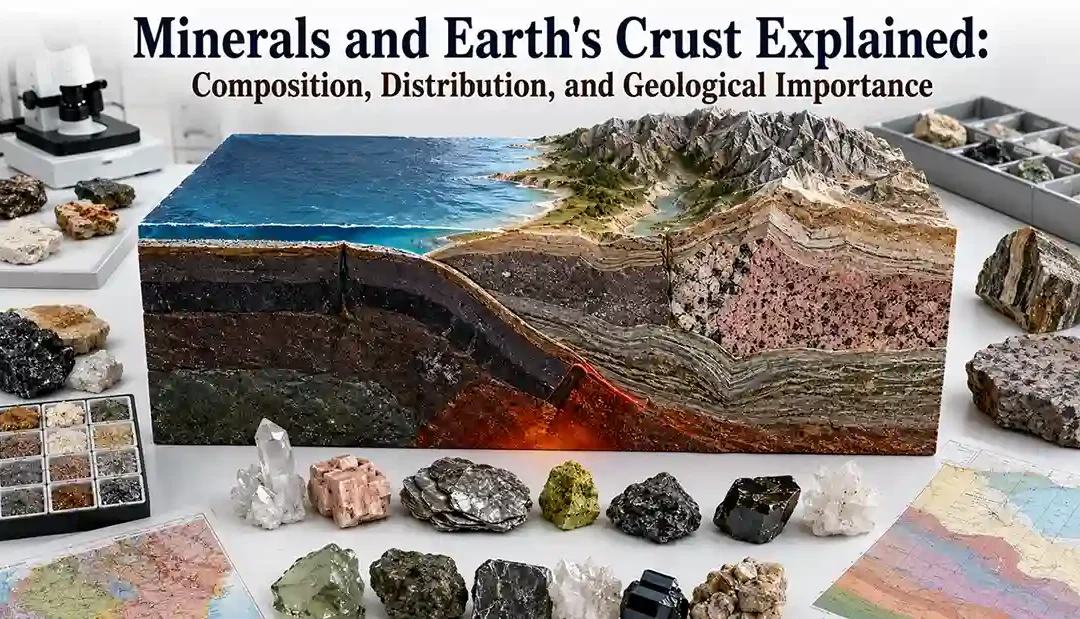
Earth's crust is the thin, outermost solid layer of our planet and contains an extraordinary variety of minerals that form the building blocks of rocks. Although more than 6,000 minerals have been identified, only a few dozen are considered rock-forming minerals because they make up nearly all of Earth's crust.
The composition of the crust varies between continents and ocean basins. Continental crust is dominated by silica-rich minerals such as quartz and feldspar, whereas oceanic crust is richer in iron- and magnesium-bearing minerals such as olivine, pyroxene, and plagioclase feldspar.
Understanding the distribution of minerals within Earth's crust helps geologists explain plate tectonics, mountain building, volcanic activity, weathering, mineral resources, and Earth's geological evolution.
What Is Earth's Crust?
Earth's crust is the outer solid shell of the planet.
It forms the upper part of the lithosphere and consists of:
- Igneous rocks
- Sedimentary rocks
- Metamorphic rocks
Its average thickness is:
- Continental crust: 30–70 km
- Oceanic crust: 5–10 km
Although it represents less than 1% of Earth's total volume, it contains nearly all economically important mineral resources.
What Are Rock-Forming Minerals?
Rock-forming minerals are minerals that make up most of Earth's crust.
The most abundant groups include:
- Feldspar
- Quartz
- Pyroxene
- Amphibole
- Mica
- Olivine
- Clay minerals
- Calcite
These minerals combine in different proportions to form thousands of rock types.
Chemical Composition of Earth's Crust
The crust consists primarily of eight chemical elements.
| Element | Approximate Abundance (%) |
|---|---|
| Oxygen (O) | 46.6 |
| Silicon (Si) | 27.7 |
| Aluminum (Al) | 8.1 |
| Iron (Fe) | 5.0 |
| Calcium (Ca) | 3.6 |
| Sodium (Na) | 2.8 |
| Potassium (K) | 2.6 |
| Magnesium (Mg) | 2.1 |
Together, oxygen and silicon account for nearly three-quarters of the crust and combine to form silicate minerals.
Major Mineral Groups in Earth's Crust
Most crustal minerals belong to the silicate group.
Major mineral groups include:
- Silicates
- Carbonates
- Oxides
- Sulfides
- Sulfates
- Halides
- Phosphates
- Native elements
Silicates alone account for roughly 90% of the crust by volume.
Most Abundant Minerals in Earth's Crust
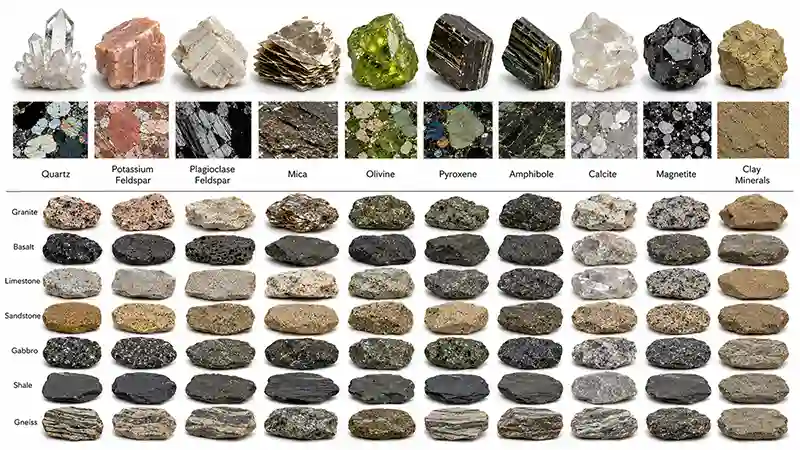
Feldspar
Feldspar is the most abundant mineral group in Earth's crust.
Characteristics:
- Approximately 50–60% of crustal rocks
- Includes plagioclase and potassium feldspar
- Major component of granite, basalt, and gabbro
Quartz
Quartz is one of the most common crustal minerals.
Characteristics:
- Hardness 7
- Chemically stable
- Resistant to weathering
Common rocks:
- Granite
- Quartzite
- Sandstone
Mica
Micas occur throughout continental crust.
Common varieties:
- Muscovite
- Biotite
Typical rocks:
- Granite
- Schist
- Gneiss
Pyroxene
Pyroxene dominates many mafic rocks.
Common rocks:
- Basalt
- Gabbro
Amphibole
Amphibole commonly occurs in intermediate and metamorphic rocks.
Examples:
- Diorite
- Amphibolite
Olivine
Olivine is abundant in the mantle and oceanic crust.
Common rocks:
- Peridotite
- Basalt
Calcite
Calcite dominates carbonate rocks.
Common rocks:
- Limestone
- Marble
Clay Minerals
Clay minerals form through weathering.
Examples:
- Kaolinite
- Illite
- Smectite
They dominate shale and many soils.
Accessory Minerals
Minor but important crustal minerals include:
- Zircon
- Magnetite
- Ilmenite
- Apatite
- Garnet
- Tourmaline
- Rutile
Although less abundant, these minerals are valuable for geochronology, geochemistry, and economic geology.
Continental Crust vs Oceanic Crust
The two main types of crust differ significantly.
Continental Crust
Characteristics:
- Thick
- Less dense
- Silica-rich
- Older
Dominant minerals:
- Quartz
- Potassium feldspar
- Plagioclase
- Mica
Common rocks:
- Granite
- Gneiss
- Schist
Oceanic Crust
Characteristics:
- Thin
- Dense
- Mafic composition
- Younger
Dominant minerals:
- Plagioclase feldspar
- Pyroxene
- Olivine
- Magnetite
Common rocks:
- Basalt
- Gabbro
Minerals in Different Rock Types
| Rock Type | Dominant Minerals |
| Granite | Quartz, Feldspar, Biotite |
| Basalt | Plagioclase, Pyroxene, Olivine |
| Gabbro | Plagioclase, Pyroxene |
| Sandstone | Quartz |
| Limestone | Calcite |
| Shale | Clay Minerals |
| Schist | Mica, Garnet |
| Gneiss | Quartz, Feldspar, Biotite |
Plate Tectonics and Crustal Minerals
Plate tectonics continually creates, destroys, and modifies crustal minerals.
Examples:
- Divergent boundaries generate basaltic crust.
- Convergent boundaries create granitic continental crust.
- Mountain building forms metamorphic minerals.
- Weathering produces clay minerals.
These processes constantly recycle crustal material.
Laboratory Identification
Scientists study crustal minerals using:
- Hand specimen identification
- Petrographic Microscopy
- X-Ray Diffraction (XRD)
- Electron Microprobe Analysis (EPMA)
- Scanning Electron Microscopy (SEM)
- Mineral Chemistry Analysis
These techniques reveal mineral composition, texture, and crystal structure.
Importance of Minerals in Earth's Crust
Studying crustal minerals helps geologists:
- Classify rocks
- Understand plate tectonics
- Reconstruct Earth's history
- Locate mineral resources
- Interpret weathering processes
- Explore groundwater reservoirs
These minerals provide the foundation for understanding Earth's geology.
Applications
Crustal mineral studies are important in:
- Mineralogy
- Petrology
- Economic geology
- Environmental geology
- Engineering geology
- Hydrogeology
- Geochemistry
- Planetary geology
Advantages of Studying Crustal Minerals
Studying crustal minerals allows scientists to:
- Understand Earth's evolution
- Identify economically valuable deposits
- Interpret geological environments
- Improve geological mapping
- Reconstruct tectonic history
- Evaluate natural resources
Limitations
Interpreting crustal mineral assemblages may be challenging because:
- Weathering alters original mineral compositions.
- Metamorphism may recrystallize minerals.
- Hydrothermal alteration can replace primary minerals.
- Laboratory analyses are often needed to identify fine-grained or altered minerals.
For comprehensive interpretation, combine crustal mineral studies with:
- Mineral Formation Explained
- Plate Tectonics and Minerals
- Minerals in Igneous Rocks
- Minerals in Sedimentary Rocks
- Minerals in Metamorphic Rocks
- Petrographic Microscopy
- Mineral Chemistry Analysis
Comparison Table
| Crust Type | Dominant Rocks | Common Minerals |
| Continental Crust | Granite, Gneiss | Quartz, Feldspar, Mica |
| Oceanic Crust | Basalt, Gabbro | Plagioclase, Pyroxene, Olivine |
Summary Table
| Feature | Minerals and Earth's Crust |
| Main Composition | Rock-Forming Minerals |
| Dominant Mineral Group | Silicates |
| Major Crust Types | Continental and Oceanic |
| Common Study Methods | Petrography, XRD, EPMA, SEM |
| Geological Importance | Earth's Structure and Mineral Resources |
Feldspar is the most abundant mineral group, followed by quartz, pyroxene, amphibole, mica, olivine, calcite, and clay minerals.
Silicate minerals dominate because oxygen and silicon are the two most abundant elements in Earth's crust, forming stable silicon-oxygen tetrahedra that make up most rock-forming minerals.
Continental crust is thicker, less dense, and richer in silica-bearing minerals such as quartz and potassium feldspar. Oceanic crust is thinner, denser, and dominated by plagioclase feldspar, pyroxene, and olivine.
Feldspar crystallizes over a wide range of temperatures and occurs in both felsic and mafic igneous rocks, making it the dominant mineral group in the crust.
Geologists use field observations together with petrographic microscopy, X-ray diffraction (XRD), electron microprobe analysis (EPMA), scanning electron microscopy (SEM), and mineral chemistry analysis.
Final Thoughts
The minerals that make up Earth's crust provide the foundation for every rock, landscape, and geological process on the planet. From quartz-rich continental crust to olivine-bearing oceanic crust, these minerals record the history of magma crystallization, plate tectonics, weathering, metamorphism, and sedimentation.
By combining mineral identification with petrographic microscopy, X-ray diffraction, mineral chemistry, and tectonic studies, geologists can better understand Earth's structure, discover mineral resources, and reconstruct the evolution of our planet. Studying minerals in Earth's crust remains fundamental to mineralogy, petrology, economic geology, and environmental science.
Continue Learning
Continue exploring Earth's geology with these related guides: