
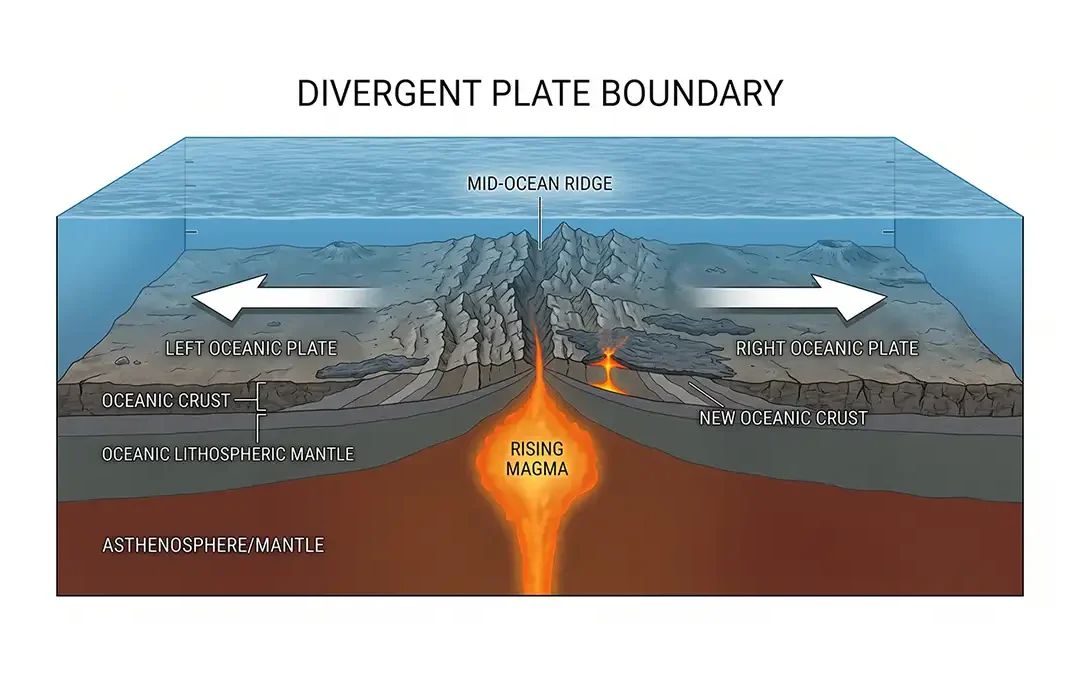
A divergent plate boundary is a region where two tectonic plates move away from each other. As the plates separate, hot material from the Earth's mantle rises toward the surface and can form new crust. This process plays an important role in plate tectonics, seafloor spreading, and the development of major geological features.
Most divergent plate boundaries occur beneath oceans, where they form long underwater mountain systems called mid-ocean ridges. They can also develop within continents, where stretching of the crust can create rift valleys. Understanding divergent plate boundaries helps explain how new crust forms and how Earth's surface changes over geological time.
What Is a Divergent Plate Boundary?
A divergent plate boundary is a tectonic boundary where two plates move away from one another. This movement creates space between the plates, allowing hot mantle material to rise and partially melt.
The rising magma can cool and solidify to form new oceanic crust. Because new crust forms at these boundaries, divergent boundaries are also called constructive plate boundaries.
Most divergent plate boundaries occur beneath oceans. However, they can also develop within continental crust when tectonic forces cause the land to stretch and break apart.
The movement at these boundaries is related to forces within the Earth's plate system, including processes in the mantle and the gravitational effects associated with elevated mid-ocean ridges and denser oceanic lithosphere.
How Do Divergent Plate Boundaries Form?
Divergent plate boundaries form when tectonic forces cause the Earth's lithosphere to stretch and move apart. As the plates separate, the crust becomes thinner and develops fractures and faults.
The reduction in pressure on the underlying mantle allows some mantle rock to melt. This process is called decompression melting. The resulting magma is less dense than the surrounding solid rock, so it rises toward the surface.
When the magma reaches the surface or cools beneath it, it solidifies and forms new igneous rock. At oceanic divergent boundaries, repeated magma activity creates new oceanic crust.
As the plates continue to move apart, newly formed crust moves away from the spreading center. This continuous process can operate for millions of years and gradually reshape ocean basins and continental regions.
Types of Divergent Plate Boundaries
Divergent plate boundaries mainly occur in two geological settings: oceanic divergent boundaries and continental divergent boundaries.
Oceanic Divergent Boundaries
Oceanic divergent boundaries occur where tectonic plates move apart beneath the ocean. Magma rises through the opening and cools to form new oceanic crust.
These boundaries commonly create mid-ocean ridges, which are long underwater mountain chains. The ridges can extend for thousands of kilometers across ocean basins.
As the plates continue to separate, newly formed crust moves away from the spreading center. This process is known as seafloor spreading.
The Mid-Atlantic Ridge is one of the best-known examples of an oceanic divergent boundary.
Continental Divergent Boundaries
Continental divergent boundaries develop when tectonic forces pull continental crust apart. The stretching causes the crust to become thinner and can produce numerous fractures and faults.
Over time, the region may develop a rift valley. If rifting continues, the continental crust can eventually split apart and a new ocean basin may begin to form.
The East African Rift is an important example of continental rifting. It provides an active setting where scientists can study the early stages of continental breakup.
Features of Divergent Plate Boundaries
A divergent plate boundary can produce several distinctive geological features. The exact features depend on whether the boundary occurs beneath an ocean or within a continent.
Common features include:
- Mid-ocean ridges
- Rift valleys
- Volcanic activity
- New crust formation
- Normal faults
- Hydrothermal vents
- Shallow earthquakes
At oceanic divergent boundaries, magma rising from the mantle cools and forms basaltic oceanic crust. Repeated volcanic activity gradually builds the elevated structure of a mid-ocean ridge.
In continental areas, stretching can produce a series of faults and lowered blocks of crust. These structures can eventually develop into large rift valleys.
Divergent boundaries can also support hydrothermal systems. Seawater can circulate through fractures in the hot crust, become heated, and return to the seafloor carrying dissolved minerals.
Divergent Plate Boundaries and Seafloor Spreading
Seafloor spreading is one of the most important processes associated with oceanic divergent plate boundaries.
At a spreading center, magma rises from the mantle and cools to form new oceanic crust. As additional magma reaches the spreading center, the newly formed crust moves away from the ridge.
This continuous process gradually pushes older oceanic crust farther from the spreading center.
Seafloor spreading provides important evidence for the theory of plate tectonics. Scientists can study the age, composition, and magnetic patterns of oceanic rocks to understand how the seafloor has formed and moved over geological time.
The youngest oceanic crust generally occurs near active spreading centers, while older oceanic crust occurs farther away from them.
Divergent vs. Convergent vs. Transform Boundaries
Earth's tectonic plates interact mainly through three types of plate boundaries: divergent, convergent, and transform.
A divergent plate boundary occurs where plates move apart. It commonly produces new crust through magma activity and seafloor spreading.
A convergent plate boundary occurs where plates move toward each other. Depending on the types of plates involved, convergence can produce subduction zones, mountain ranges, volcanic arcs, and deep ocean trenches.
A transform plate boundary occurs where two plates slide horizontally past one another. These boundaries commonly form faults and can produce earthquakes.
The main difference between these boundaries is the direction in which the tectonic plates move and the geological processes associated with that movement.
| Plate Boundary | Plate Movement | Common Features |
|---|---|---|
| Divergent | Plates move apart | Mid-ocean ridges, rift valleys, new crust |
| Convergent | Plates move toward each other | Mountains, trenches, subduction zones |
| Transform | Plates slide past each other | Faults and earthquakes |
Why Are Divergent Plate Boundaries Important?
Divergent plate boundaries are important because they continuously contribute to the formation and renewal of Earth's crust. They are major locations where material from the mantle becomes part of the lithosphere.
One of their most important roles is creating new oceanic crust. Through seafloor spreading, divergent boundaries help expand ocean basins and influence the movement of tectonic plates.
They also help shape Earth's surface. Oceanic divergent boundaries form extensive mid-ocean ridges, while continental rifting can produce valleys, faults, volcanoes, and eventually new ocean basins.
Divergent boundaries are also important for understanding the rock cycle and plate tectonics. The magma that rises at these boundaries cools to form igneous rocks, while the movement of newly formed crust contributes to the long-term recycling and transformation of Earth's materials.
In addition, divergent boundaries provide scientists with valuable evidence about how tectonic plates move and how Earth's crust has changed throughout geological history.
Examples of Divergent Plate Boundaries
Several important divergent plate boundaries occur around the world.
Mid-Atlantic Ridge
The Mid-Atlantic Ridge is one of the clearest examples of a divergent plate boundary. It extends through the Atlantic Ocean and separates several tectonic plates.
As the plates move apart, magma rises and forms new oceanic crust. This process contributes to the gradual widening of the Atlantic Ocean.
East African Rift
The East African Rift is an important example of continental rifting. Tectonic forces are gradually stretching and thinning parts of the African continent.
The region contains extensive faulting, volcanic activity, and elongated valleys. If the rifting continues over a sufficiently long geological period, the continental crust could eventually separate and allow a new ocean basin to develop.
Red Sea Rift
The Red Sea represents a region where continental separation has progressed toward oceanic spreading. The Arabian Plate is moving away from the African Plate, creating an active zone of extension.
The region provides an important example of how continental rifting can develop into a system with newly formed oceanic crust.
A divergent plate boundary is a region where two tectonic plates move away from each other. The separation allows mantle material to rise, and the resulting magma can form new crust.
Most divergent plate boundaries occur beneath oceans along mid-ocean ridges. They can also occur within continents where tectonic forces cause the crust to stretch and rift.
Divergent plate boundaries can form new oceanic crust, mid-ocean ridges, rift valleys, volcanic features, normal faults, and hydrothermal systems.
Yes. The Mid-Atlantic Ridge is a major divergent plate boundary where tectonic plates move apart and new oceanic crust forms.
Yes. At oceanic divergent boundaries, rising magma cools and solidifies to form new oceanic crust. This process is known as seafloor spreading.
Conclusion
A divergent plate boundary is a region where tectonic plates move away from each other. This movement allows hot mantle material to rise, partially melt, and contribute to the formation of new crust.
Oceanic divergent boundaries commonly produce mid-ocean ridges and drive seafloor spreading, while continental divergent boundaries can create rift valleys and may eventually lead to the formation of new ocean basins. Examples such as the Mid-Atlantic Ridge, East African Rift, and Red Sea demonstrate how divergent tectonic activity shapes Earth's surface.
Divergent plate boundaries are therefore an important part of the plate tectonic system. They help create new crust, expand ocean basins, form major geological features, and provide valuable evidence for understanding how Earth's lithosphere changes over geological time.