
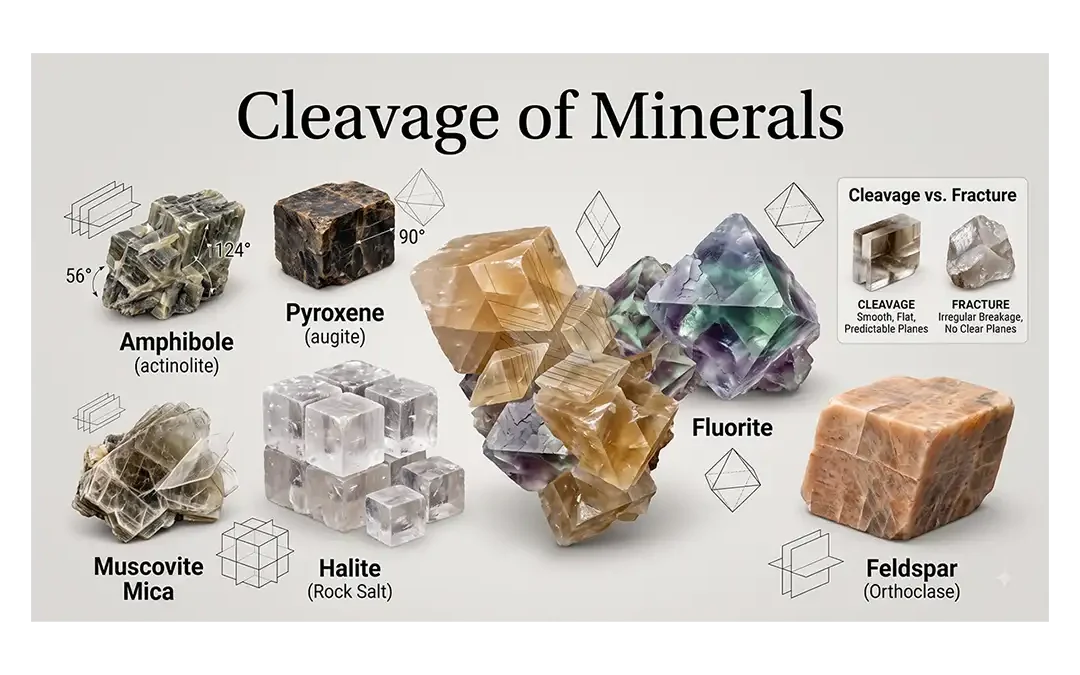
Cleavage of minerals is an important physical property that describes how a mineral breaks along specific planes of weakness within its crystal structure. When a mineral has cleavage, it tends to split or break in a predictable direction, producing relatively smooth and flat surfaces.
Mineral cleavage is useful for identifying minerals because different minerals have different numbers, directions, and qualities of cleavage. For example, mica commonly splits into thin sheets along one direction, while halite breaks along three directions to produce cubic pieces. Understanding cleavage also helps explain how the internal arrangement of atoms and the strength of chemical bonds influence the way minerals break.
What Is Cleavage of Minerals?
Cleavage of minerals is the tendency of a mineral to break along one or more specific planes within its crystal structure. These planes are called cleavage planes. They generally form where the bonds between atoms are weaker than the bonds in other directions.
When a mineral is broken, it may split repeatedly along these planes and produce relatively smooth, flat surfaces. The direction and number of cleavage planes depend mainly on the mineral's internal atomic arrangement.
For example, mica has cleavage in one direction, allowing it to separate into thin, flexible sheets. Halite has three directions of cleavage that meet at right angles, causing it to break into roughly cubic pieces.
Cleavage should not be confused with the external shape of a crystal. A crystal may have well-developed faces, but cleavage describes how the mineral breaks when subjected to force.
Why Does Cleavage Occur in Minerals?
Cleavage occurs because atoms within a mineral are arranged in an organized crystal structure. The atoms are held together by chemical bonds, but these bonds are not always equally strong in every direction.
Some planes within the crystal have weaker bonding than others. When enough force is applied, the mineral tends to break along these weaker planes. The resulting surfaces are called cleavage surfaces.
The type of chemical bonding and the arrangement of atoms strongly influence cleavage. A mineral with a regular arrangement of weaker bonding planes may have very distinct cleavage, while another mineral may have no cleavage if there are no preferred planes of weakness.
For this reason, cleavage provides useful information about the internal structure of a mineral even though the crystal structure cannot normally be seen directly.
Types of Mineral Cleavage
Mineral cleavage can be described according to the orientation of the cleavage planes and the shape they produce. Common types include basal, cubic, octahedral, dodecahedral, and prismatic cleavage.
Basal Cleavage
Basal cleavage occurs when a mineral breaks easily along planes that are roughly parallel to the base of its crystal structure. This type of cleavage is commonly associated with minerals that have layered structures.
Mica is a well-known example. It has one excellent direction of cleavage and can be split into thin sheets.
Cubic Cleavage
Cubic cleavage occurs when cleavage planes intersect at approximately right angles, producing cubic fragments.
Halite and galena are common examples. When these minerals break along their cleavage planes, the resulting surfaces commonly meet at angles of about 90 degrees.
Octahedral Cleavage
Octahedral cleavage occurs when a mineral breaks along planes that produce an octahedral arrangement.
Fluorite is a common example. Diamond also has octahedral cleavage, although its exceptional hardness makes its cleavage behavior different from that of many softer minerals.
Dodecahedral Cleavage
Dodecahedral cleavage is associated with cleavage planes arranged in a pattern related to a dodecahedral form.
Sphalerite is a commonly cited example of a mineral showing this type of cleavage.
Prismatic Cleavage
Prismatic cleavage occurs when cleavage planes are oriented parallel or approximately parallel to the length of a prismatic crystal.
Amphiboles and pyroxenes are important examples. Their cleavage directions and the angles between those directions can help distinguish the two mineral groups.
How Is Mineral Cleavage Classified?
Mineral cleavage can be classified in several ways. Two important characteristics are the number and orientation of cleavage directions and the quality or perfection of cleavage.
The number of cleavage directions refers to how many distinct sets of parallel planes along which the mineral can break. The angles between these directions can also be useful for identification. Cleavage can also vary from very easy and well-developed to weak or difficult to observe.
Perfect Cleavage
Perfect cleavage means that a mineral breaks very easily and repeatedly along a specific plane or planes. The resulting surfaces are usually smooth and clearly visible.
Mica is a classic example of very strong cleavage in one direction.
Good Cleavage
Good cleavage means that a mineral commonly breaks along specific planes, but the cleavage may not be as easily developed as perfect cleavage.
The cleavage surfaces are generally recognizable, although other types of breakage may also occur.
Poor or Imperfect Cleavage
Poor or imperfect cleavage means that cleavage planes are less obvious and the mineral does not break as easily along them.
In these minerals, it may be necessary to examine several surfaces carefully to identify the cleavage.
How to Identify Cleavage in Minerals
Distinguishing cleavage from crystal faces or random fractures takes practice. Follow these systematic steps when inspecting a hand sample in the field or laboratory:
Compare Cleavage with Other Physical Properties: Verify your observation by testing the sample's hardness, streak, and luster. Ensure you are not confusing a natural, grown crystal face (which occurs only on the outside of an unbroken crystal) with an internal cleavage plane (which appears on broken interior surfaces).
Look for Smooth, Flat Surfaces: Hold the mineral specimen under a direct light source (like sunlight or a desk lamp) and tilt it slowly. Look for flat, shiny surfaces that catch the light simultaneously like tiny mirrors.
Identify Repeated Breakage Planes: Observe whether these flat surfaces repeat across the sample in a series of parallel "steps" or staircases. True cleavage planes repeat internally throughout the mineral's volume.
Count Cleavage Directions: Determine how many unique spatial orientations those parallel planes have. Remember that two opposite, parallel flat sides represent one single cleavage direction.
Observe Angles Between Cleavage Planes: If the sample exhibits two or more cleavage directions, look closely at where those planes meet. Determine whether they intersect at right angles (90°) or at oblique angles, such as 60° or 120°.
Examine the Mineral from Different Angles: Rotate the specimen fully in three dimensions. What looks like a single flat surface from the top might reveal a multi-directional geometric pattern when viewed from the side.
Common Minerals and Their Cleavage
Different minerals show different cleavage patterns. Some of the most useful examples include mica, feldspar, calcite, halite, galena, pyroxene, amphibole, and fluorite.
| Mineral | Cleavage | Typical Character |
|---|---|---|
| Mica | One direction | Splits into thin sheets |
| Feldspar | Two directions | Cleavage planes meet at nearly 90° |
| Calcite | Three directions | Produces rhombohedral fragments |
| Halite | Three directions | Produces cubic fragments |
| Galena | Three directions | Produces cubic cleavage surfaces |
| Pyroxene | Two directions | Cleavage planes meet at nearly 90° |
| Amphibole | Two directions | Cleavage planes meet at about 60° and 120° |
| Fluorite | Four directions | Produces an octahedral pattern |
Mica is especially easy to recognize because it can separate into thin sheets.
Feldspar has two cleavage directions that meet at approximately right angles. This is one of its useful identification features.
Calcite has three cleavage directions that produce distinctive rhombohedral fragments.
Halite has three cleavage directions at right angles, giving broken pieces a cubic appearance.
Galena also has three directions of cleavage and commonly produces cubic forms.
Pyroxene and amphibole both commonly have two cleavage directions, but their cleavage angles differ. Pyroxene generally has angles close to 90 degrees, whereas amphibole commonly has angles of about 60 and 120 degrees.
Fluorite has four directions of cleavage and commonly breaks into octahedral forms.
Cleavage vs Fracture in Minerals
Cleavage and fracture both describe how minerals break, but they are different physical properties.
What Is Fracture?
Fracture is the way a mineral breaks when it does not follow a specific cleavage plane. Instead of producing repeated, predictable flat surfaces, the broken surface may be irregular, curved, uneven, or otherwise distinctive.
Quartz is a well-known example because it lacks cleavage and commonly shows conchoidal fracture, which produces curved, shell-like surfaces.
Key Differences Between Cleavage and Fracture
| Feature | Cleavage | Fracture |
| Breakage | Occurs along specific planes | Does not follow specific cleavage planes |
| Surface | Usually smooth and relatively flat | May be uneven, curved, or irregular |
| Relationship to structure | Controlled by crystal structure and weaker bonding planes | Occurs where no cleavage plane controls the break |
| Example | Mica | Quartz |
The easiest way to remember the difference is that cleavage produces predictable planes of breakage, while fracture produces breakage that does not follow cleavage planes.
A mineral can also show both cleavage and fracture. For example, a mineral may preferentially break along cleavage planes but fracture when the applied force does not favor those planes.
Why Is Cleavage Important for Mineral Identification?
Cleavage is one of the most useful physical properties for identifying minerals. Many minerals can have similar colors or lusters, so cleavage can provide an additional and often more reliable clue.
For example, the cleavage of feldspar helps distinguish it from quartz. Both minerals are common in rocks and can sometimes appear similar, but feldspar has two prominent cleavage directions while quartz lacks cleavage.
Cleavage can also help distinguish pyroxene from amphibole. Both mineral groups commonly have two cleavage directions, but the angles between their cleavage planes are different.
In geology and mineralogy, cleavage is therefore used together with other properties such as hardness, streak, luster, color, crystal form, and specific gravity.
Cleavage is also important because it provides information about the internal structure of a mineral. By observing how a mineral breaks, geologists can gain clues about the arrangement and bonding of atoms within its crystal structure.
Cleavage of minerals is the tendency of a mineral to break along specific planes of weakness within its crystal structure. These planes produce relatively smooth and predictable surfaces.
Cleavage is mainly caused by differences in the strength and arrangement of chemical bonds within a mineral's crystal structure. Minerals tend to break along planes where bonding is relatively weaker.
Common types include basal, cubic, octahedral, dodecahedral, and prismatic cleavage. These types describe the orientation and arrangement of cleavage planes within a mineral.
Mica is a well-known example of a mineral with very strong or perfect cleavage in one direction. It can split into thin sheets along its cleavage plane.
Cleavage occurs when a mineral breaks along specific, predictable planes. Fracture occurs when a mineral breaks without following a cleavage plane and may produce irregular, curved, or uneven surfaces.
Conclusion
Cleavage of minerals is an important physical property that describes how minerals break along specific planes within their crystal structure. It develops because chemical bonds are not equally strong in every direction, creating planes where breakage occurs more easily.
Mineral cleavage can occur in different patterns, including basal, cubic, octahedral, dodecahedral, and prismatic cleavage. The number, direction, angle, and quality of cleavage can provide valuable clues for mineral identification.
Understanding cleavage also helps distinguish minerals from one another and separate cleavage from fracture. When combined with properties such as hardness, luster, streak, color, and crystal form, cleavage becomes a powerful tool for identifying minerals in geology and mineralogy.