
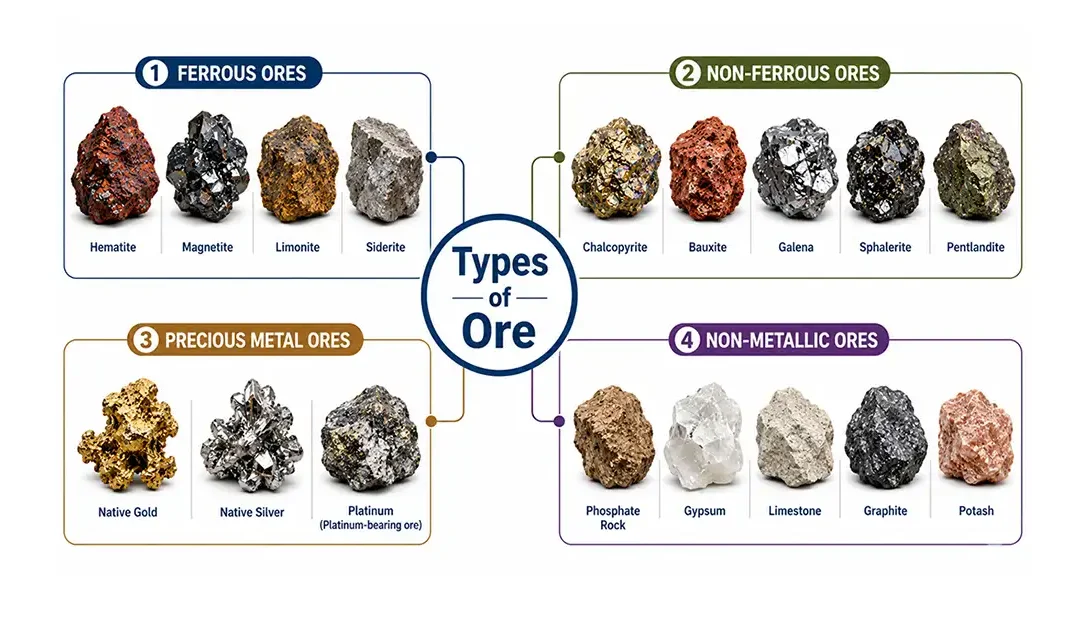
From the steel used in skyscrapers to the copper inside electrical wiring, different types of ore supply the raw materials that power modern civilization. However, not all ores are the same. Geologists classify ores based on their metal content, mineral composition, geological origin, and economic value. This classification helps scientists understand how ore deposits form, while enabling mining companies to choose the most efficient methods for extraction and processing.
Types of Ore
Walk into any mining museum, and you'll quickly notice that ore exists in many different forms. Mining companies extract metals from some rocks, while they mine others for industrial minerals used in agriculture, construction, and manufacturing. Because ore varies so widely, geologists classify it in several ways. They most commonly group ores according to the type of valuable material each one contains.
Geologists broadly divide ores into two main categories: metallic ores and non-metallic ores. Mining and processing operations extract metals such as iron, copper, and gold from metallic ores. In contrast, industries mine non-metallic ores for valuable industrial minerals, which they use directly or process only slightly before use.
Metallic Ores
Metallic ores are rocks or minerals that contain metals in concentrations high enough to be extracted economically. These ores supply the raw materials needed to manufacture everything from skyscrapers and vehicles to electrical equipment and electronic devices.
Based on the type of metal they contain, metallic ores are commonly grouped into three categories.
Ferrous Ores
Ferrous ores contain iron as their primary valuable metal. Because iron is the main ingredient in steel production, ferrous ores are among the most heavily mined mineral resources in the world.
Some of the most important ferrous ores include:
- Hematite (Fe₂O₃) – The world's most important iron ore because of its high iron content and relatively easy processing.
- Magnetite (Fe₃O₄) – A naturally magnetic mineral with one of the highest iron concentrations among iron ores.
- Limonite (FeO(OH)·nH₂O) – A hydrated iron oxide commonly found in weathered deposits.
- Siderite (FeCO₃) – An iron carbonate mineral that occurs mainly in sedimentary environments.
These ores are the backbone of the global steel industry, supporting construction, transportation, machinery, and infrastructure development.
Non-Ferrous Ores
Non-ferrous ores contain valuable metals other than iron. Many of these metals are lightweight, corrosion-resistant, or highly conductive, making them essential in modern engineering and technology.
Some common non-ferrous ores include:
| Ore Mineral | Main Metal | Common Uses |
|---|---|---|
| Chalcopyrite | Copper | Electrical wiring, electronics |
| Bauxite | Aluminum | Aircraft, packaging, construction |
| Galena | Lead | Batteries, radiation shielding |
| Sphalerite | Zinc | Galvanized steel, alloys |
| Pentlandite | Nickel | Stainless steel, rechargeable batteries |
As demand for electric vehicles and renewable energy grows, non-ferrous ores have become increasingly important because they supply many of the metals used in batteries, power grids, and clean energy technologies.
Precious Metal Ores
Precious metal ores contain rare metals that are highly valued because of their scarcity, beauty, and unique physical properties.
Common examples include:
- Gold ore
- Silver ore
- Platinum ore
Besides jewelry and investment, these metals are widely used in electronics, medical devices, aerospace technology, and scientific instruments due to their excellent conductivity and resistance to corrosion.
Non-Metallic Ores
Unlike metallic ores, non-metallic ores are mined not for metals, but for the valuable minerals they contain. These minerals are essential in industries such as agriculture, construction, ceramics, chemicals, and manufacturing.
Important examples include:
- Phosphate rock – Used to produce agricultural fertilizers.
- Potash – A major source of potassium for crop production.
- Gypsum – Used in plaster, drywall, and cement.
- Limestone – An essential raw material for cement and lime production.
- Fluorite – Used in the chemical and metallurgical industries.
- Graphite – Used in lubricants, batteries, pencils, and refractory materials.
Although they don't produce metals, these ores are just as important to modern society as metallic ores.
Ore Classification Based on Formation
Geologists often classify ores according to how they formed, especially during mineral exploration. Understanding the origin of an ore deposit helps scientists predict where similar deposits may occur.
Major formation-based ore types include:
- Magmatic ores – Formed as minerals crystallize from cooling magma.
- Hydrothermal ores – Produced when hot, mineral-rich fluids deposit metals within fractures and surrounding rocks.
- Sedimentary ores – Formed through sediment accumulation, chemical precipitation, or biological processes.
- Metamorphic ores – Created or modified by heat and pressure acting on existing rocks.
- Residual ores – Produced when weathering removes less resistant materials, leaving valuable minerals concentrated near the surface.
Each of these geological environments produces distinctive ore deposits that require different exploration and mining techniques.
Summary of Ore Types
| Ore Type | Primary Resource | Typical Examples |
|---|---|---|
| Ferrous Ore | Iron | Hematite, Magnetite, Limonite, Siderite |
| Non-Ferrous Ore | Copper, Aluminum, Lead, Zinc, Nickel | Chalcopyrite, Bauxite, Galena, Sphalerite, Pentlandite |
| Precious Metal Ore | Gold, Silver, Platinum | Native Gold, Native Silver, Platinum-bearing ores |
| Non-Metallic Ore | Industrial minerals | Phosphate, Gypsum, Limestone, Graphite, Potash |
| Formation-Based Ore | Classified by geological origin | Magmatic, Hydrothermal, Sedimentary, Metamorphic, Residual |
Conclusion
Understanding the different types of ore helps students, geologists, mineralogists, and mining professionals identify and evaluate Earth's valuable mineral resources. Geologists classify ores based on several factors, including metal content, geological formation, economic value, and industrial use. Metallic ores supply valuable metals such as iron, copper, aluminum, and gold, while non-metallic ores provide essential industrial minerals for construction, agriculture, and manufacturing. Unique geological processes create each type of ore, and these resources support modern infrastructure, advanced technology, and renewable energy systems. As global demand for mineral resources continues to rise, geologists rely on ore classification to discover new deposits, improve exploration strategies, and promote more efficient and sustainable resource development.
The most important iron ores are hematite (Fe₂O₃) and magnetite (Fe₃O₄). Together, they supply most of the iron used in steel production worldwide.
Copper, nickel, lithium, cobalt, graphite, and rare earth element ores are essential for manufacturing batteries, electric vehicles, wind turbines, and solar energy systems.
Ore classification helps geologists understand how mineral deposits form, assists mining companies in selecting appropriate extraction methods, and improves the efficient use of Earth's mineral resources.
Ferrous ores contain iron and are primarily used to produce steel. Non-ferrous ores contain little or no iron and are mined for metals such as copper, aluminum, lead, zinc, and nickel.