
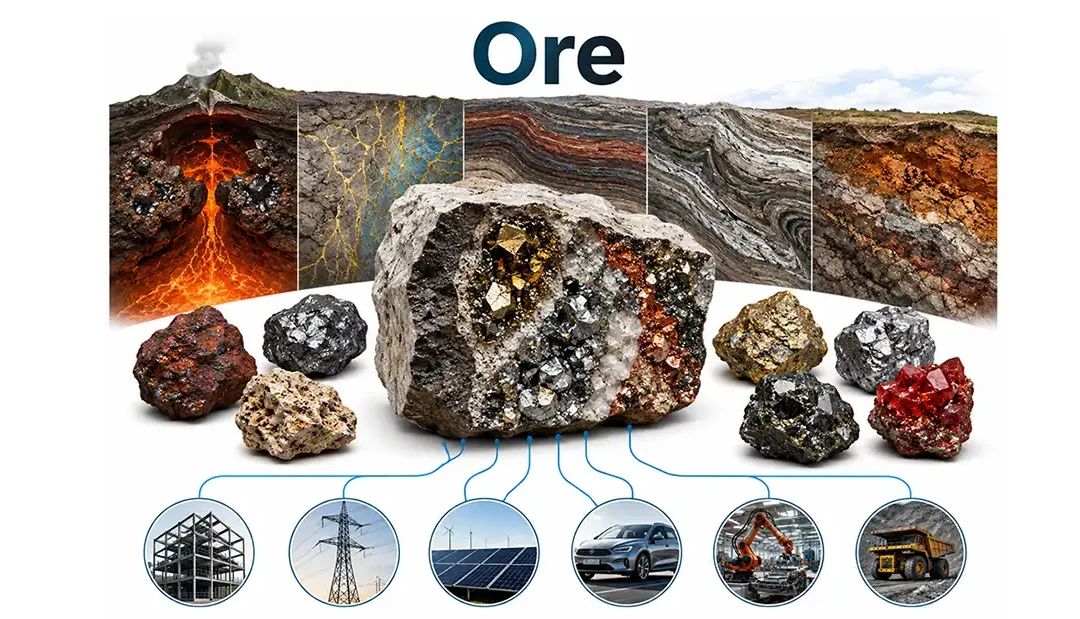
Take a moment to look around you. The steel in buildings, the copper inside electrical wires, the aluminum in airplanes, and even the minerals used in smartphones all have one thing in common—they began as ore hidden deep within the Earth. Before these valuable materials can become part of everyday products, they must first be discovered, mined, and processed from naturally occurring ore deposits.
Ore is far more than just a rock containing metal. It represents the Earth's natural storehouse of valuable resources that have formed over millions of years through complex geological processes. These deposits have shaped human civilization by providing the raw materials needed for construction, transportation, manufacturing, energy production, and technological innovation.
For geologists, understanding ore is a fundamental part of economic geology because it explains where valuable mineral resources are found, how they form, and why some deposits can be mined profitably while others cannot. The distribution of ores also tells an important story about Earth's volcanic activity, plate tectonics, weathering, and the movement of mineral-rich fluids beneath the surface.
What Is Ore?
If you pick up a random rock, there's a good chance it contains small amounts of different minerals or even traces of metals. However, that doesn't automatically make it an ore. In geology, an ore is defined by both its composition and its economic value.
An ore is a naturally occurring rock or mineral that contains valuable elements in concentrations high enough to be extracted economically using available mining and processing methods. In simple terms, an ore is a rock that is worth mining because the valuable minerals it contains can be recovered profitably.
The word "economically" is important. A mineral deposit may contain gold, copper, or iron, but if those metals occur in very small amounts or are too expensive to extract, the deposit is not considered an ore. Advances in mining technology, changes in metal prices, and improvements in processing methods can even change whether a deposit is classified as an ore over time.
For example, hematite and magnetite are among the world's most important iron ores because they contain high concentrations of iron that can be extracted efficiently. Likewise, bauxite is the principal source of aluminum, while chalcopyrite supplies much of the world's copper.
Most ores are not composed entirely of valuable minerals. Instead, they contain a mixture of ore minerals, which hold the valuable elements, and gangue minerals, such as quartz or feldspar, which have little or no economic value. Before metals can be extracted, these unwanted minerals must be separated through a process known as beneficiation.
It's also helpful to understand the difference between a mineral and an ore. A mineral is a naturally occurring inorganic substance with a specific chemical composition and crystal structure. An ore, on the other hand, is defined by its economic usefulness. While every ore contains one or more minerals, not every mineral deposit qualifies as an ore.
How Ore Forms
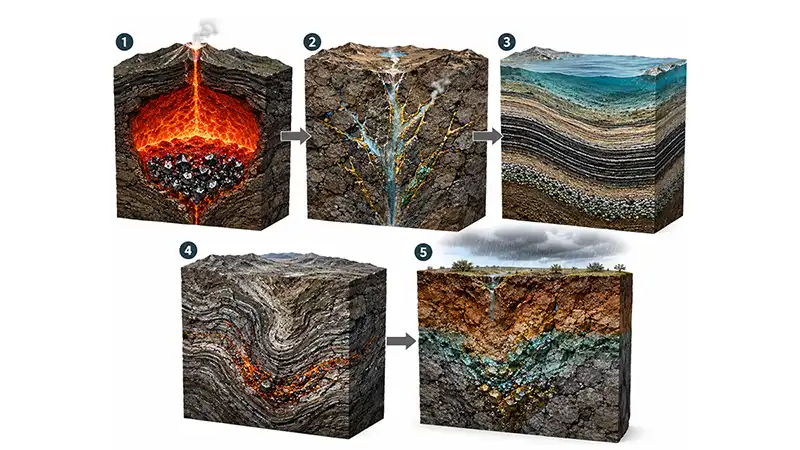
Every ore deposit has a story that began millions—or even billions—of years ago. The metals we mine today were not placed randomly within the Earth's crust. Instead, they were concentrated by powerful geological processes driven by magma, hot underground fluids, sedimentation, metamorphism, and surface weathering.
These natural processes gradually gather scattered minerals into deposits rich enough to be mined economically. That's why certain regions become famous for gold, copper, or iron mining, while others contain very few valuable mineral resources.
Most ore deposits form through one or more of the following geological processes.
1. Magmatic Processes
Some ores begin their journey deep beneath the Earth's surface inside molten rock, known as magma. As magma slowly cools, different minerals crystallize at different temperatures. Heavy, metal-rich minerals often settle toward the bottom of a magma chamber, forming concentrated layers that can later become valuable ore deposits.
This process produces many important metallic ores, particularly those containing iron, chromium, nickel, titanium, and platinum-group elements.
For example, large chromite deposits in layered igneous intrusions and many magnetite-rich iron deposits formed through magmatic crystallization.
2. Hydrothermal Processes
Many of the world's richest ore deposits were created by hydrothermal fluids—hot water enriched with dissolved metals moving through cracks and fractures in the Earth's crust.
As these mineral-rich fluids rise and cool, changes in temperature, pressure, or chemistry cause dissolved metals to crystallize and accumulate within veins or surrounding rocks. Over time, these minerals build up into economically valuable ore deposits.
Hydrothermal activity is responsible for many of the world's major deposits of:
- Gold
- Copper
- Silver
- Lead
- Zinc
- Tin
Some of the most productive mining districts on Earth owe their existence to hydrothermal systems associated with ancient volcanic and mountain-building events.
3. Sedimentary Processes
Not all ores form deep underground. Some develop at or near Earth's surface through sedimentary processes.
Over long periods, rivers, lakes, and oceans transport and deposit mineral particles. In other cases, dissolved minerals precipitate directly from water, gradually forming extensive mineral-rich layers.
One of the best-known examples is the Banded Iron Formation (BIF), which supplies a large portion of the world's iron ore. Other important sedimentary ores include phosphate rock and certain manganese deposits.
Because sedimentary deposits often cover vast areas, they can provide enormous mineral resources for decades of mining.
4. Metamorphic Processes
Existing rocks do not always remain unchanged. When they are buried deep within the Earth's crust, they may experience intense heat and pressure, causing their minerals to recrystallize or become chemically altered.
This process, known as metamorphism, can improve the concentration of valuable minerals or modify existing ore deposits into richer and more mineable forms.
Graphite, talc, and some gold-bearing deposits are closely associated with metamorphic environments.
Although metamorphism does not usually create entirely new ore bodies, it often upgrades older deposits, increasing their economic value.
5. Weathering and Supergene Enrichment
Ore formation can also continue near Earth's surface long after the original deposit has formed.
Rainwater and groundwater slowly weather exposed rocks, dissolving certain minerals and carrying dissolved metals downward. These metals may then accumulate in lower zones, creating richer concentrations through a process known as supergene enrichment.
This natural enrichment can significantly increase the grade of an ore deposit without adding new material. Many important copper deposits around the world have become economically valuable because of supergene enrichment.
Characteristics of Ore
Imagine discovering a rock that contains traces of gold or copper. At first glance, it might seem valuable, but geologists don't classify every metal-bearing rock as an ore. Before a mineral deposit can be mined commercially, it must meet several geological and economic criteria.
In simple terms, an ore is valuable not just because it contains a useful mineral, but because that mineral can be extracted safely, efficiently, and profitably. Geologists evaluate these characteristics during mineral exploration to determine whether a deposit is worth developing.
The following are the most important characteristics of an ore.
1. Contains Valuable Minerals
Every ore contains one or more ore minerals that hold economically useful elements. These minerals are the reason a deposit is mined and processed.
Some of the world's most important ore minerals include:
- Hematite – Iron
- Magnetite – Iron
- Bauxite – Aluminum
- Chalcopyrite – Copper
- Galena – Lead
- Sphalerite – Zinc
The type of ore mineral determines which metal can be extracted and how the ore will be processed.
2. Has an Economically Viable Ore Grade
One of the first questions a mining company asks is, "Is there enough valuable mineral to justify mining?"
The answer depends on the ore grade, which refers to the concentration of valuable minerals or metals within a deposit.
Generally, higher-grade ores require less processing to recover the same amount of metal, making them more profitable. However, improvements in mining technology and rising demand for critical minerals have made it possible to exploit some lower-grade deposits that were once considered uneconomical.
3. Contains Both Ore and Gangue Minerals
Ore deposits rarely consist entirely of valuable minerals. Instead, they contain a mixture of:
- Ore minerals, which have economic value.
- Gangue minerals, which have little or no commercial value.
Common gangue minerals include quartz, feldspar, calcite, mica, and clay minerals.
Before valuable metals can be extracted, these unwanted materials must be separated through beneficiation processes such as crushing, grinding, flotation, or magnetic separation.
4. Can Be Mined Safely and Efficiently
Even a high-grade deposit may not be considered an ore if it cannot be mined economically or safely.
Several factors influence mineability, including:
- Depth below the surface
- Size of the deposit
- Shape and continuity of the ore body
- Stability of the surrounding rocks
- Available mining technology
Large, shallow deposits are generally less expensive to develop than small, deeply buried ore bodies.
5. Suitable for Mineral Processing
An ore should allow valuable minerals to be recovered using practical processing methods. Depending on the mineral composition, processing may involve:
- Crushing and grinding
- Gravity separation
- Magnetic separation
- Froth flotation
- Chemical leaching
- Smelting and refining
The easier it is to separate valuable minerals from gangue, the more economically attractive the deposit becomes.
6. Has Long-Term Economic Potential
An ore deposit is also evaluated based on its ability to support mining over many years. Factors such as market demand, infrastructure, environmental regulations, and future metal prices all influence whether a deposit remains economically viable.
For example, minerals such as lithium, nickel, cobalt, and rare earth elements have become increasingly valuable in recent years due to the rapid growth of electric vehicles, renewable energy technologies, and battery manufacturing. As a result, deposits once considered marginal may now be developed into productive mines.
Ore Minerals vs. Gangue Minerals
When geologists discover a new mineral deposit, they aren't looking for rocks made entirely of valuable minerals. In reality, almost every ore body is a mixture of valuable minerals and ordinary rock-forming minerals. The valuable minerals are known as ore minerals, while the unwanted materials are called gangue minerals.
Ore Minerals vs. Gangue Minerals
| Feature | Ore Minerals | Gangue Minerals |
|---|---|---|
| Economic Value | High | Low or none |
| Purpose | Source of valuable metals or industrial minerals | Removed during mineral processing |
| Metal Content | Contains economically useful elements | Usually contains little or no valuable metal |
| Role in Mining | Target of extraction | Separated as waste or by-product |
| Common Examples | Hematite, Chalcopyrite, Galena, Bauxite | Quartz, Feldspar, Calcite, Mica |
Common Examples of Ore
Ore deposits occur on every continent and supply the raw materials needed to produce metals that support modern civilization. While thousands of minerals are known to science, only a relatively small number are mined extensively as ores because they contain valuable elements in economically recoverable concentrations.
Each ore has its own chemical composition, geological origin, and industrial importance. Some are the backbone of the steel industry, while others are essential for electronics, batteries, construction, and renewable energy technologies.
Below are some of the world's most important ores.
Hematite (Fe₂O₃)
If there is one ore that has shaped human civilization more than any other, it is hematite. As the world's most important iron ore, hematite supplies much of the iron used to produce steel.
It is easily recognized by its reddish-brown streak and metallic to earthy appearance. Large hematite deposits commonly occur within Banded Iron Formations (BIFs), some of which formed more than two billion years ago.
Main Uses:
- Steel production
- Construction materials
- Bridges and railways
- Heavy machinery
Magnetite (Fe₃O₄)
Magnetite is another major iron ore and is well known for its natural magnetic properties. It contains one of the highest iron contents among naturally occurring minerals, making it an excellent source of iron after beneficiation.
Magnetite is commonly found in igneous and metamorphic rocks and is mined extensively in countries such as Australia, Sweden, and South Africa.
Main Uses:
- Steel manufacturing
- Heavy industry
- Magnetic materials
- Dense concrete aggregates
Bauxite
Unlike most metallic ores, bauxite is not a single mineral but a mixture of several aluminum-bearing minerals formed through intense tropical weathering.
It is the world's primary source of aluminum, a lightweight and corrosion-resistant metal widely used in transportation and packaging.
Main Uses:
- Aircraft manufacturing
- Beverage cans
- Building materials
- Electrical transmission lines
Chalcopyrite (CuFeS₂)
Chalcopyrite is the most abundant copper ore mineral and has supplied much of the world's copper for centuries.
It usually forms in hydrothermal deposits associated with volcanic activity and mountain-building processes. Because copper is one of the best electrical conductors, chalcopyrite plays a vital role in modern technology.
Main Uses:
- Electrical wiring
- Electronic devices
- Renewable energy systems
- Plumbing
Galena (PbS)
Galena is the principal ore of lead and is easily recognized by its bright metallic luster and distinctive cubic crystals.
It commonly occurs together with sphalerite, chalcopyrite, and silver-bearing minerals in hydrothermal deposits.
Main Uses:
- Lead-acid batteries
- Radiation shielding
- Industrial equipment
Sphalerite (ZnS)
Sphalerite is the world's most important zinc ore. It ranges in color from yellowish-brown to nearly black and is often mined alongside galena.
Zinc extracted from sphalerite is primarily used to protect steel from corrosion through a process known as galvanization.
Main Uses:
- Galvanized steel
- Brass production
- Die-casting alloys
- Chemical industries
Cinnabar (HgS)
Cinnabar is the principal ore of mercury and is famous for its striking bright red color.
Most cinnabar deposits formed through hydrothermal activity associated with volcanic regions. Although mercury mining has declined because of environmental and health concerns, cinnabar remains an important mineral in economic geology.
Main Uses:
- Historical mercury production
- Scientific research
- Specialized industrial applications
Uses and Importance of Ore
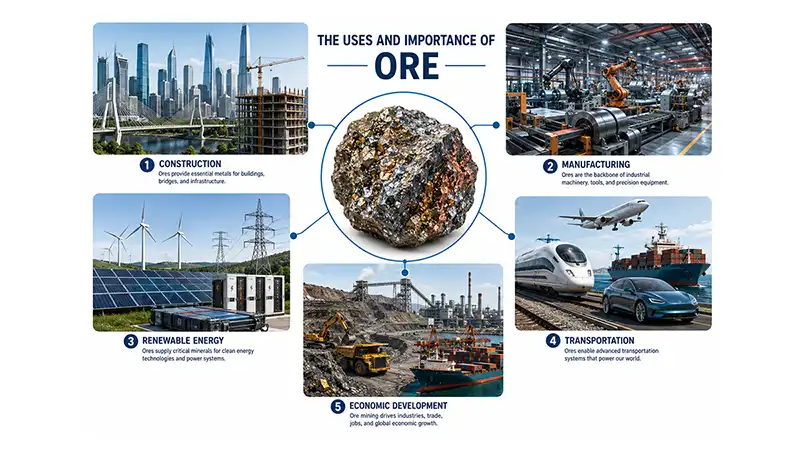
It's easy to overlook the role of ore in everyday life because we rarely see it in its natural form. Yet almost everything around us—from the buildings we live in to the smartphones we carry—begins with minerals extracted from ore deposits. Every bridge, railway, electrical grid, vehicle, and renewable energy project depends on metals that were once locked inside rocks beneath the Earth's surface.
Beyond supplying raw materials, ore mining supports economic development, creates millions of jobs, and provides the resources needed to improve living standards around the world.
Building Modern Infrastructure
One of the most important uses of ore is in the construction industry. Metals extracted from ores provide the strength, durability, and reliability needed for large-scale infrastructure projects.
For example:
- Iron ore is processed into steel for buildings, bridges, railways, and skyscrapers.
- Aluminum from bauxite is used in roofing, window frames, and lightweight structural components.
- Copper is widely used in plumbing systems and electrical wiring because of its excellent conductivity.
Without these materials, modern cities and transportation networks would not exist in their current form.
Supporting Manufacturing and Industry
Nearly every manufacturing sector depends on metals obtained from ores.
Factories use steel to build heavy machinery, aluminum to manufacture lightweight products, and copper to produce electrical equipment. Zinc, nickel, and lead are also essential for producing alloys, batteries, and corrosion-resistant materials.
From household appliances to industrial robots, ores provide the raw materials that keep global manufacturing moving.
Powering Technology and Clean Energy
As technology advances, the demand for mineral resources continues to grow.
Copper remains one of the most important metals for electrical systems because it efficiently conducts electricity. Meanwhile, metals such as nickel, cobalt, lithium, and rare earth elements play a critical role in rechargeable batteries, electric vehicles, wind turbines, and solar energy systems.
Although not all of these metals are discussed in this article as common ores, they highlight how mineral resources have become increasingly important in the transition to cleaner and more sustainable energy.
Improving Transportation
Modern transportation would be impossible without metals extracted from ore.
Cars, trains, ships, and aircraft rely on steel for strength and aluminum for reduced weight. Copper powers electrical systems, while zinc coatings help protect vehicle components from corrosion.
These materials make transportation safer, more efficient, and longer-lasting.
Driving Economic Growth
Mining is one of the world's oldest and most important industries. It provides employment for millions of people and contributes significantly to the economies of many countries through exports, industrial development, and infrastructure investment.
In addition to supplying raw materials, mining projects often stimulate the development of roads, power supplies, water systems, and communication networks in surrounding regions.
However, responsible resource management is essential. Modern mining increasingly focuses on reducing environmental impacts through efficient extraction methods, land rehabilitation, water conservation, and improved waste management practices.
Future of Ore Mining
The future of mining isn't just about discovering new ore deposits—it's about finding smarter, safer, and more sustainable ways to use Earth's limited mineral resources. As demand for metals continues to rise, driven by electric vehicles, renewable energy, and advanced technologies, the mining industry is undergoing one of the biggest transformations in its history.
Today, geologists no longer rely solely on field mapping and drilling. Modern mineral exploration combines satellite imagery, drones, Geographic Information Systems (GIS), artificial intelligence (AI), and advanced geophysical surveys to identify promising ore deposits with greater accuracy. These technologies reduce exploration costs while minimizing unnecessary environmental disturbance.
Mining operations are also becoming more automated. Autonomous haul trucks, robotic drilling systems, and real-time monitoring technologies improve productivity while reducing safety risks for workers. At the same time, advanced ore-sorting techniques help recover more valuable minerals from each ton of rock, reducing waste and energy consumption.
Sustainability is another major focus. Many mining companies are investing in renewable energy, water recycling systems, mine rehabilitation, and responsible waste management. Recycling metals from discarded electronics and industrial products is also becoming an important way to supplement newly mined resources and reduce pressure on natural ore deposits.
As the world transitions toward a low-carbon economy, demand for critical minerals such as copper, nickel, lithium, cobalt, and rare earth elements is expected to increase significantly. Meeting this demand will require responsible mining practices, continuous technological innovation, and careful management of Earth's mineral resources.
The future of ore mining is not simply about extracting more minerals—it's about extracting them more efficiently, more safely, and with greater respect for the environment.
Conclusion
From the iron that strengthens skyscrapers to the copper powering electrical grids, ores provide the raw materials that make modern life possible. These valuable geological resources are the result of millions of years of Earth's natural processes, including magmatism, hydrothermal activity, sedimentation, metamorphism, and weathering.
Understanding what ore is, how it forms, and why it is economically valuable is fundamental to both geology and mining. It not only helps geologists discover new mineral deposits but also supports the responsible use of natural resources that society depends on every day.
As technology advances and the demand for critical minerals continues to grow, the future of ore mining will depend on balancing resource development with environmental stewardship. Through sustainable mining practices, improved recycling, and innovative exploration methods, we can continue to meet global mineral needs while protecting the planet for future generations.
The two primary categories are metallic ores, which are mined to extract metals, and non-metallic ores, which provide valuable industrial minerals used in construction, agriculture, and manufacturing.
Ore grade is the concentration of valuable minerals or metals within an ore deposit. In general, higher-grade ores contain a greater proportion of valuable material and are often more economical to mine.
Gangue refers to the unwanted minerals associated with an ore deposit. These minerals are separated from the valuable ore minerals during beneficiation before metal extraction.
Some of the world's most widely mined ores include hematite, magnetite, bauxite, chalcopyrite, galena, sphalerite, and cinnabar.
Ore is the primary source of metals and industrial minerals used in construction, manufacturing, transportation, electronics, energy production, and countless other industries. Without ore, many of the technologies and infrastructure that support modern life would not exist.