
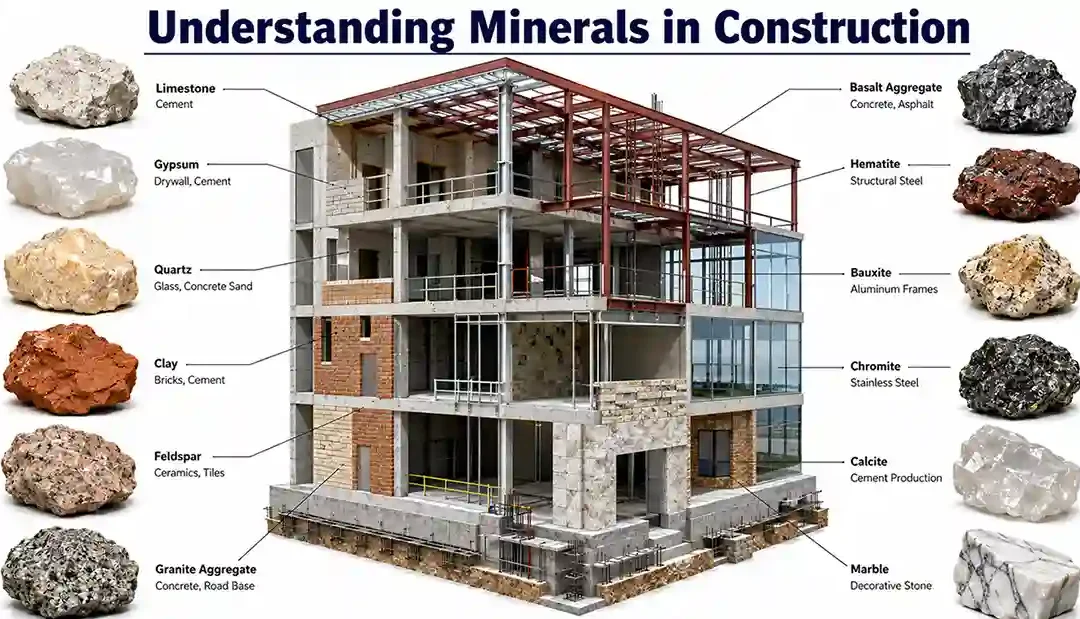
The modern construction industry relies on an enormous variety of minerals that provide strength, durability, stability, insulation, and aesthetic value. From homes and skyscrapers to highways, bridges, tunnels, and dams, nearly every structure begins with minerals extracted from the Earth's crust.
Minerals in construction are transformed into cement, concrete, bricks, steel, glass, ceramics, insulation, roofing materials, and decorative stone. Common minerals such as limestone, quartz, gypsum, clay, feldspar, and iron ores form the foundation of modern infrastructure, while specialty minerals improve energy efficiency, corrosion resistance, and fire protection.
Understanding these minerals highlights the essential role geology plays in civil engineering, architecture, and sustainable development.
This topic should be studied together with Industrial Minerals and Mineralogy.
Why Construction Depends on Minerals
Construction materials require minerals with specialized physical and chemical properties.
These minerals provide:
- Structural strength
- Long-term durability
- Fire resistance
- Weather resistance
- Thermal insulation
- Corrosion resistance
- Decorative appearance
Without these minerals, modern buildings and infrastructure would not exist.
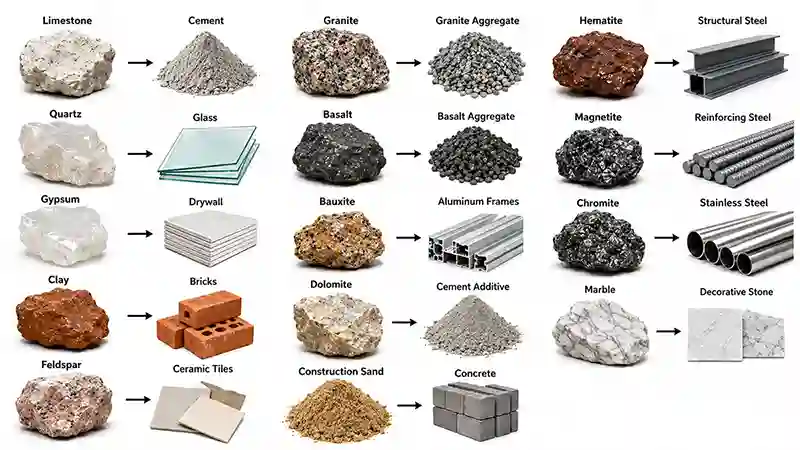
Major Minerals Used in Construction
Limestone
Main mineral:
- Calcite
Uses:
- Cement production
- Concrete
- Lime
- Building stone
Importance:
Limestone is the most important raw material for manufacturing Portland cement.
Quartz
Uses:
- Glass
- Concrete sand
- Engineered stone
- Silica products
Importance:
Quartz provides hardness, durability, and chemical resistance.
Clay Minerals
Common minerals:
- Kaolinite
- Illite
- Smectite
Uses:
- Bricks
- Roof tiles
- Cement
- Ceramics
Importance:
Clay forms the foundation of many traditional building materials.
Gypsum
Uses:
- Drywall
- Plaster
- Cement additive
Importance:
Gypsum improves cement performance and provides fire-resistant wall materials.
Feldspar
Uses:
- Ceramic tiles
- Sanitary ware
- Glass manufacturing
Importance:
Feldspar acts as a flux during ceramic production.
Iron Minerals
Common sources:
- Hematite
- Magnetite
Uses:
- Structural steel
- Reinforcing bars
- Construction equipment
Importance:
Steel provides strength for buildings, bridges, and infrastructure.
Granite
Main minerals:
- Quartz
- Feldspar
- Mica
Uses:
- Aggregate
- Building stone
- Countertops
- Paving
Importance:
Granite is durable and resistant to weathering.
Basalt
Uses:
- Road aggregate
- Railway ballast
- Concrete aggregate
- Rock wool insulation
Importance:
Basalt offers exceptional strength and abrasion resistance.
Marble
Main mineral:
- Calcite
Uses:
- Flooring
- Wall cladding
- Decorative stone
- Monuments
Importance:
Marble is valued for its beauty and durability.
Dolomite
Uses:
- Cement production
- Aggregate
- Glass manufacturing
Importance:
Dolomite contributes magnesium and improves material performance.
Bauxite
Uses:
- Aluminum windows
- Doors
- Roofing systems
- Curtain walls
Importance:
Aluminum is lightweight and corrosion-resistant.
Chromite
Uses:
- Stainless steel
- High-strength construction alloys
Importance:
Chromium increases corrosion resistance.
Sand and Gravel
Main minerals:
- Quartz
- Feldspar
Uses:
- Concrete
- Asphalt
- Road construction
Importance:
Sand and gravel are among the world's most widely used construction materials.
Minerals by Construction Material
| Construction Material | Main Minerals |
|---|---|
| Cement | Limestone, Clay, Gypsum |
| Concrete | Limestone, Quartz, Sand, Gravel |
| Steel | Hematite, Magnetite |
| Bricks | Clay Minerals |
| Glass | Quartz, Feldspar |
| Ceramic Tiles | Feldspar, Clay |
| Drywall | Gypsum |
| Aluminum Frames | Bauxite |
| Decorative Stone | Granite, Marble |
| Roads | Basalt, Granite, Sand, Gravel |
From Mine to Construction Site
Construction minerals pass through several stages before becoming building materials.
- Geological exploration
- Quarrying or mining
- Crushing and processing
- Cement, steel, glass, and ceramic manufacturing
- Transportation
- Building construction
- Infrastructure maintenance
- Demolition and recycling
Each stage transforms natural minerals into durable construction materials.
Environmental Challenges
Construction mineral production presents several environmental challenges.
These include:
- Quarrying impacts
- Carbon emissions from cement production
- Energy-intensive steel manufacturing
- Dust generation
- Land disturbance
- Resource depletion
Sustainable construction practices help reduce these impacts.
Recycling Construction Minerals
Many construction materials can be recycled after demolition.
Recovered materials include:
- Concrete aggregate
- Steel
- Aluminum
- Glass
- Asphalt
- Stone
Construction recycling reduces waste and conserves natural resources.
Geological Importance
Construction minerals are among the most heavily extracted mineral resources on Earth.
Geologists help:
- Locate suitable quarry sites
- Evaluate aggregate quality
- Assess limestone reserves
- Support sustainable resource development
- Improve long-term infrastructure planning
Their work ensures a reliable supply of building materials.
Laboratory Investigation
Construction minerals are analyzed using:
- X-Ray Diffraction (XRD)
- X-Ray Fluorescence (XRF)
- Petrographic Microscopy
- Scanning Electron Microscopy (SEM)
- Compressive strength testing
- Chemical analysis
These techniques evaluate mineral composition, durability, purity, and engineering performance.
Applications
Construction minerals are essential in:
- Residential buildings
- Commercial buildings
- Roads
- Bridges
- Airports
- Dams
- Tunnels
- Railways
- Industrial facilities
Advantages of Studying Construction Minerals
Understanding construction minerals helps scientists and engineers:
- Design stronger structures
- Improve material durability
- Develop sustainable construction practices
- Reduce environmental impacts
- Improve recycling technologies
- Secure long-term mineral resources
Limitations
Despite their importance, construction minerals present several challenges.
- Cement production contributes significant carbon dioxide emissions.
- Quarrying can alter landscapes and ecosystems.
- High demand increases pressure on natural resources.
- Transporting heavy materials consumes large amounts of energy.
- Sustainable extraction and recycling require careful planning.
For a broader understanding, study this topic together with:
- Economic Minerals
- Industrial Minerals
- Construction Materials
- Engineering Geology
- Environmental Geology
- Aggregate Resources
- Sustainable Construction
- Mineralogy
Comparison Table
| Mineral | Main Construction Function | Example Product |
| Limestone | Cement | Portland Cement |
| Quartz | Glass and Concrete | Windows, Concrete |
| Clay | Bricks | Masonry Bricks |
| Gypsum | Drywall | Wallboard |
| Feldspar | Ceramics | Floor Tiles |
| Hematite | Steel | Reinforcing Bars |
| Granite | Aggregate | Concrete |
| Basalt | Road Aggregate | Highways |
| Marble | Decorative Stone | Flooring |
| Bauxite | Aluminum | Window Frames |
Summary Table
| Feature | Minerals in Construction |
| Main Purpose | Building and Infrastructure Materials |
| Key Minerals | Limestone, Quartz, Clay, Gypsum |
| Industrial Minerals | Feldspar, Dolomite, Granite, Basalt |
| Study Methods | XRD, XRF, SEM, Petrography |
| Geological Importance | Infrastructure Development and Sustainable Construction |
The most important construction minerals include limestone, quartz, clay, gypsum, feldspar, granite, basalt, hematite, and marble.
Limestone is the primary raw material used to manufacture Portland cement, which is the main binding material in concrete.
Glass is primarily made from quartz (silica sand), along with feldspar and limestone.
Yes. Concrete, steel, aluminum, glass, asphalt, and many natural stone materials can be recovered and reused in new construction projects.
Aggregates such as granite, basalt, sand, and gravel provide strength, stability, and durability in concrete, asphalt, and road construction.
Final Thoughts
Construction depends on a diverse range of minerals that provide the strength, durability, and performance required for modern infrastructure. From limestone used in cement and quartz used in glass to iron ores for steel and granite for aggregates, these minerals form the backbone of buildings, roads, bridges, and cities.
As global demand for infrastructure continues to grow, sustainable mining, efficient material use, and increased recycling will play an increasingly important role in conserving natural resources while supporting future development.
Continue Learning
Continue exploring related topics: