
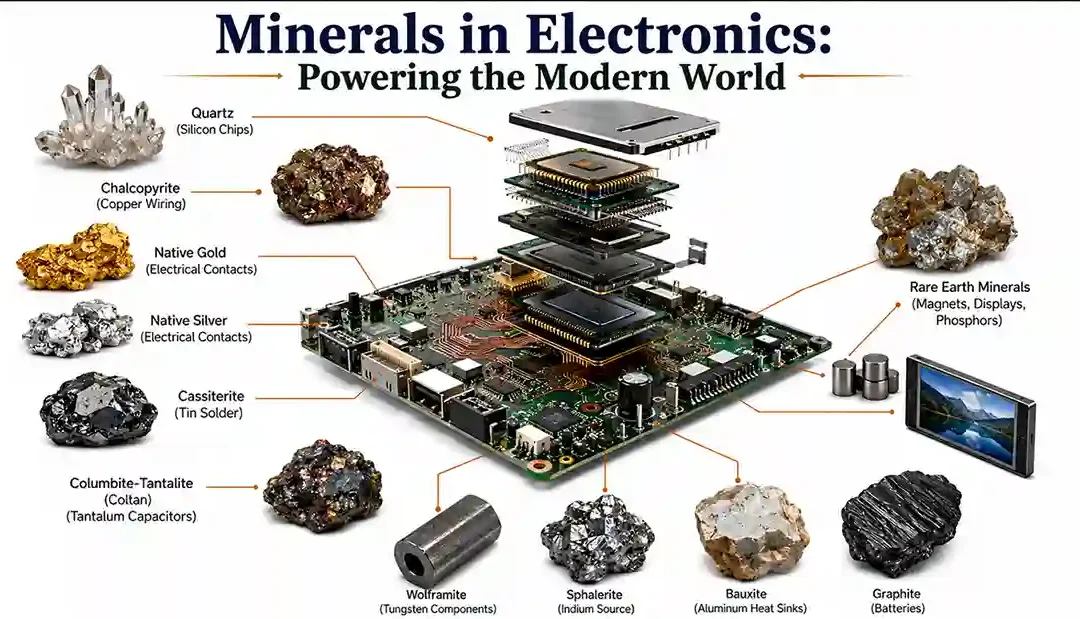
Modern electronics are built from an extraordinary range of minerals extracted from Earth's crust. Smartphones, computers, televisions, medical devices, satellites, communication systems, and industrial equipment all rely on carefully selected minerals that provide electrical conductivity, magnetic properties, energy storage, heat resistance, and structural strength.
Minerals in electronics serve as the foundation of semiconductors, printed circuit boards, batteries, displays, sensors, connectors, and countless electronic components. Some minerals, such as quartz and chalcopyrite, are abundant and widely used, while others—including tantalum, indium, gallium, and rare earth elements—are considered critical minerals because of their technological importance and limited supply.
Understanding these minerals demonstrates how geology supports nearly every aspect of modern technology.
This topic should be studied together with Critical Minerals, Rare Earth Minerals, and Mineralogy.
Why Electronics Depend on Minerals
Electronic devices require materials with specialized physical and chemical properties.
These minerals provide:
- Electrical conductivity
- Semiconductor behavior
- Thermal conductivity
- Magnetic performance
- Energy storage
- Corrosion resistance
- Optical transparency
- Mechanical durability
Without these minerals, modern electronic devices would not function.
Major Minerals Used in Electronics
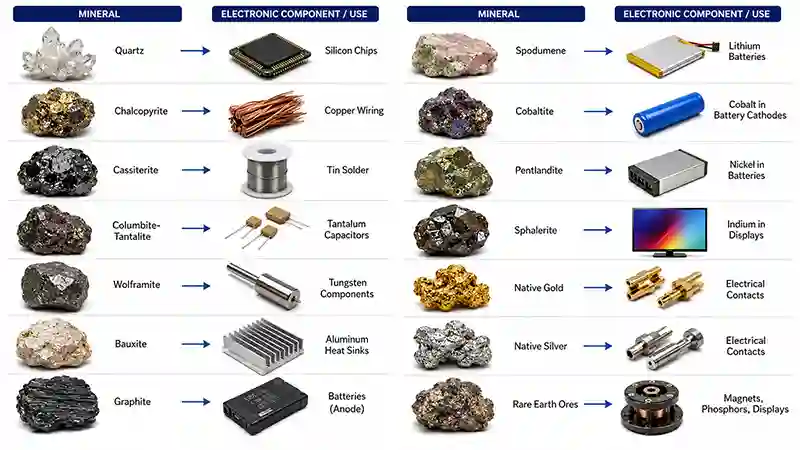
Quartz
Common mineral:
- Quartz
Uses:
- Silicon semiconductor chips
- Oscillators
- Electronic timing crystals
Importance:
Quartz is refined into ultra-pure silicon, which forms the foundation of modern integrated circuits.
Copper Minerals
Common source:
- Chalcopyrite
- Bornite
Uses:
- Printed circuit boards
- Electrical wiring
- Connectors
- Power transmission
Importance:
Copper provides outstanding electrical conductivity.
Gold
Uses:
- Electrical contacts
- Connectors
- Integrated circuits
Importance:
Gold resists corrosion while maintaining excellent conductivity.
Silver
Uses:
- Conductive circuits
- Switches
- High-performance connectors
Importance:
Silver has the highest electrical conductivity of any metal.
Tin
Common source:
- Cassiterite
Uses:
- Electronic solder
- Circuit board assembly
Importance:
Tin joins electronic components securely.
Tantalum
Common source:
- Columbite-Tantalite (Coltan)
Uses:
- Capacitors
Importance:
Stores electrical charge in compact, reliable electronic devices.
Tungsten
Common source:
- Wolframite
- Scheelite
Uses:
- High-temperature electronic components
- Heat-resistant contacts
- Vibration motors
Importance:
Provides exceptional density and heat resistance.
Aluminum
Common source:
- Bauxite
Uses:
- Heat sinks
- Device housings
- Capacitors
Importance:
Lightweight with excellent thermal conductivity.
Graphite
Uses:
- Lithium-ion battery anodes
- Thermal management materials
Importance:
Stores electrical energy and dissipates heat.
Lithium Minerals
Common sources:
- Spodumene
- Lepidolite
Uses:
- Rechargeable batteries
Importance:
Provides high energy density for portable electronics.
Cobalt Minerals
Common source:
- Cobaltite
Uses:
- Battery cathodes
Importance:
Improves battery stability and lifespan.
Nickel Minerals
Common source:
- Pentlandite
Uses:
- Rechargeable batteries
Importance:
Increases battery capacity.
Indium
Common source:
- Sphalerite (by-product)
Uses:
- Indium Tin Oxide (ITO)
- LCD and touchscreen displays
Importance:
Transparent electrical conductor.
Gallium
Common source:
- Bauxite
- Zinc ores
Uses:
- LEDs
- High-speed semiconductors
- Solar electronics
Importance:
Supports advanced electronic devices.
Rare Earth Elements
Important elements include:
- Neodymium
- Dysprosium
- Europium
- Terbium
- Yttrium
- Lanthanum
Uses:
- Magnets
- Speakers
- Hard drives
- Displays
- Lasers
- Optical devices
Importance:
Essential for compact, high-performance electronics.
Minerals by Electronic Component
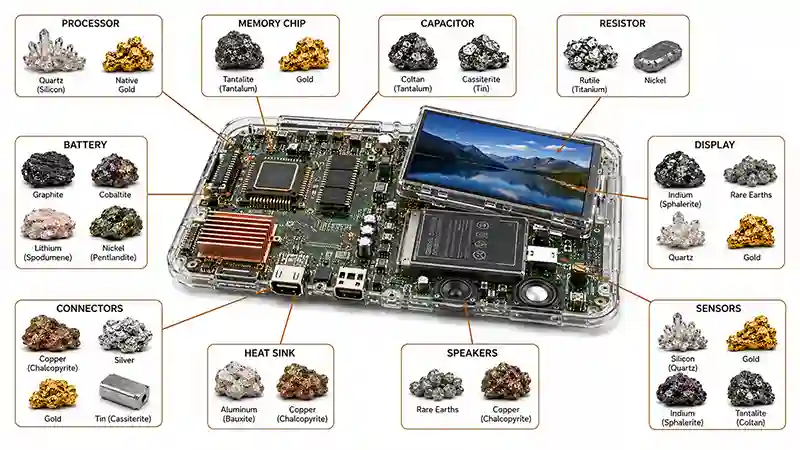
| Electronic Component | Main Minerals |
|---|---|
| Processor | Quartz (Silicon) |
| Circuit Board | Copper, Gold, Silver, Tin |
| Capacitors | Tantalum |
| Battery | Lithium, Graphite, Cobalt, Nickel |
| Display | Indium, Gallium |
| Speakers | Rare Earth Elements |
| Magnets | Neodymium, Dysprosium |
| Heat Sink | Aluminum |
| Connectors | Gold, Copper |
From Mine to Electronic Device
Electronic minerals pass through several production stages.
- Geological exploration
- Mining
- Ore processing
- Metal refining
- Semiconductor manufacturing
- Electronic component fabrication
- Device assembly
- Consumer use
- Electronic recycling
Each stage transforms raw minerals into sophisticated electronic products.
Environmental Challenges
Electronics manufacturing creates several environmental challenges.
These include:
- Critical mineral supply risks
- Energy-intensive refining
- Mine waste
- Water consumption
- Electronic waste (e-waste)
- Carbon emissions
Responsible mining and recycling help reduce these impacts.
Recycling Electronic Minerals
Many valuable materials can be recovered from discarded electronics.
Recovered materials include:
- Gold
- Silver
- Copper
- Aluminum
- Cobalt
- Lithium
- Nickel
- Rare earth elements
Electronic recycling conserves natural resources and reduces environmental impacts.
Geological Importance
Electronic minerals are among the world's most valuable mineral resources.
Geologists study them to:
- Discover new ore deposits
- Evaluate critical mineral supplies
- Support sustainable mining
- Improve recycling technologies
- Strengthen global supply chains
Many countries now consider these materials strategically important.
Laboratory Investigation
Scientists study electronic minerals using:
- X-Ray Diffraction (XRD)
- X-Ray Fluorescence (XRF)
- Scanning Electron Microscopy (SEM)
- Electron Probe Microanalysis (EPMA)
- ICP-MS
- Raman Spectroscopy
These techniques determine mineral composition, purity, crystal structure, and trace element content.
Applications
Electronic minerals are essential in:
- Smartphones
- Computers
- Tablets
- Televisions
- Medical equipment
- Aerospace systems
- Telecommunications
- Consumer electronics
- Renewable energy technologies
Advantages of Studying Electronic Minerals
Understanding electronic minerals helps scientists and engineers:
- Develop faster electronic devices
- Improve battery performance
- Secure critical mineral supplies
- Support sustainable mining
- Enhance recycling technologies
- Advance next-generation electronics
Limitations
Despite their importance, electronic minerals present several challenges.
- Many critical minerals are concentrated in a limited number of countries.
- Demand continues to increase as technology advances.
- Mining and refining can have environmental impacts.
- Electronic waste remains one of the world's fastest-growing waste streams.
- Recycling rates for several critical minerals are still relatively low.
For a broader understanding, study this topic together with:
- Economic Minerals
- Critical Minerals
- Rare Earth Minerals
- Mineral Resources
- Electronic Waste Recycling
- Sustainable Mining
- Environmental Geology
- Mineralogy
Comparison Table
| Mineral | Main Electronic Function | Example Source Mineral |
| Quartz | Silicon chips | Quartz |
| Copper | Wiring | Chalcopyrite |
| Gold | Connectors | Native Gold |
| Silver | Conductive circuits | Native Silver |
| Tin | Solder | Cassiterite |
| Tantalum | Capacitors | Columbite-Tantalite |
| Tungsten | Heat-resistant components | Wolframite |
| Lithium | Batteries | Spodumene |
| Graphite | Battery anodes | Graphite |
| Indium | Touchscreens | Sphalerite |
Summary Table
| Feature | Minerals in Electronics |
| Main Purpose | Manufacture Electronic Components |
| Key Minerals | Quartz, Copper, Gold, Silver, Lithium |
| Critical Minerals | Tantalum, Indium, Gallium, Rare Earth Elements |
| Study Methods | XRD, XRF, SEM, ICP-MS |
| Geological Importance | Critical Mineral Exploration and Modern Technology |
Some of the most important minerals include quartz, chalcopyrite, cassiterite, columbite-tantalite, graphite, spodumene, cobaltite, and rare earth mineral ores.
Silicon, refined from quartz, is a semiconductor that forms the foundation of computer chips, processors, and integrated circuits.
Rare earth elements are used to produce powerful magnets, display phosphors, speakers, hard drives, lasers, and many other high-performance electronic components.
Yes. Valuable materials such as gold, silver, copper, aluminum, cobalt, lithium, nickel, and rare earth elements can be recovered through electronic waste recycling.
Many are essential for advanced technologies, have rapidly growing demand, and may have limited or geographically concentrated supplies.
Final Thoughts
Modern electronics depend on a remarkable variety of minerals that make computing, communication, energy storage, and digital technology possible. From quartz-derived silicon chips and copper wiring to tantalum capacitors and rare earth magnets, each mineral contributes specialized properties that enable electronic devices to operate efficiently and reliably.
As demand for advanced electronics continues to grow, sustainable mining, responsible resource management, and improved recycling will become increasingly important. Understanding the geology behind electronic devices highlights the vital role minerals play in powering today's connected world and tomorrow's technological innovations.
Continue Learning
Continue exploring related topics: