
Ceramics are among the oldest and most versatile materials created by humans. From pottery made thousands of years ago to modern porcelain, ceramic tiles, sanitary ware, electrical insulators, and aerospace components, ceramics rely on carefully selected minerals extracted from the Earth's crust.
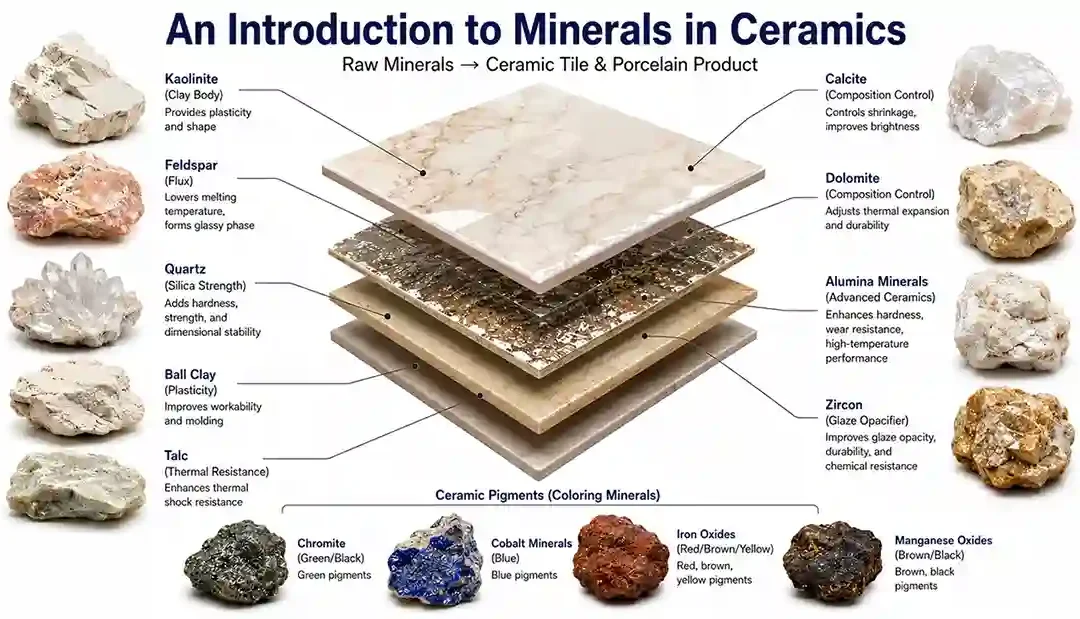
Minerals in ceramics provide plasticity, strength, hardness, heat resistance, chemical stability, and decorative finishes. Clay minerals form the ceramic body, quartz strengthens the product, feldspar lowers firing temperatures, while specialty minerals improve glazing, color, and advanced engineering performance.
Understanding these minerals demonstrates how geology supports construction, manufacturing, electronics, healthcare, and modern technology.
This topic should be studied together with Industrial Minerals, Clay Mineralogy, and Mineralogy.
Why Ceramics Depend on Minerals
Ceramic products require minerals with specialized physical and chemical properties.
These minerals provide:
- Plasticity during shaping
- Mechanical strength
- Heat resistance
- Chemical stability
- Wear resistance
- Decorative appearance
- Electrical insulation
Without these minerals, ceramic manufacturing would not be possible.
Major Minerals Used in Ceramics
Kaolinite
Main mineral:
- Kaolinite
Uses:
- Porcelain
- Fine ceramics
- Sanitary ware
- Electrical insulators
Importance:
Kaolinite is the primary clay mineral used to produce high-quality white ceramics.
Ball Clay
Uses:
- Ceramic bodies
- Tableware
- Tiles
Importance:
Ball clay improves plasticity, making ceramic materials easier to shape before firing.
Quartz
Uses:
- Ceramic body
- Porcelain
- Tiles
- Refractories
Importance:
Quartz provides silica, improving hardness, strength, and dimensional stability.
Feldspar
Uses:
- Flux
- Porcelain
- Ceramic tiles
- Stoneware
Importance:
Feldspar lowers the melting temperature during firing and forms a glassy phase that binds ceramic particles together.
Talc
Uses:
- Wall tiles
- Electrical ceramics
- Cookware
Importance:
Talc improves thermal shock resistance and firing performance.
Calcite
Uses:
- Ceramic bodies
- Glazes
Importance:
Calcite contributes calcium oxide, improving firing behavior and final properties.
Dolomite
Uses:
- Ceramic glazes
- Specialty ceramics
Importance:
Dolomite supplies magnesium oxide, improving glaze durability and thermal performance.
Alumina Minerals
Common sources:
- Bauxite
- Corundum
Uses:
- Advanced ceramics
- Wear-resistant parts
- Electrical components
Importance:
Alumina greatly increases hardness, wear resistance, and electrical insulation.
Zircon
Uses:
- Ceramic glazes
- Opacifiers
- Refractory ceramics
Importance:
Zircon improves whiteness, durability, and resistance to high temperatures.
Chromite
Uses:
- Brown pigments
- Refractory bricks
Importance:
Chromium compounds produce durable ceramic colors and high-temperature materials.
Cobalt Minerals
Uses:
- Blue ceramic glazes
- Decorative pottery
Importance:
Cobalt creates intense blue colors that remain stable during firing.
Iron Minerals
Common sources:
- Hematite
- Magnetite
Uses:
- Red, brown, and black ceramic pigments
Importance:
Iron oxides produce many traditional ceramic colors.
Manganese Minerals
Common source:
- Pyrolusite
Uses:
- Brown and purple glazes
Importance:
Manganese improves decorative ceramic finishes.
Minerals by Ceramic Product
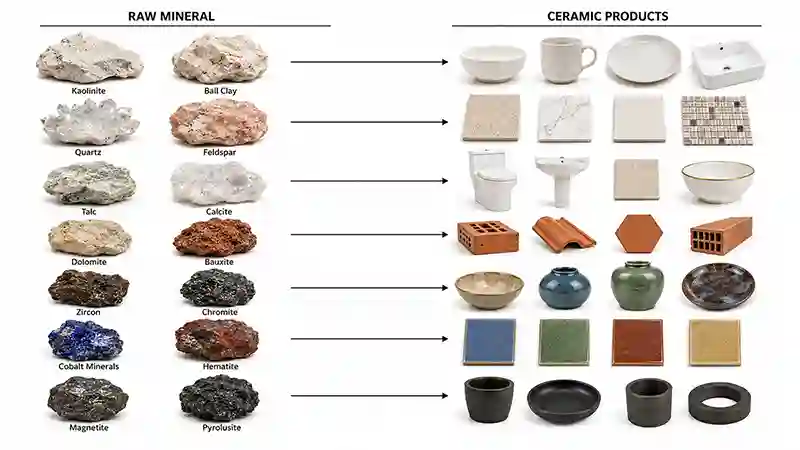
| Ceramic Product | Main Minerals |
|---|---|
| Porcelain | Kaolinite, Feldspar, Quartz |
| Ceramic Tiles | Ball Clay, Feldspar, Quartz |
| Sanitary Ware | Kaolinite, Feldspar |
| Pottery | Clay Minerals, Quartz |
| Refractory Bricks | Alumina, Chromite |
| Electrical Insulators | Kaolinite, Alumina |
| Ceramic Glazes | Feldspar, Zircon, Dolomite |
| Decorative Ceramics | Cobalt, Iron, Manganese Minerals |
Types of Ceramics and Their Mineral Composition
Earthenware
Main minerals:
- Clay
- Quartz
- Feldspar
Low-fired traditional ceramics.
Stoneware
Main minerals:
- Ball Clay
- Feldspar
- Quartz
Dense and durable ceramics used for cookware and tableware.
Porcelain
Main minerals:
- Kaolinite
- Feldspar
- Quartz
Produces strong, white, translucent ceramics.
Refractory Ceramics
Main minerals:
- Alumina
- Chromite
Designed to withstand extremely high temperatures.
Advanced Ceramics
Main minerals:
- Alumina
- Zircon
- Specialty oxides
Used in aerospace, electronics, medicine, and industrial engineering.
From Mine to Ceramic Product
Ceramic minerals undergo several production stages.
- Geological exploration
- Mining and quarrying
- Mineral processing
- Mixing and blending
- Shaping and molding
- Drying
- Kiln firing
- Glazing and finishing
- Quality inspection
Each stage transforms raw minerals into durable ceramic products.
Environmental Challenges
Ceramic manufacturing faces several environmental challenges.
These include:
- Energy-intensive kiln firing
- Quarrying impacts
- Dust generation
- Water consumption
- Carbon emissions
Modern manufacturing increasingly improves energy efficiency and material recycling.
Recycling Ceramic Materials
Although ceramics are difficult to remelt, many products can be crushed and reused.
Recycled ceramic materials are used in:
- Road base
- Concrete aggregate
- Construction fill
- New ceramic products
Recycling reduces waste and conserves natural resources.
Geological Importance
Ceramic manufacturing depends on reliable supplies of industrial minerals.
Geologists help:
- Locate clay deposits
- Evaluate feldspar resources
- Assess silica quality
- Identify refractory mineral deposits
- Support sustainable mining
Their work ensures long-term availability of ceramic raw materials.
Laboratory Investigation
Ceramic minerals are studied using:
- X-Ray Diffraction (XRD)
- X-Ray Fluorescence (XRF)
- Scanning Electron Microscopy (SEM)
- Petrographic Microscopy
- Thermal Analysis (DTA/TGA)
- ICP-MS
These methods determine mineral composition, purity, particle size, and firing behavior.
Applications
Ceramic minerals are essential in:
- Floor and wall tiles
- Porcelain tableware
- Pottery
- Sanitary ware
- Electrical insulators
- Medical implants
- Aerospace components
- Industrial machinery
- Laboratory equipment
Advantages of Studying Ceramic Minerals
Understanding ceramic minerals helps scientists and engineers:
- Improve ceramic strength
- Develop advanced materials
- Enhance heat resistance
- Improve glaze quality
- Increase manufacturing efficiency
- Support sustainable mineral resource management
Limitations
Despite their importance, ceramic minerals present several challenges.
- High-temperature firing requires significant energy.
- Clay deposits vary in quality and composition.
- Ceramic products are brittle under high impact.
- Mining and quarrying can affect natural landscapes.
- Some advanced ceramic minerals are relatively expensive.
For a broader understanding, study this topic together with:
- Industrial Minerals
- Clay Mineralogy
- Engineering Geology
- Economic Minerals
- Materials Science
- Refractory Minerals
- Sustainable Manufacturing
- Mineralogy
Comparison Table
| Mineral | Main Ceramic Function | Example Product |
| Kaolinite | Ceramic Body | Porcelain |
| Ball Clay | Plasticity | Ceramic Tiles |
| Quartz | Strength | Stoneware |
| Feldspar | Flux | Porcelain |
| Talc | Thermal Resistance | Cookware |
| Calcite | Calcium Source | Ceramic Body |
| Dolomite | Glaze Modifier | Ceramic Glazes |
| Zircon | Opacifier | White Glazes |
| Alumina | High Strength | Advanced Ceramics |
| Chromite | Pigment & Refractory | Fire Bricks |
Summary Table
| Feature | Minerals in Ceramics |
| Main Purpose | Ceramic Manufacturing |
| Key Minerals | Kaolinite, Quartz, Feldspar, Ball Clay |
| Specialty Minerals | Zircon, Alumina, Chromite, Talc |
| Study Methods | XRD, XRF, SEM, Thermal Analysis |
| Geological Importance | Industrial Mineral Resources and Ceramic Production |
Kaolinite is one of the most important ceramic minerals because it forms the main body of porcelain and many fine ceramic products.
Feldspar acts as a flux, lowering the firing temperature and forming a glassy phase that strengthens ceramic products.
Iron oxides produce red and brown colors, cobalt creates blue glazes, chromium produces green and brown shades, and manganese forms purple or brown tones.
Yes. Crushed ceramic waste can be reused as aggregate, road base, construction fill, or as a raw material in some ceramic products.
Quartz provides silica, increasing hardness, strength, dimensional stability, and resistance to thermal shock.
Final Thoughts
Ceramic manufacturing depends on a carefully balanced combination of industrial minerals that provide plasticity, strength, durability, and attractive finishes. Kaolinite, ball clay, quartz, and feldspar form the foundation of traditional ceramics, while zircon, alumina, chromite, and specialty minerals enable advanced engineering applications.
As demand for high-performance ceramics continues to grow in construction, healthcare, electronics, and aerospace, sustainable mining, efficient manufacturing, and responsible resource management will remain essential. Understanding the geology behind ceramic materials highlights the important role minerals play in both everyday products and cutting-edge technologies.
Continue Learning
Continue exploring related topics: