
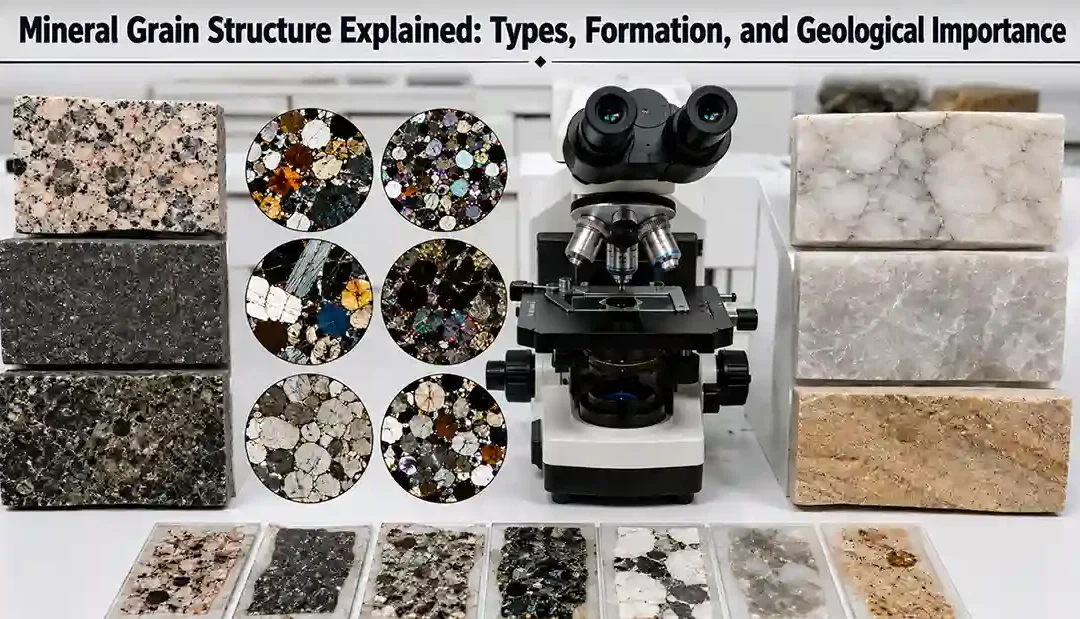
Mineral grain structure refers to the size, shape, arrangement, and relationships of individual mineral grains within a rock or mineral aggregate. Every rock is composed of one or more mineral grains that formed through crystallization, recrystallization, sediment deposition, or metamorphism. Studying these grains helps geologists understand how rocks formed, the environmental conditions during their formation, and the geological processes that modified them over time.
Grain structure is one of the most important characteristics examined in mineralogy and petrology. It provides information about cooling history, deformation, metamorphism, weathering, and sediment transport. Large, well-developed grains often indicate slow crystallization, whereas tiny grains usually form during rapid cooling.
Modern grain structure studies combine field observations with petrographic microscopy, scanning electron microscopy (SEM), electron backscatter diffraction (EBSD), and digital image analysis.
For a complete understanding of mineral textures, this topic should be studied together with Petrographic Microscopy, Thin Section Mineral Analysis, and Crystal Growth in Minerals.
What Is Mineral Grain Structure?
Mineral grain structure describes the physical characteristics of individual mineral crystals within a rock.
It includes:
- Grain size
- Grain shape
- Grain boundaries
- Crystal orientation
- Grain distribution
- Grain relationships
These characteristics help determine the origin and history of rocks.
What Is a Mineral Grain?
A mineral grain is an individual crystal or crystal fragment within a rock.
A rock may contain:
- One mineral species (monomineralic)
- Multiple mineral species (polymineralic)
Each grain has its own crystal structure and chemical composition.
Why Is Grain Structure Important?
Studying grain structure helps geologists:
- Classify rocks
- Determine cooling history
- Identify metamorphic conditions
- Interpret deformation
- Evaluate engineering properties
- Understand weathering processes
Grain structure provides valuable clues about geological history.
Grain Size
Grain size is one of the most important grain characteristics.
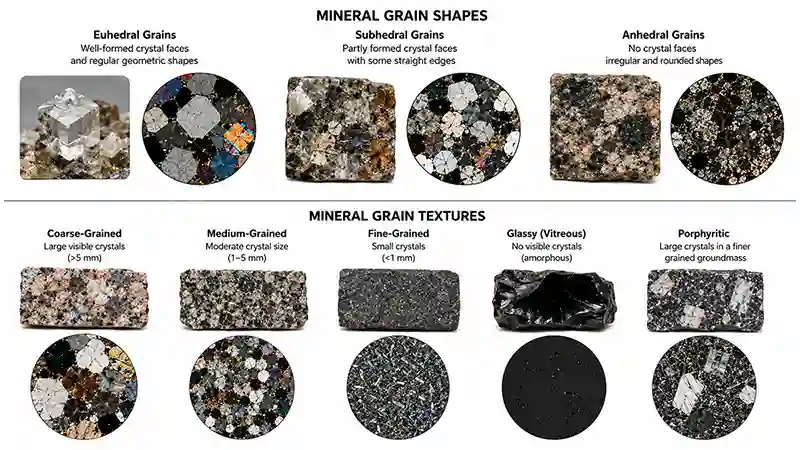
Coarse-Grained
Visible mineral crystals larger than approximately 5 mm.
Examples:
- Granite
- Pegmatite
Usually indicates slow cooling.
Medium-Grained
Crystals between 1–5 mm.
Common in:
- Diorite
- Gabbro
Fine-Grained
Crystals smaller than 1 mm.
Examples:
- Basalt
- Rhyolite
Typically produced by rapid cooling.
Glassy Texture
No visible mineral grains because crystals did not have time to form.
Example:
- Obsidian
Grain Shape
Mineral grains occur in several shapes.
Euhedral
Well-developed crystal faces.
Indicates unrestricted crystal growth.
Subhedral
Partially developed crystal faces.
Represents intermediate crystal growth.
Anhedral
Irregular grain shape with no crystal faces.
Forms when crystals compete for space.
Grain Boundaries
Grain boundaries are the surfaces where adjacent mineral grains meet.
They influence:
- Rock strength
- Deformation
- Fluid movement
- Metamorphic reactions
- Recrystallization
Different boundary types provide clues to geological history.
Grain Arrangement
Mineral grains may be arranged in different ways.
Common arrangements include:
- Interlocking crystals
- Random orientation
- Preferred orientation
- Layered arrangement
- Foliated texture
These patterns help identify igneous, sedimentary, and metamorphic rocks.
Grain Structure in Different Rock Types
Igneous Rocks
Igneous rocks commonly show:
- Interlocking crystals
- Euhedral grains
- Coarse or fine grain size
Cooling rate strongly influences grain size.
Sedimentary Rocks
Sedimentary rocks often contain:
- Rounded grains
- Angular grains
- Cement between grains
- Pore spaces
Grain characteristics reflect transport and deposition.
Metamorphic Rocks
Metamorphic rocks commonly display:
- Recrystallized grains
- Preferred orientation
- Interlocking crystals
- Grain growth during metamorphism
Pressure and temperature modify grain structure.
Factors Affecting Grain Structure
Several factors influence grain development.
Cooling Rate
Slow cooling produces large grains.
Rapid cooling produces small grains.
Pressure
High pressure promotes recrystallization and grain deformation.
Temperature
Increasing temperature encourages crystal growth.
Deformation
Stress may elongate grains or create preferred orientations.
Fluid Activity
Hydrothermal fluids may dissolve and recrystallize minerals.
Grain Structure and Mineral Identification
Grain characteristics help identify minerals by revealing:
- Crystal habit
- Cleavage relationships
- Twinning
- Grain contacts
- Mineral associations
However, grain structure should always be combined with optical and chemical analyses for accurate identification.
Laboratory Techniques
Scientists study mineral grain structure using:
- Petrographic microscope
- Polarized light microscope
- Scanning Electron Microscope (SEM)
- Electron Backscatter Diffraction (EBSD)
- X-ray Diffraction (XRD)
- Digital image analysis
These techniques reveal grain size, shape, orientation, and crystallographic relationships.
Applications
Grain structure analysis is important in:
- Mineralogy
- Petrology
- Engineering geology
- Mining
- Sedimentology
- Metamorphic geology
- Materials science
- Structural geology
Advantages of Grain Structure Analysis
Studying grain structure allows scientists to:
- Classify rocks
- Interpret geological history
- Estimate cooling rates
- Understand deformation
- Evaluate rock strength
- Support mineral identification
Limitations
Grain structure alone cannot identify all minerals.
For complete analysis, combine grain structure studies with:
- Petrographic Microscopy
- Thin Section Mineral Analysis
- Crystal Growth in Minerals
- Optical Properties of Minerals
- Electron Microprobe Analysis
- X-Ray Diffraction in Mineralogy
- How to Identify Minerals
Comparison Table
| Grain Type | Characteristics | Typical Rocks |
|---|---|---|
| Coarse-Grained | Large visible crystals | Granite, Pegmatite |
| Medium-Grained | Moderate crystal size | Diorite, Gabbro |
| Fine-Grained | Tiny crystals | Basalt, Rhyolite |
| Glassy | No visible crystals | Obsidian |
Summary Table
| Feature | Mineral Grain Structure |
| Main Concept | Size, Shape, and Arrangement of Mineral Grains |
| Major Characteristics | Grain Size, Shape, Boundaries, Orientation |
| Common Study Methods | Petrographic Microscopy, SEM, EBSD |
| Geological Importance | Rock Formation, Cooling History, Deformation |
| Best Applications | Mineralogy, Petrology, Engineering Geology |
Mineral grain structure refers to the size, shape, orientation, and arrangement of mineral grains within a rock or mineral aggregate.
Grain size provides information about cooling rate, metamorphism, deformation, and the environment in which a rock formed.
Grain boundaries are the surfaces where neighboring mineral grains meet. They influence rock strength, fluid movement, and recrystallization.
Euhedral grains have well-developed crystal faces, while anhedral grains have irregular shapes because they grew in confined spaces.
Geologists study grain structure using petrographic microscopes, scanning electron microscopes (SEM), EBSD, XRD, and digital image analysis.
Final Thoughts
Mineral grain structure provides essential information about how rocks and minerals formed, evolved, and responded to geological processes. By examining grain size, grain shape, grain boundaries, and crystal relationships, geologists can reconstruct cooling histories, identify deformation, interpret metamorphic conditions, and classify rocks with greater confidence.
When combined with petrographic microscopy, crystal growth studies, mineral chemistry, and X-ray diffraction, grain structure analysis offers a comprehensive understanding of Earth's materials. It remains one of the most important tools in mineralogy, petrology, engineering geology, and modern geological research.
Continue Learning
Expand your mineralogy knowledge with these related guides: