
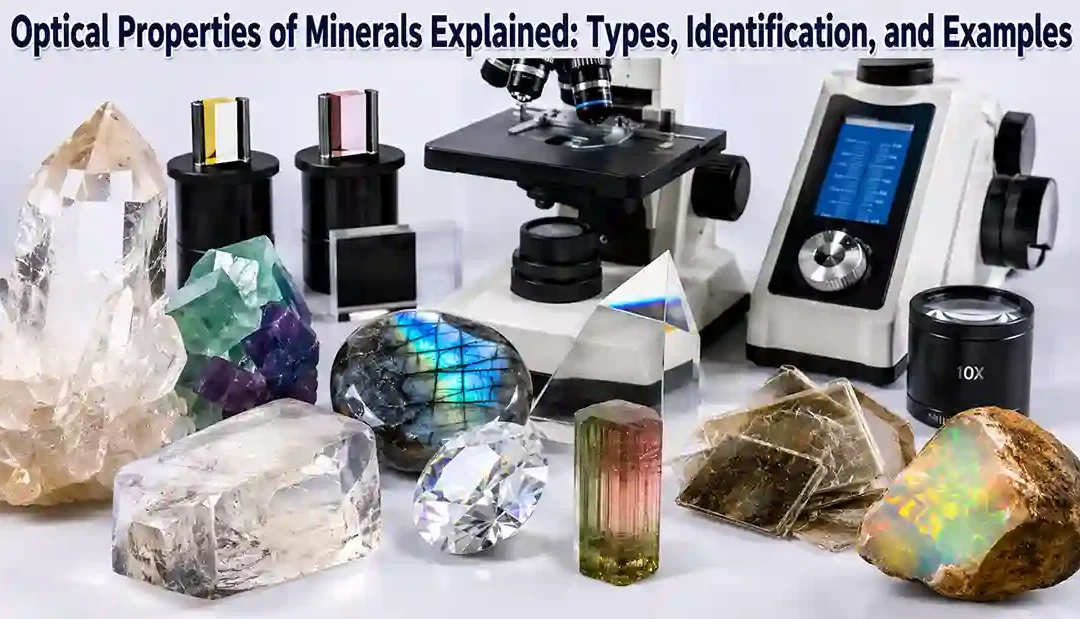
The optical properties of minerals describe how minerals interact with visible light. These properties include color, luster, transparency, refractive index, birefringence, pleochroism, fluorescence, and optical phenomena such as iridescence and chatoyancy. Because each mineral interacts with light differently, optical properties provide valuable clues for mineral identification.
In geology, mineralogy, and gemology, optical tests are widely used to distinguish minerals that may have similar chemical compositions or physical properties. While some optical properties can be observed with the naked eye, others require specialized instruments such as refractometers, dichroscopes, or polarized light microscopes.
For reliable identification, optical properties should always be evaluated together with hardness, density, cleavage, fracture, streak, and crystal habit.
What Are Optical Properties?
Optical properties are the characteristics that describe how a mineral:
- Reflects light
- Absorbs light
- Transmits light
- Refracts light
- Polarizes light
These interactions are controlled by the mineral's chemical composition and crystal structure.
Why Are Optical Properties Important?
Optical properties help geologists:
- Identify minerals
- Distinguish similar minerals
- Classify gemstones
- Study crystal structure
- Analyze thin sections
Many minerals that appear identical in hand specimens can easily be distinguished under polarized light.
Major Optical Properties of Minerals
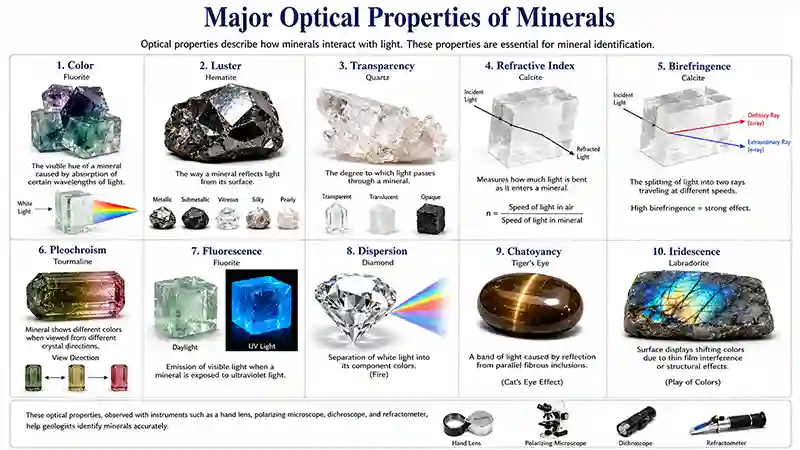
The most important optical properties include:
- Color
- Luster
- Transparency
- Refractive Index
- Double Refraction (Birefringence)
- Pleochroism
- Fluorescence
- Dispersion
- Chatoyancy
- Asterism
- Iridescence
Each provides unique identification information.
Color
Color is usually the first property noticed.
Mineral colors are influenced by:
- Chemical composition
- Trace elements
- Crystal defects
- Weathering
Examples:
| Mineral | Typical Color |
|---|---|
| Quartz | Colorless |
| Sulfur | Yellow |
| Malachite | Green |
| Azurite | Blue |
| Pyrite | Brass Yellow |
Color alone should never be used for identification because many minerals occur in multiple colors.
Luster
Luster describes how light reflects from a mineral surface.
Common luster types include:
- Metallic
- Vitreous
- Pearly
- Silky
- Resinous
- Adamantine
- Waxy
- Earthy
Learn more in Luster Test Explained.
Transparency
Transparency describes how much light passes through a mineral.
Classification:
- Transparent
- Translucent
- Opaque
Diamond and quartz are transparent, whereas galena is opaque.
Refractive Index
When light enters a mineral, it changes speed and bends.
This bending is called refraction.
The refractive index measures how strongly light bends inside a mineral.
Examples:
| Mineral | Refractive Index |
| Quartz | 1.54 |
| Calcite | 1.49–1.66 |
| Diamond | 2.42 |
Higher refractive index generally produces greater brilliance.
Double Refraction (Birefringence)
Some minerals split light into two rays. This property is called birefringence. Calcite is one of the best-known examples. Strong birefringence causes double images when viewed through a crystal.
Pleochroism
Pleochroism occurs when a mineral displays different colors when viewed from different directions.
Common pleochroic minerals include:
- Tourmaline
- Cordierite
- Andalusite
Gemologists often use a dichroscope to observe this property.
Fluorescence
Some minerals emit visible light under ultraviolet radiation.
Examples include:
- Fluorite
- Willemite
- Calcite
- Scheelite
Fluorescence is covered in detail in Fluorescent Minerals Explained.
Dispersion (Fire)
Dispersion is the separation of white light into rainbow colors.
Minerals with strong dispersion include:
- Diamond
- Demantoid Garnet
- Zircon
Dispersion contributes to gemstone brilliance.
Chatoyancy
Chatoyancy produces a narrow moving band of reflected light resembling a cat's eye.
Examples:
- Chrysoberyl Cat's Eye
- Tiger's Eye
Asterism
Asterism produces a star-shaped reflection.
Examples:
- Star Sapphire
- Star Ruby
The effect is caused by microscopic needle-like inclusions.
Iridescence
Iridescence produces changing colors due to interference of light.
Common examples:
- Labradorite
- Bornite
- Opal
- Peacock Ore
Optical Instruments Used
Geologists and gemologists commonly use:
- Polarized Light Microscope
- Refractometer
- Dichroscope
- Polariscope
- Spectroscope
- UV Lamp
- Loupe
These instruments reveal optical properties invisible to the naked eye.
Optical Mineral Identification
Optical properties are widely used for:
- Mineral identification
- Thin section analysis
- Gemstone grading
- Petrography
- Research
- Museum collections
Under polarized light, many minerals display unique optical characteristics.
Advantages
Optical properties provide:
- Non-destructive testing
- Rapid identification
- High accuracy
- Reliable gemstone identification
- Excellent laboratory analysis
Limitations
Optical properties should be used together with:
- Mineral Hardness Test
- Mineral Density Test
- Cleavage Test Explained
- Fracture in Minerals
- Streak Test Explained
- Magnetism in Minerals
- Acid Test for Minerals
No single optical property can positively identify every mineral.
Comparison Table
| Optical Property | Measures |
| Color | Visible Appearance |
| Luster | Surface Reflection |
| Transparency | Light Transmission |
| Refractive Index | Light Bending |
| Birefringence | Double Refraction |
| Fluorescence | UV Response |
Summary Table
| Property | Best Example |
| Color | Malachite |
| Luster | Pyrite |
| Transparency | Quartz |
| Refractive Index | Diamond |
| Birefringence | Calcite |
| Pleochroism | Tourmaline |
| Fluorescence | Fluorite |
| Dispersion | Diamond |
| Chatoyancy | Tiger's Eye |
| Asterism | Star Sapphire |
| Iridescence | Labradorite |
They are characteristics describing how minerals interact with light, including color, luster, transparency, refractive index, birefringence, fluorescence, and pleochroism.
No single property is sufficient. Mineral identification is most accurate when multiple optical properties are examined together.
Birefringence occurs when light travels through anisotropic minerals at different speeds, producing two refracted rays.
Fluorescence is caused by activator elements or crystal defects that absorb ultraviolet light and emit visible light.
The polarized light microscope is the primary instrument used for identifying minerals in thin sections.
Final Thoughts
The optical properties of minerals provide some of the most valuable clues for identifying and understanding minerals. From the vivid colors of malachite to the brilliance of diamond, the double refraction of calcite, and the fluorescence of fluorite, each optical property reflects the mineral's unique chemistry and crystal structure.
By combining optical observations with hardness, density, cleavage, fracture, magnetism, and other physical properties, geologists and gemologists can accurately identify minerals in both field and laboratory settings. Mastering these optical characteristics is an essential step toward understanding mineralogy and Earth science.
Continue Learning
Build your mineral identification knowledge with these related guides: