
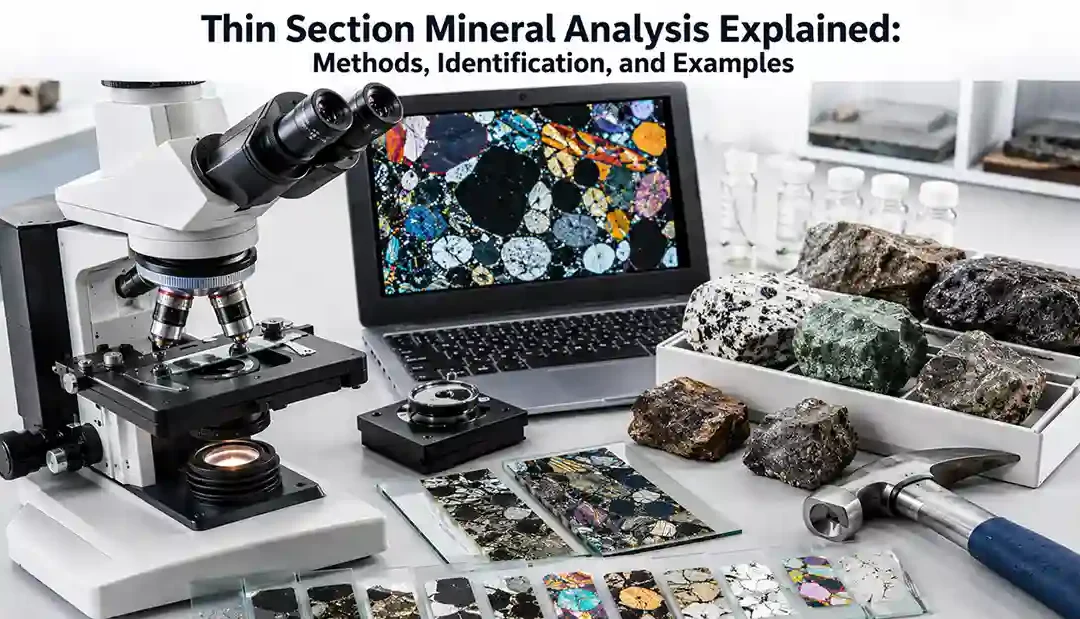
Thin section mineral analysis is one of the most important laboratory techniques in mineralogy, petrology, and geology. It involves preparing an extremely thin slice of rock—typically 30 micrometers (0.03 mm) thick—and examining it under a polarized light microscope. At this thickness, most transparent minerals transmit light, allowing geologists to study their optical properties, crystal structure, texture, and mineral relationships.
Unlike hand-specimen identification, thin section analysis reveals microscopic details that cannot be observed with the naked eye. Features such as birefringence, extinction, twinning, cleavage, interference colors, and crystal boundaries become visible, enabling accurate mineral identification and interpretation of a rock's origin and geological history.
Thin section analysis is widely used in universities, geological surveys, mining exploration, petroleum geology, and scientific research. It remains one of the most reliable methods for identifying minerals and classifying rocks.
If you are studying mineral identification, this topic should be learned together with Optical Properties of Minerals, Double Refraction Explained, and How to Identify Minerals.
What Is Thin Section Mineral Analysis?
Thin section mineral analysis is the microscopic examination of minerals in a rock slice mounted on a glass slide.
The rock sample is ground to approximately 30 µm thick so that light can pass through most minerals.
This allows geologists to observe:
- Optical properties
- Crystal shapes
- Mineral textures
- Grain boundaries
- Mineral relationships
Why Is a Thin Section 30 Micrometers Thick?
Most rock thin sections are prepared to a standard thickness of 30 µm because:
- Quartz displays its characteristic first-order gray interference colors.
- Most transparent minerals transmit sufficient light.
- Optical properties become standardized.
- Mineral identification becomes more accurate.
This international standard allows geologists worldwide to compare observations consistently.
How Is a Thin Section Prepared?
Thin section preparation follows several steps.
Step 1
Collect a representative rock sample.
Step 2
Cut a small slab using a diamond saw.
Step 3
Bond the sample to a glass slide with epoxy.
Step 4
Grind and polish the rock until it reaches approximately 30 µm thickness.
Step 5
Cover the surface with a protective cover slip.
The finished slide is ready for microscopic examination.
Equipment Used
Thin section analysis requires specialized laboratory equipment.
Common tools include:
- Polarized light microscope
- Diamond rock saw
- Grinding wheel
- Polishing machine
- Glass slides
- Cover slips
- Epoxy resin
- Petrographic accessories
Modern laboratories may also use digital microscope cameras for image analysis.
Polarized Light Microscopy
The most important instrument is the polarized light microscope (PLM).
It uses:
- Plane-polarized light (PPL)
- Cross-polarized light (XPL)
These lighting conditions reveal different optical properties of minerals.
Plane-Polarized Light (PPL)
In PPL, geologists observe:
- Color
- Pleochroism
- Relief
- Cleavage
- Crystal habit
- Transparency
Many minerals can be identified from these properties alone.
Cross-Polarized Light (XPL)
In XPL, additional optical properties become visible.
These include:
- Interference colors
- Birefringence
- Extinction
- Twinning
- Crystal orientation
Cross-polarized light is essential for identifying many silicate minerals.
Optical Properties Observed
Thin section analysis reveals numerous optical properties.
Common observations include:
- Color
- Relief
- Cleavage
- Crystal habit
- Pleochroism
- Twinning
- Birefringence
- Extinction
- Interference colors
- Mineral inclusions
These properties help distinguish similar minerals.
Common Minerals Seen in Thin Sections
| Mineral | Typical Appearance |
|---|---|
| Quartz | Colorless, Low Relief, First-Order Gray Colors |
| Feldspar | Twinning, Low Relief |
| Biotite | Brown Pleochroism, Perfect Cleavage |
| Muscovite | Colorless, Bright Interference Colors |
| Amphibole | Green to Brown Pleochroism |
| Pyroxene | High Relief, Two Cleavage Directions |
| Olivine | High Relief, No Cleavage |
| Calcite | Very High Birefringence |
| Garnet | High Relief, Isotropic |
Each mineral exhibits distinctive optical characteristics under polarized light.
Rock Types Studied
Thin section analysis is widely used for:
Igneous Rocks
- Granite
- Basalt
- Diorite
- Gabbro
Sedimentary Rocks
- Sandstone
- Limestone
- Shale
Metamorphic Rocks
- Schist
- Gneiss
- Marble
- Quartzite
Each rock type displays unique mineral textures and grain relationships.
Applications
Thin section mineral analysis is essential in:
- Mineral identification
- Petrology
- Petrography
- Geological mapping
- Mining exploration
- Petroleum geology
- Engineering geology
- Academic research
It is one of the most powerful tools for studying rocks and minerals.
Advantages of Thin Section Analysis
Thin section analysis provides:
- Highly accurate mineral identification
- Non-destructive analysis
- Microscopic observation of textures
- Reliable optical measurements
- Detailed rock classification
It is considered one of the most important laboratory methods in geology.
Limitations
Thin section analysis also has some limitations.
- Requires specialized laboratory equipment.
- Preparation is time-consuming.
- Opaque minerals cannot be fully examined using transmitted light.
- Experience is required for accurate interpretation.
For complete mineral identification, combine thin section analysis with:
- Optical Properties of Minerals
- Refractive Index in Minerals
- Double Refraction Explained
- Mineral Hardness Test
- Mineral Density Test
- Crystal Systems Explained
- How to Identify Minerals
Comparison Table
| Observation Method | Main Information Obtained |
| Plane-Polarized Light (PPL) | Color, Relief, Pleochroism |
| Cross-Polarized Light (XPL) | Interference Colors, Birefringence, Twinning |
| Hand Specimen | Color, Hardness, Cleavage |
| X-ray Diffraction | Crystal Structure |
Summary Table
| Feature | Thin Section Mineral Analysis |
| Standard Thickness | 30 µm |
| Main Instrument | Polarized Light Microscope |
| Primary Purpose | Mineral & Rock Identification |
| Major Techniques | PPL and XPL |
| Scientific Importance | Petrology, Mineralogy, Petrography |
Thin section mineral analysis is the microscopic study of minerals in a rock slice that has been ground to approximately 30 micrometers thick.
At this thickness, most transparent minerals transmit light and display standardized optical properties, making identification more accurate.
Geologists use a polarized light microscope, which allows examination under both plane-polarized and cross-polarized light.
Common minerals include quartz, feldspar, biotite, muscovite, amphibole, pyroxene, olivine, calcite, and garnet.
It reveals microscopic mineral properties and textures that cannot be observed in hand specimens, making it one of the most accurate methods for identifying minerals and interpreting rock history.
Final Thoughts
Thin section mineral analysis is one of the foundations of modern geology and mineralogy. By reducing a rock sample to a standard thickness of 30 micrometers, geologists can examine the optical behavior, textures, and relationships of individual mineral grains using polarized light microscopy. This method provides detailed information about mineral composition, crystal structure, and rock formation that cannot be obtained through visual inspection alone.
Combined with optical properties, birefringence, refractive index, crystal systems, and other mineral identification techniques, thin section analysis remains an indispensable tool for students, researchers, geologists, and mining professionals working to understand Earth's rocks and minerals.
Continue Learning
Continue exploring optical mineralogy with these related guides: