
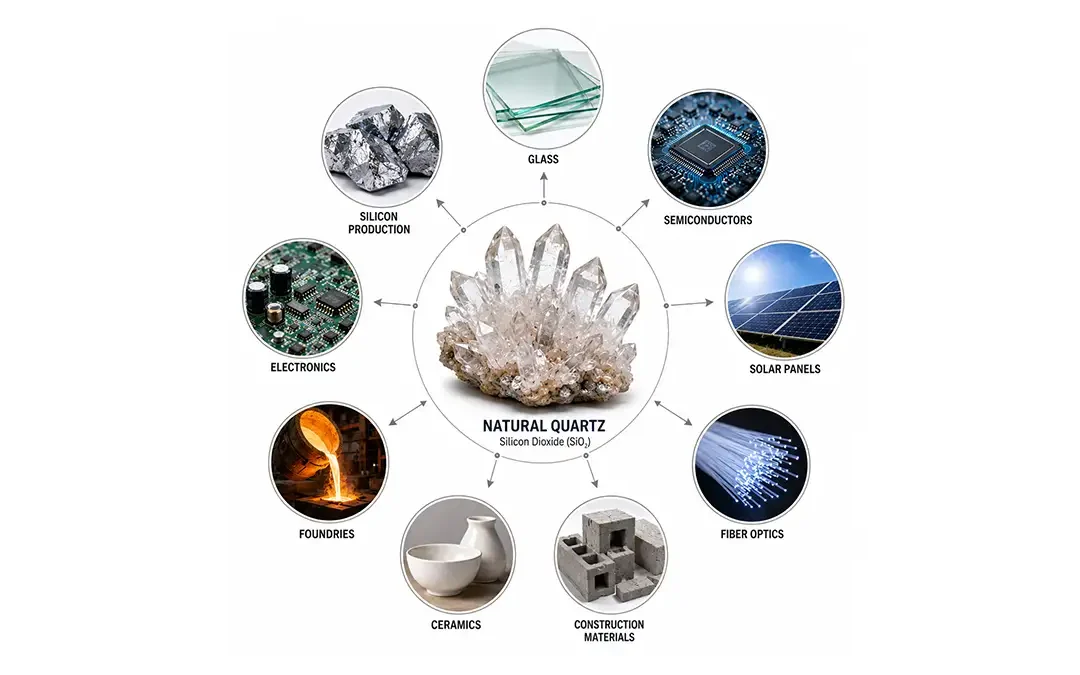
Quartz is one of the most abundant and economically important minerals found in the Earth's crust. Composed primarily of silicon dioxide (SiO₂), quartz is valued for its hardness, chemical stability, transparency, and high silica content. These unique properties make it an essential raw material in numerous industries.
The industrial uses of quartz extend far beyond gemstones and decorative stones. Today, quartz is a critical material used in glass manufacturing, semiconductor production, solar energy, construction, electronics, telecommunications, ceramics, foundries, and advanced technologies.
Understanding the industrial uses of quartz demonstrates the close relationship between geology, mineralogy, materials science, manufacturing, and technological innovation.
This topic should be studied together with Mineralogy, Minerals in Medicine, Minerals in Agriculture, Minerals in Paint, and Silicon in Technology.
Why Quartz Is Important in Industry
Quartz is widely used because it offers:
- High silica purity
- Excellent hardness
- Chemical resistance
- High melting temperature
- Electrical insulation
- Optical transparency
- Piezoelectric properties
- Excellent durability
These characteristics make quartz one of the world's most versatile industrial minerals.
Major Industrial Uses of Quartz
Glass Manufacturing
Common products:
- Window glass
- Bottles
- Laboratory glass
- Optical glass
Importance:
Quartz sand is the primary raw material used in commercial glass production.
Semiconductor Industry
Common products:
- Silicon wafers
- Integrated circuits
- Computer processors
Importance:
Ultra-pure quartz provides silica for producing electronic-grade silicon.
Solar Panel Manufacturing
Common products:
- Solar cells
- Photovoltaic panels
Importance:
Quartz is processed into high-purity silicon used in photovoltaic technology.
Construction Industry
Common products:
- Concrete
- Mortar
- Engineered stone
- Flooring
Importance:
Quartz sand improves strength, durability, and wear resistance.
Foundry Industry
Common products:
- Casting molds
- Metal casting cores
Importance:
Quartz sand withstands high temperatures during metal casting.
Ceramics Industry
Common products:
- Tiles
- Porcelain
- Sanitary ware
Importance:
Quartz improves hardness, strength, and dimensional stability.
Electronics Industry
Common products:
- Oscillators
- Frequency control devices
- Quartz watches
Importance:
Quartz crystals exhibit piezoelectric properties essential for precise electronic timing.
Fiber Optics
Common products:
- Optical fibers
- Communication cables
Importance:
High-purity silica enables efficient light transmission over long distances.
Chemical Industry
Common products:
- Silicon chemicals
- Silica gels
- Industrial catalysts
Importance:
Quartz serves as a major source of silica for chemical manufacturing.
Abrasives
Common products:
- Sandblasting materials
- Grinding media
- Abrasive papers
Importance:
Quartz hardness makes it suitable for abrasive applications.
Major Industrial Products Made from Quartz
| Industry | Quartz Application |
|---|---|
| Glass | Windows, Bottles, Containers |
| Electronics | Semiconductor Chips |
| Renewable Energy | Solar Panels |
| Construction | Concrete and Engineered Stone |
| Telecommunications | Fiber Optics |
| Ceramics | Tiles and Porcelain |
| Foundries | Casting Molds |
| Chemical Industry | Silica Products |
From Quartz Ore to Industrial Products
The journey of quartz involves several stages.
- Quartz deposits are explored.
- Quartz is mined.
- Ore is crushed and sorted.
- Silica is purified according to industrial requirements.
- High-purity quartz is processed for specialized industries.
- Silicon is produced for electronics and solar panels.
- Finished industrial products are manufactured.
- Industrial materials are recycled whenever possible.
This process demonstrates how a common mineral supports advanced technology.
How Quartz Supports Modern Industries
Quartz contributes to nearly every major manufacturing sector.
Electronics
- Semiconductor chips
- Electronic circuits
- Quartz oscillators
Renewable Energy
- Solar cells
- Energy systems
Construction
- Concrete
- Glass
- Engineered stone
Telecommunications
- Fiber optic communication
- Internet infrastructure
Manufacturing
- Industrial molds
- Ceramics
- Chemical processing
These applications make quartz one of the world's most valuable industrial minerals.
Geological Importance
Economic geologists study quartz deposits to evaluate silica resources.
Research includes:
- Quartz vein deposits
- Silica sand deposits
- Pegmatites
- Hydrothermal quartz
- Resource estimation
These investigations ensure reliable supplies for industrial development.
Laboratory Investigation
Quartz is analyzed using:
- X-Ray Fluorescence (XRF)
- X-Ray Diffraction (XRD)
- ICP-MS
- Scanning Electron Microscopy (SEM)
- Optical microscopy
- Grain-size analysis
These methods determine silica purity, mineral composition, and industrial suitability.
Applications
Quartz is widely used in:
- Glass manufacturing
- Semiconductor chips
- Solar panels
- Fiber optics
- Concrete
- Ceramics
- Foundries
- Chemical manufacturing
- Electronics
- Engineered stone
Advantages of Studying Industrial Uses of Quartz
Understanding industrial uses of quartz helps:
- Explain silica processing
- Understand semiconductor manufacturing
- Improve mineral resource management
- Support renewable energy technologies
- Advance industrial geology
- Promote sustainable mineral utilization
Limitations
Despite its versatility, quartz has several industrial challenges.
- High-purity quartz deposits are relatively rare.
- Impurities reduce suitability for semiconductor manufacturing.
- Mining operations require environmental management.
- Purification processes can be energy-intensive.
- Some industrial applications require extremely strict quality control.
For a broader understanding, study this topic together with:
- Mineralogy
- Economic Geology
- Materials Science
- Mining Engineering
- Industrial Geology
- Electronic Materials
- Renewable Energy Engineering
- Sustainability
Comparison Table
| Industry | Role of Quartz | Main Benefit |
| Glass Manufacturing | Silica Source | Transparency |
| Electronics | Silicon Production | High Purity |
| Solar Energy | Solar Cells | Renewable Energy |
| Construction | Aggregate and Stone | Durability |
| Telecommunications | Fiber Optics | Light Transmission |
| Ceramics | Raw Material | Hardness |
| Foundries | Casting Sand | Heat Resistance |
| Chemical Industry | Silica Feedstock | Chemical Stability |
Summary Table
| Feature | Industrial Uses of Quartz |
| Main Mineral | Quartz (SiO₂) |
| Main Purpose | Industrial Raw Material |
| Major Products | Glass, Silicon, Solar Panels, Fiber Optics |
| Study Methods | XRF, XRD, ICP-MS, SEM |
| Geological Importance | One of the World's Most Important Industrial Minerals |
Quartz is used to manufacture glass, semiconductor chips, solar panels, ceramics, fiber optics, construction materials, foundry molds, and chemical products.
High-purity quartz is processed into silicon, which forms the foundation of semiconductor chips and integrated circuits.
Yes. Quartz is refined into high-purity silicon for photovoltaic solar cells and solar panel manufacturing.
Quartz improves the strength, durability, abrasion resistance, and longevity of concrete, engineered stone, and building materials.
Yes. Many quartz-containing materials, such as glass and engineered stone, can be recycled depending on the application and local recycling processes.
Final Thoughts
Quartz is one of the most important industrial minerals because of its exceptional physical and chemical properties. From glass and semiconductor manufacturing to renewable energy, telecommunications, construction, and advanced electronics, quartz supports countless technologies used every day. As demand for clean energy and digital technologies continues to grow, high-quality quartz resources will remain critical for sustainable industrial development.
Understanding the industrial uses of quartz highlights the essential connection between geology, mineral resources, manufacturing, and modern technology.
Continue Learning
Continue exploring related topics: