
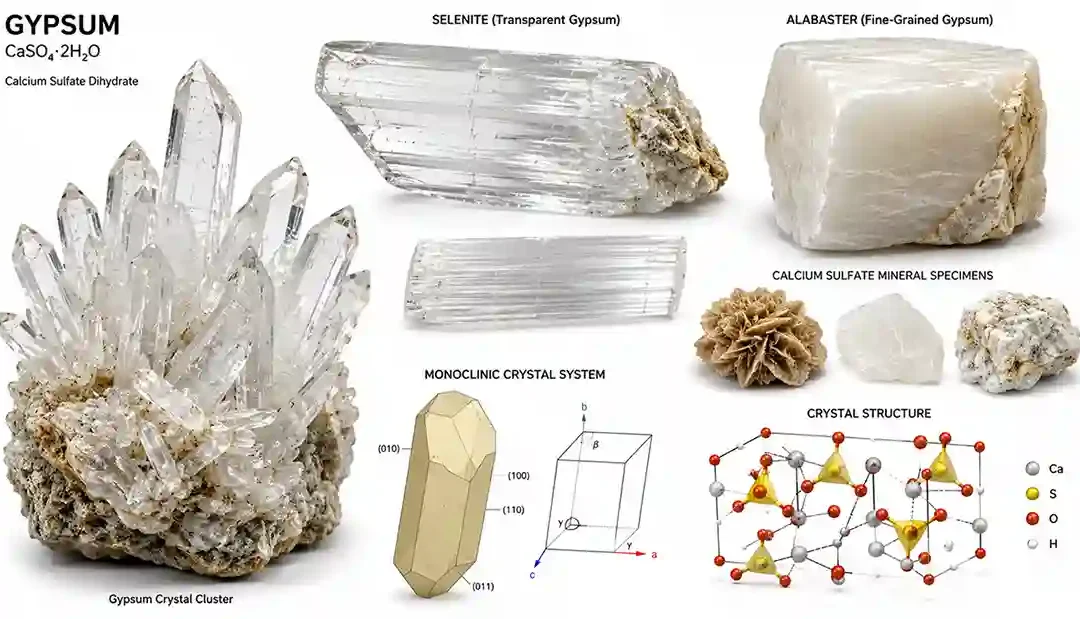
Gypsum is a common sulfate mineral known for its softness, transparency, and wide range of industrial applications. It is one of the most important non-metallic minerals in the world and is widely used in construction, agriculture, and manufacturing.
Gypsum forms in sedimentary environments where water evaporates, leaving dissolved minerals behind. Because of its low hardness and distinctive crystal forms, gypsum is relatively easy to identify.
The mineral is especially important because it is the primary ingredient in:
- drywall
- plaster
- cement
- soil conditioners
Learn more → what is a mineral
What Is Gypsum?
Gypsum is a hydrated calcium sulfate mineral. Its chemical formula is: CaSO4⋅2H2O
Gypsum consists of:
- calcium (Ca)
- sulfur (S)
- oxygen (O)
- water molecules (H₂O)
It belongs to the sulfate mineral group.
Basic Properties of Gypsum
| Property | Value |
|---|---|
| Chemical Formula | CaSO₄·2H₂O |
| Mineral Group | Sulfate |
| Crystal System | Monoclinic |
| Hardness | 2 |
| Streak | White |
| Luster | Vitreous to Pearly |
How Gypsum Forms
Gypsum commonly forms through:
Evaporation
Mineral-rich water evaporates and leaves gypsum deposits behind.
Marine Basins
Shallow seas may produce large gypsum beds.
Salt Lakes
Drying lakes often accumulate gypsum crystals.
Hydrothermal Activity
Some gypsum forms from mineral-rich hot fluids.
These processes make gypsum an important evaporite mineral.
Crystal Structure of Gypsum
Gypsum has a hydrated crystal structure containing water molecules within its crystal lattice.
This structure contributes to:
- softness
- transparency
- cleavage
- crystal growth patterns
Learn more → crystal structure in minerals
Crystal System of Gypsum
Gypsum belongs to the monoclinic crystal system. Its crystallographic relationship is
Gypsum often forms:
- tabular crystals
- bladed crystals
- fibrous crystals
Learn more → monoclinic crystal system
Physical Properties of Gypsum
| Property | Description |
|---|---|
| Color | Colorless, white, gray |
| Streak | White |
| Luster | Vitreous to pearly |
| Hardness | 2 |
| Cleavage | Perfect |
| Transparency | Transparent to opaque |
| Specific Gravity | ~2.3 |
Gypsum Hardness
Gypsum has a hardness of 2 on the Mohs Scale
This means:
- it can be scratched by a fingernail
- it is softer than calcite
- it scratches talc but not harder minerals
Gypsum serves as the reference mineral for hardness level 2.
Learn more → Mohs hardness scale
Common Varieties of Gypsum
Gypsum occurs in several well-known varieties.
Selenite
- Transparent crystals
- Glass-like appearance
Satin Spar
- Fibrous structure
- Silky luster
Alabaster
- Fine-grained massive gypsum
- Used for carving
Major Gypsum Varieties
| Variety | Characteristics |
|---|---|
| Selenite | Transparent crystals |
| Satin Spar | Fibrous texture |
| Alabaster | Massive fine-grained form |
Selenite Crystals
Selenite is the transparent crystalline variety of gypsum.
Characteristics:
- colorless
- transparent
- excellent crystal development
Some selenite crystals can grow to enormous sizes in caves.
Gypsum Cleavage
Gypsum exhibits perfect cleavage. This means it breaks smoothly along preferred directions.
The cleavage surfaces are often:
- flat
- shiny
- reflective
This property helps geologists identify gypsum quickly.
Learn more → mineral cleavage vs fracture
Gypsum Deposits Around the World
Large gypsum deposits occur in:
- United States
- Canada
- Mexico
- Spain
- Iran
- China
These deposits are mined extensively for industrial use.
Industrial Uses of Gypsum
Gypsum is one of the most important industrial minerals.
Construction
Used in drywall and plaster products.
Cement Industry
Controls cement setting time.
Agriculture
Improves soil quality.
Decorative Materials
Used in sculptures and carvings.
Major Uses of Gypsum
| Industry | Application |
|---|---|
| Construction | Drywall |
| Cement | Set control |
| Agriculture | Soil conditioner |
| Art | Carving material |
Gypsum in Mineral Identification
Geologists identify gypsum using:
- hardness of 2
- perfect cleavage
- white streak
- low density
- transparent crystal forms
These features make gypsum one of the easiest sulfate minerals to recognize.
Learn more → mineral identification guide
Gypsum Identification Summary
| Property | Gypsum |
|---|---|
| Formula | CaSO₄·2H₂O |
| Hardness | 2 |
| Crystal System | Monoclinic |
| Cleavage | Perfect |
| Streak | White |
| Mineral Group | Sulfate |
Gypsum is hydrated calcium sulfate with the formula CaSO₄·2H₂O.
Gypsum has a hardness of 2 on the Mohs Hardness Scale.
Selenite is the transparent crystalline variety of gypsum.
Gypsum is used in drywall, plaster, cement, agriculture, and decorative stonework.
Gypsum belongs to the monoclinic crystal system.
Final Thoughts
Gypsum is one of the world's most important industrial and geological minerals. Its softness, transparency, perfect cleavage, and widespread occurrence make it easy to identify and valuable for both scientific study and commercial applications.
From giant selenite crystals to drywall and cement production, gypsum demonstrates how a common mineral can play a major role in both natural geological processes and modern society.
Continue learning with → monoclinic crystal system