
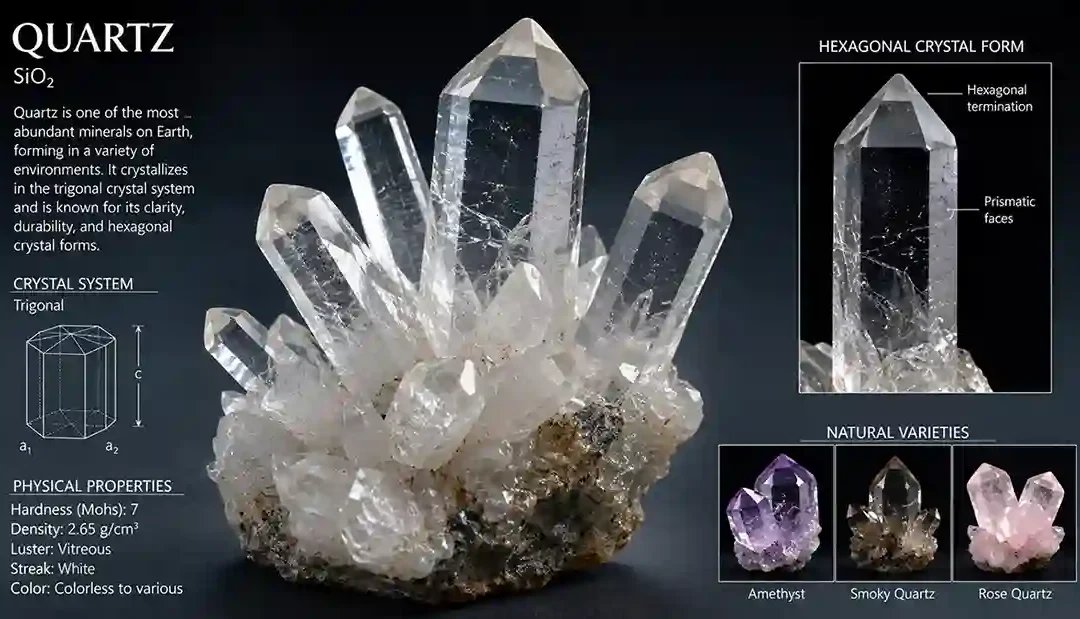
Quartz is one of the most common and important minerals on Earth. Found in igneous, metamorphic, and sedimentary rocks, quartz plays a major role in geology, mineralogy, and modern technology.
Quartz is composed of silicon and oxygen and is known for its hardness, durability, and beautiful crystal forms. Because it resists weathering, quartz is often preserved long after other minerals have broken down.
From mountain ranges to beach sand, quartz can be found almost everywhere on Earth.
Learn more → what is a mineral
What Is Quartz?
Quartz is a mineral composed of silicon dioxide (SiO₂). Its chemical formula is SiO2. Quartz forms when silicon and oxygen atoms combine into a strong crystal structure.
Basic Facts
| Property | Value |
|---|---|
| Chemical Formula | SiO₂ |
| Mineral Group | Silicate |
| Crystal System | Hexagonal Family |
| Hardness | 7 |
| Cleavage | None |
| Fracture | Conchoidal |
How Quartz Forms
Quartz forms through several geological processes:
Magma Crystallization
Quartz crystallizes from cooling magma.
Hydrothermal Activity
Hot mineral-rich fluids deposit quartz crystals.
Metamorphism
Quartz recrystallizes during heat and pressure changes.
Sedimentary Processes
Quartz survives weathering and accumulates in sediments.
Quartz Crystal Structure
Quartz has a highly ordered atomic arrangement.
This structure produces:
- exceptional hardness
- chemical stability
- characteristic crystal forms
Quartz crystals commonly grow as:
- six-sided prisms
- pyramid-shaped terminations
Learn more → crystal structure in minerals
Quartz Crystal System
Quartz belongs to the hexagonal crystal family
Quartz crystals commonly display:
- six-sided prisms
- pointed crystal terminations
- excellent crystal symmetry
The crystal relationship is:
a1=a2=a3=c
Learn more → hexagonal crystal system
Physical Properties of Quartz
| Property | Description |
|---|---|
| Color | Variable |
| Streak | White |
| Luster | Vitreous |
| Hardness | 7 |
| Cleavage | Absent |
| Fracture | Conchoidal |
| Transparency | Transparent to opaque |
Quartz Hardness
Quartz has a hardness of 7 on the Mohs Scale
This means quartz can scratch:
- glass
- steel
- many common minerals
Its hardness contributes to its resistance to weathering.
Common Varieties of Quartz
Quartz occurs in many varieties.
Clear Quartz
Colorless and transparent.
Amethyst
Purple variety.
Citrine
Yellow to orange variety.
Rose Quartz
Pink variety.
Smoky Quartz
Brown to gray variety.
Milky Quartz
White and cloudy variety.
Common Quartz Varieties
| Variety | Typical Color |
|---|---|
| Clear Quartz | Colorless |
| Amethyst | Purple |
| Citrine | Yellow |
| Rose Quartz | Pink |
| Smoky Quartz | Brown |
| Milky Quartz | White |
Quartz in Rocks
Quartz is a major component of:
Igneous Rocks
- Granite
- Rhyolite
Metamorphic Rocks
- Quartzite
- Gneiss
Sedimentary Rocks
- Sandstone
- Conglomerate
Because quartz resists weathering, it becomes concentrated in sediments.
Quartz and Weathering
Quartz survives weathering better than many minerals because of:
- strong atomic bonds
- chemical stability
- high hardness
This explains why most beach sand contains abundant quartz grains.
Industrial Uses of Quartz
Quartz is extremely important in modern industry.
Glass Manufacturing
Quartz provides silica for glass production.
Electronics
Quartz crystals are used in watches and electronic devices.
Construction
Quartz is used in concrete, countertops, and building materials.
Optical Equipment
High-purity quartz is used in scientific instruments.
Major Uses of Quartz
| Industry | Use |
|---|---|
| Construction | Concrete and stone |
| Electronics | Oscillators and watches |
| Glass | Silica source |
| Jewelry | Gemstones |
| Science | Optical instruments |
Quartz and Piezoelectricity
Quartz possesses a special property called piezoelectricity. When pressure is applied to quartz, electrical charges are generated.
This property makes quartz useful in:
- clocks
- radios
- sensors
- electronic devices
Quartz in Mineral Identification
Geologists identify quartz using:
- hardness of 7
- vitreous luster
- no cleavage
- conchoidal fracture
- hexagonal crystal forms
These characteristics make quartz one of the easiest minerals to recognize.
Learn more → mineral identification guide
Quartz Identification Summary
| Property | Quartz |
|---|---|
| Hardness | 7 |
| Cleavage | None |
| Fracture | Conchoidal |
| Crystal System | Hexagonal |
| Luster | Vitreous |
| Streak | White |
Quartz is composed of silicon dioxide (SiO₂).
Quartz has a hardness of 7 on the Mohs Hardness Scale.
Quartz belongs to the hexagonal crystal family and trigonal crystal class.
Quartz is chemically stable, resistant to weathering, and forms in many geological environments.
Clear quartz, amethyst, citrine, rose quartz, smoky quartz, and milky quartz.
Final Thoughts
Quartz is one of the most important minerals on Earth. Its durability, abundance, beautiful crystal forms, and industrial value make it essential in geology, mineralogy, and everyday life.
From mountain rocks and beach sand to watches and electronics, quartz influences both natural processes and modern technology. Understanding quartz provides a strong foundation for studying minerals and Earth's geological history.
Continue learning with → hexagonal crystal system and crystal structure in minerals.