
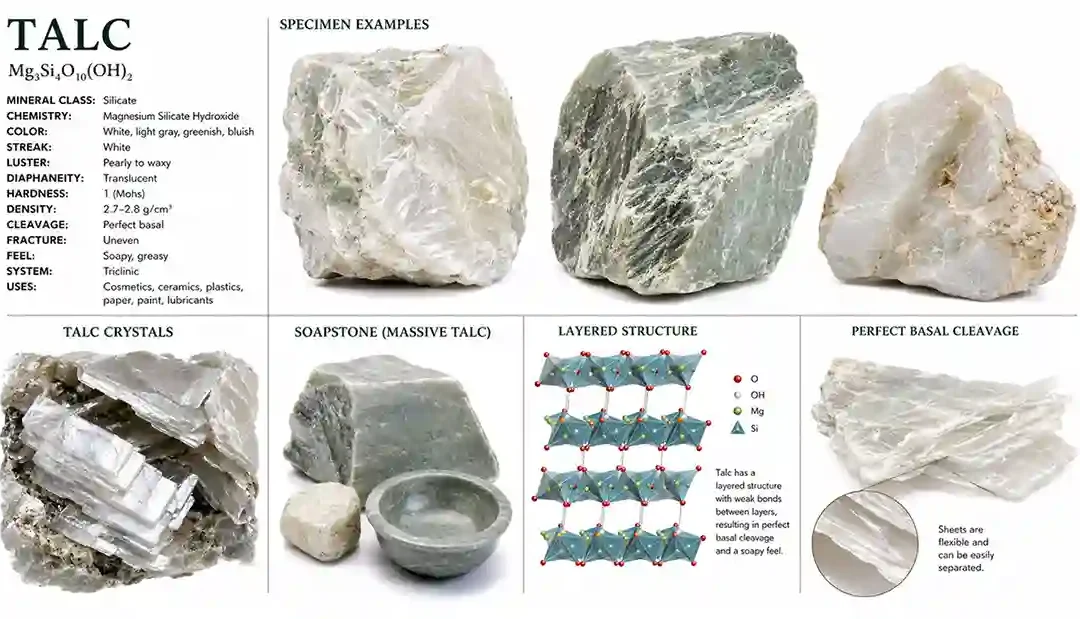
Talc is the softest known mineral and serves as the standard for hardness value 1 on the Mohs Hardness Scale. It is a magnesium-rich silicate mineral recognized for its extremely soft feel, greasy texture, and ability to be scratched easily with a fingernail.
Talc is widely used in industrial products, cosmetics, ceramics, paints, and paper manufacturing. In geology, talc is an important mineral for studying metamorphic environments and hydrothermal alteration.
Because of its unique properties, talc is one of the easiest minerals to identify.
What Is Talc?
Talc is a hydrated magnesium silicate mineral. Its chemical formula is Mg3Si4O10(OH)2. Talc belongs to the phyllosilicate (sheet silicate) group. Its layered crystal structure gives it its softness and slippery feel.
Basic Properties of Talc
| Property | Value |
|---|---|
| Chemical Formula | Mg₃Si₄O₁₀(OH)₂ |
| Mineral Group | Silicate |
| Subgroup | Phyllosilicate |
| Crystal System | Monoclinic |
| Hardness | 1 |
| Streak | White |
| Luster | Pearly to Greasy |
Why Talc Is So Soft
Talc's softness results from weak bonding between crystal layers. Its crystal structure consists of stacked sheets that slide easily over one another.
This gives talc:
- extreme softness
- slippery texture
- greasy feel
- excellent cleavage
The layered structure is similar to other sheet silicate minerals.
Learn more → mica mineral explained
Talc and the Mohs Hardness Scale
Talc defines hardness 1 on the Mohs Scale. The hardness relationship can be shown as:
Talc can be:
- scratched by a fingernail
- cut easily with a knife
- powdered with little effort
No common mineral is softer than talc.
Learn more → hardness of minerals
Crystal Structure of Talc
Talc has a layered sheet structure consisting of:
- magnesium
- silicon
- oxygen
- hydroxyl groups
These layers are held together by weak forces, allowing easy separation.
This structure explains:
- softness
- cleavage
- flexibility of thin flakes
Learn more → crystal structure in minerals
Physical Properties of Talc
| Property | Description |
|---|---|
| Color | White, green, gray |
| Streak | White |
| Luster | Pearly to greasy |
| Hardness | 1 |
| Cleavage | Perfect |
| Transparency | Transparent to opaque |
| Specific Gravity | 2.7–2.8 |
How Talc Forms
Talc commonly forms through:
Metamorphism
Magnesium-rich rocks undergo heat and pressure.
Hydrothermal Alteration
Hot fluids alter existing minerals into talc.
Serpentinization
Ultramafic rocks may transform into talc-bearing rocks.
These environments are common in mountain-building regions.
Talc in Soapstone
Soapstone is a rock composed largely of talc.
Characteristics:
- very soft
- heat resistant
- easy to carve
Soapstone has been used for:
- sculptures
- countertops
- laboratory surfaces
- decorative objects
Common Talc-Bearing Rocks
| Rock Type | Talc Content |
|---|---|
| Soapstone | Very High |
| Talc Schist | High |
| Altered Ultramafic Rocks | Moderate to High |
Industrial Uses of Talc
Talc is one of the most widely used industrial minerals.
Cosmetics
Used in powders and skincare products.
Ceramics
Improves heat resistance and strength.
Paper Industry
Enhances smoothness and print quality.
Paints
Acts as a filler and improves texture.
Plastics
Increases durability and stability.
Major Uses of Talc
| Industry | Application |
|---|---|
| Cosmetics | Powders |
| Ceramics | Tiles and pottery |
| Paper | Coatings |
| Paint | Fillers |
| Plastics | Reinforcement |
Talc and Mineral Identification
Geologists identify talc using:
- hardness of 1
- greasy feel
- white streak
- perfect cleavage
- pearly luster
These properties make talc one of the easiest minerals to recognize.
Learn more → mineral identification guide
Talc vs Mica
| Property | Talc | Mica |
|---|---|---|
| Hardness | 1 | 2.5–3 |
| Texture | Greasy | Flexible sheets |
| Cleavage | Perfect | Perfect |
| Feel | Soapy | Smooth |
Both minerals are sheet silicates, but talc is much softer.
Talc Identification Summary
| Property | Talc |
|---|---|
| Formula | Mg₃Si₄O₁₀(OH)₂ |
| Hardness | 1 |
| Crystal System | Monoclinic |
| Cleavage | Perfect |
| Streak | White |
| Feel | Greasy |
Talc is a hydrated magnesium silicate mineral with the formula Mg₃Si₄O₁₀(OH)₂.
Its layered crystal structure contains weak bonds between sheets, allowing them to slide easily.
Talc has a hardness of 1, making it the softest mineral on the Mohs Hardness Scale.
Soapstone is a rock composed mainly of talc.
Talc is used in cosmetics, ceramics, paints, paper products, plastics, and industrial applications.
Final Thoughts
Talc is a unique mineral known for being the softest mineral on Earth. Its layered crystal structure, greasy feel, and widespread industrial applications make it one of the most important minerals in both geology and manufacturing.
From soapstone carvings to cosmetic powders and ceramic products, talc demonstrates how mineral properties influence practical uses. Understanding talc also helps geologists better understand metamorphic processes and mineral formation.