
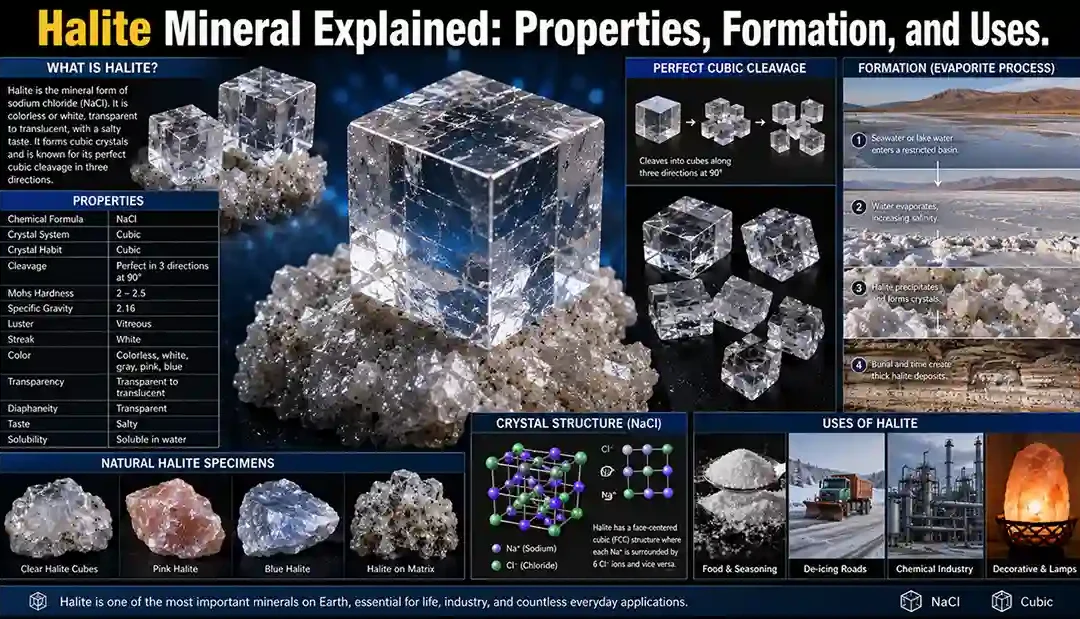
Halite is the mineral form of sodium chloride and is commonly known as rock salt. It is one of the most recognizable evaporite minerals because of its salty taste, cubic crystals, and perfect cubic cleavage.
Halite forms when salt-rich water evaporates, leaving dissolved minerals behind. Large deposits occur in ancient seas, salt lakes, and evaporite basins around the world.
Beyond its geological importance, halite is essential to modern life and is widely used for:
- food seasoning
- road de-icing
- water treatment
- chemical manufacturing
Learn more → what is a mineral
What Is Halite?
Halite is a sodium chloride mineral. Its chemical formula is NaCl. Halite belongs to the halide mineral group. It is the natural mineral equivalent of common table salt.
Basic Properties of Halite
| Property | Value |
|---|---|
| Chemical Formula | NaCl |
| Mineral Group | Halide |
| Crystal System | Isometric (Cubic) |
| Hardness | 2.5 |
| Streak | White |
| Cleavage | Perfect Cubic |
How Halite Forms
Halite commonly forms through:
Evaporation of Seawater
As seawater evaporates, dissolved salt becomes concentrated and eventually crystallizes.
Salt Lakes
Dry climates allow lakes to evaporate and deposit halite.
Inland Basins
Restricted marine basins often produce thick salt deposits.
Underground Salt Domes
Buried salt layers may rise through surrounding rocks over time.
Crystal Structure of Halite
Halite has a highly symmetrical atomic arrangement.
Its crystal structure produces:
- cubic crystals
- perfect cubic cleavage
- uniform crystal growth
This symmetry is responsible for halite's characteristic appearance.
Learn more → crystal structure in minerals
Crystal System of Halite
Halite belongs to the Isometric (Cubic) Crystal System. Its crystallographic relationship is . This high symmetry produces perfectly cubic crystal forms.
Learn more → isometric crystal system
Physical Properties of Halite
| Property | Description |
|---|---|
| Color | Colorless, white, gray, pink |
| Streak | White |
| Luster | Vitreous |
| Hardness | 2.5 |
| Cleavage | Perfect cubic |
| Transparency | Transparent to translucent |
| Taste | Salty |
Halite Cleavage
Halite exhibits perfect cubic cleavage.
When broken, halite forms:
- cubes
- square fragments
- right-angle surfaces
This is one of the easiest mineral properties to recognize.
Learn more → mineral cleavage vs fracture
Halite Hardness
Halite has a hardness of 2.5 on the Mohs Scale
This means:
- it can be scratched by a copper coin
- it is softer than calcite
- it is harder than gypsum
Its softness makes it easy to identify in the field.
Learn more → Mohs hardness scale
Colors and Varieties of Halite
Pure halite is:
- colorless
- transparent
However, impurities may create:
White Halite
Most common variety.
Pink Halite
Contains trace minerals.
Blue Halite
Rare variety caused by structural defects.
Gray Halite
Contains clay or organic material.
Common Halite Varieties
| Variety | Color |
|---|---|
| Pure Halite | Colorless |
| Rock Salt | White |
| Pink Halite | Pink |
| Blue Halite | Blue |
| Gray Halite | Gray |
Halite Deposits Around the World
Major halite deposits occur in:
- United States
- Canada
- Germany
- Poland
- China
- India
- Pakistan
Many deposits originated from ancient evaporated seas.
Industrial Uses of Halite
Halite is one of the most economically important minerals.
Food Industry
Used as table salt and food preservative.
Road Safety
Applied to roads to melt ice and snow.
Chemical Industry
Source of sodium and chlorine compounds.
Water Treatment
Used in water softening systems.
Major Uses of Halite
| Industry | Application |
|---|---|
| Food | Table salt |
| Transportation | Road de-icing |
| Chemical | Chlorine production |
| Water Treatment | Water softeners |
Halite and Evaporite Rocks
Halite is one of the most important evaporite minerals. Evaporites form when water evaporates and leaves dissolved minerals behind.
Common evaporite minerals include:
- Halite
- Gypsum
- Anhydrite
These minerals provide evidence of ancient dry climates and shallow seas.
Learn more → gypsum mineral explained
Halite in Mineral Identification
Geologists identify halite using:
- salty taste (when appropriate in controlled identification settings)
- cubic crystals
- perfect cubic cleavage
- low hardness
- high solubility in water
These properties make halite one of the easiest minerals to identify.
Learn more → mineral identification guide
Halite Identification Summary
| Property | Halite |
|---|---|
| Formula | NaCl |
| Hardness | 2.5 |
| Crystal System | Isometric |
| Cleavage | Perfect Cubic |
| Streak | White |
| Mineral Group | Halide |
Halite is composed of sodium chloride (NaCl).
Yes. Halite is the natural mineral form of table salt.
Halite belongs to the isometric (cubic) crystal system.
Halite has a hardness of approximately 2.5 on the Mohs Hardness Scale.
Halite forms when salt-rich water evaporates and leaves sodium chloride crystals behind.
Final Thoughts
Halite is one of the most familiar minerals on Earth, serving as both a geological indicator and an essential resource for human society. Its cubic crystals, salty composition, evaporite origin, and wide range of industrial uses make it a key mineral in mineralogy and geology.
From ancient salt deposits to modern food production and chemical industries, halite demonstrates how minerals shape both Earth's history and everyday life.