
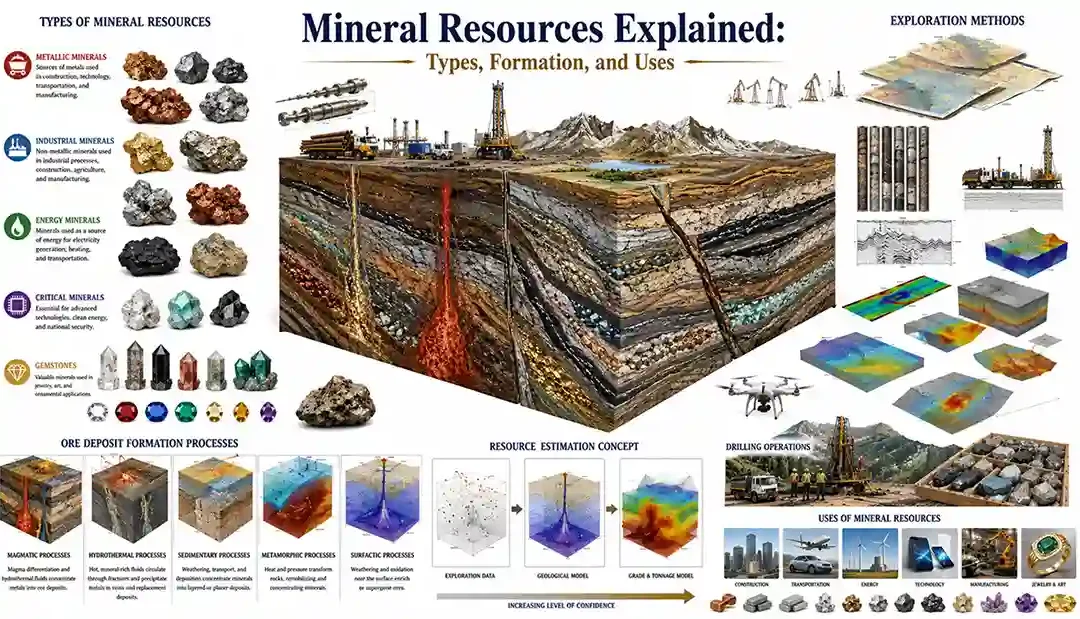
Mineral resources are the foundation of modern civilization. Every building, vehicle, smartphone, power plant, and renewable energy system relies on minerals extracted from Earth's crust.
From iron used in steel production to lithium used in batteries, mineral resources provide the raw materials necessary for economic development and technological progress.
Understanding mineral resources helps geologists locate deposits, estimate reserves, and ensure sustainable use of Earth's natural wealth.
What Are Mineral Resources?
Mineral resources are naturally occurring concentrations of minerals that have economic value or the potential to become economically valuable in the future.
These resources include:
- metallic minerals
- industrial minerals
- energy minerals
- gemstones
- critical minerals
Mineral resources are essential because they provide the raw materials needed by industries worldwide.
Examples of Mineral Resources
| Resource Type | Examples |
|---|---|
| Metallic Minerals | Iron, Copper, Gold |
| Industrial Minerals | Gypsum, Halite, Talc |
| Energy Minerals | Coal, Uranium |
| Critical Minerals | Lithium, Cobalt, Rare Earths |
| Gemstones | Diamond, Ruby, Emerald |
Mineral Resources vs Mineral Reserves
These terms are often confused.
Mineral Resource
A known concentration of minerals with potential economic value.
Mineral Reserve
A portion of a mineral resource that can be mined profitably using current technology and market conditions.
Resource vs Reserve
| Term | Meaning |
|---|---|
| Resource | Potentially economic |
| Reserve | Proven economic |
All reserves are resources, but not all resources become reserves.
Types of Mineral Resources
Economic geologists classify mineral resources into several categories.
Metallic Mineral Resources
These resources provide metals used in industry and manufacturing.
Examples include:
- iron
- copper
- aluminum
- gold
- silver
- zinc
- nickel
Industrial Mineral Resources
Used directly without metal extraction.
Examples include:
- gypsum
- talc
- limestone
- halite
- phosphate
Energy Mineral Resources
Provide energy for society.
Examples include:
- coal
- uranium
- oil shale
Critical Mineral Resources
Strategically important for modern technologies.
Examples include:
- lithium
- cobalt
- rare earth elements
- graphite
- nickel
Major Categories of Mineral Resources
| Category | Example |
|---|---|
| Metallic | Copper |
| Industrial | Gypsum |
| Energy | Uranium |
| Critical | Lithium |
| Gemstone | Diamond |
How Mineral Resources Form
Mineral resources form through various geological processes.
Magmatic Processes
Minerals crystallize from magma.
Hydrothermal Processes
Hot fluids transport and deposit minerals.
Sedimentary Processes
Minerals accumulate in sedimentary environments.
Metamorphic Processes
Heat and pressure create new mineral concentrations.
Weathering Processes
Surface processes concentrate valuable minerals.
Ore Deposits and Mineral Resources
A mineral resource becomes economically important when minerals are concentrated into ore deposits. Ore deposits contain sufficient valuable minerals for potential extraction.
Examples include:
- copper porphyry deposits
- gold veins
- iron formations
- chromite deposits
- lithium pegmatites
Learn more → economic geology explained
Metallic Mineral Resources
Important metallic resources include:
Iron Ore
Steel production.
Copper
Electrical systems.
Gold
Investment and electronics.
Nickel
Battery production.
Zinc
Galvanized steel.
Lead
Industrial batteries.
Industrial Mineral Resources
Industrial minerals are used directly without refining into metals.
Important examples include:
- limestone
- gypsum
- phosphate
- fluorite
- potash
- talc
These resources support agriculture, construction, and manufacturing.
Critical Minerals
Critical minerals are increasingly important because they support:
- electric vehicles
- renewable energy
- battery storage
- electronics
- national security technologies
Important critical minerals include:
- lithium
- cobalt
- rare earth elements
- graphite
Learn more → rare earth minerals explained
Mineral Exploration
Before resources can be mined, geologists must locate and evaluate them.
Common exploration methods include:
Geological Mapping
Studying rock distributions.
Geochemical Surveys
Analyzing soil and rock chemistry.
Geophysical Surveys
Detecting buried deposits.
Drilling
Confirming mineralization underground.
Resource Estimation
Geologists evaluate mineral resources using:
Grade
Amount of valuable mineral present.
Tonnage
Size of the deposit.
Recovery Rate
Amount that can be extracted.
Economic Value
Potential profitability.
These factors determine whether a resource can become a reserve.
Sustainable Mineral Resource Management
Modern resource development emphasizes:
- environmental protection
- responsible mining
- waste reduction
- land reclamation
- resource conservation
Sustainable management ensures future generations can benefit from mineral resources.
Why Mineral Resources Matter
Mineral resources support:
- infrastructure
- transportation
- manufacturing
- renewable energy
- communications
- economic growth
Without mineral resources, modern society could not function.
Importance of Mineral Resources
| Sector | Resource Use |
|---|---|
| Construction | Steel, Cement |
| Energy | Uranium, Lithium |
| Electronics | Copper, Rare Earths |
| Transportation | Iron, Aluminum |
| Agriculture | Phosphate, Potash |
Mineral resources are naturally occurring concentrations of minerals that have economic value or potential economic value.
A mineral resource has potential economic value, while a mineral reserve can be mined profitably under current conditions.
The major types are metallic minerals, industrial minerals, energy minerals, critical minerals, and gemstones.
They provide the raw materials needed for construction, technology, transportation, manufacturing, and energy production.
They form through geological processes such as magmatism, hydrothermal activity, sedimentation, metamorphism, and weathering.
Final Thoughts
Mineral resources are among Earth's most valuable natural assets. They provide the materials needed for modern technology, infrastructure, energy production, and economic development.
From iron ore and copper deposits to lithium and rare earth elements, mineral resources play a crucial role in shaping society and supporting future technological innovation. Understanding how these resources form and are managed is a key part of geology and sustainable development.