
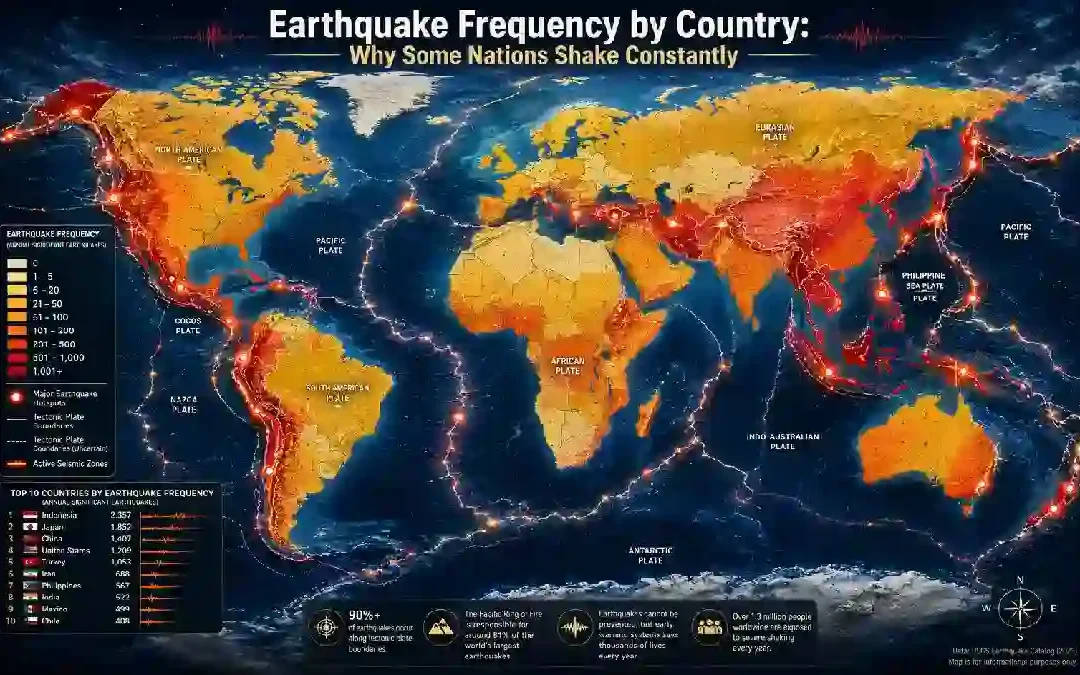
Some countries experience earthquakes only a few times each decade. Others record seismic activity almost daily. The reason is simple: tectonic location. Countries near active plate boundaries experience far more earthquakes because tectonic stress continuously builds and releases underground.
But frequency does not always mean destruction. Some countries experience many small earthquakes, while others face fewer but much larger events.
If you’re new to earthquakes, begin here → what is an earthquake
What Controls Earthquake Frequency?
Earthquake frequency depends mainly on:
| Geological Factor | Effect |
|---|---|
| Active plate boundaries | More earthquakes |
| Subduction zones | Frequent + powerful earthquakes |
| Transform faults | Repeated shallow earthquakes |
| Volcanic systems | Seismic swarms |
| Stable continental crust | Low earthquake frequency |
Countries inside the Pacific Ring of Fire usually record the most earthquakes.
Learn more → causes of earthquakes
Countries With the Highest Earthquake Frequency
1. Japan — Constant Seismic Activity
Japan experiences one of the highest earthquake frequencies in the world.
Why?
- Multiple tectonic plates meet beneath Japan
- Major subduction zones
- Frequent offshore and inland earthquakes
Thousands of earthquakes are detected every year.
Learn more → earthquakes Tokyo region
2. Indonesia — Earthquakes Across Thousands of Islands
Indonesia experiences constant seismic activity.
Main Reasons
- Subduction zones
- Volcanic arc systems
- Multiple plate interactions
Indonesia records frequent offshore and volcanic earthquakes.
Explore → earthquakes Jakarta
3. Philippines — Frequent Fault & Volcanic Earthquakes
Philippines lies in one of the world’s busiest seismic zones.
Main Sources
- Philippine Fault Zone
- Manila Trench
- Volcanic systems
Earthquakes occur regularly throughout the islands.
4. Chile — Frequent Megathrust Earthquakes
Chile experiences frequent seismic activity along its Pacific coast.
Why?
- Nazca Plate dives beneath South America
- Continuous tectonic stress buildup
- Major subduction earthquakes
Chile records some of the world’s strongest earthquakes.
Learn more → earthquakes Santiago Chile
5. Turkey — Active Transform Fault Earthquakes
Turkey experiences regular earthquakes because of major transform faults.
Main Faults
- North Anatolian Fault
- East Anatolian Fault
Shallow earthquakes occur frequently across the region.
Explore → Istanbul fault zone
6. Mexico — Frequent Pacific Coast Earthquakes
Mexico frequently experiences earthquakes from offshore subduction zones.
Main Features
- Pacific coast seismicity
- Subduction earthquakes
- Strong inland shaking effects
7. New Zealand — Constant Plate Boundary Motion
New Zealand experiences earthquakes almost continuously.
Why?
- Located between two moving plates
- Active transform and subduction systems
- Frequent crustal earthquakes
Learn more → earthquakes Christchurch NZ
8. Iran — Constant Continental Compression
Iran experiences frequent earthquakes from continental collision.
Main Causes
- Arabian Plate pushing northward
- Mountain-building tectonics
- Numerous active faults
Countries With Lower Earthquake Frequency
Some countries remain relatively stable because they are far from tectonic boundaries.
| Country | Seismic Activity |
|---|---|
| Australia | Low–Moderate |
| Finland | Low |
| Denmark | Very Low |
| Brazil | Low |
| Central Canada | Low |
These regions lie within stable continental interiors.
Explore → least earthquake-prone places
Frequency vs Magnitude: Important Difference
A country with frequent earthquakes is not always the most dangerous.
For example:
- Japan → many small earthquakes
- Chile → fewer but extremely large earthquakes
- Turkey → damaging shallow earthquakes
- Indonesia → both frequent and large earthquakes
Frequency and intensity are different measurements.
Understand the difference → magnitude-vs-intensity
Why the Pacific Ring of Fire Dominates Earthquake Frequency
The Pacific Ring of Fire contains:
- subduction zones
- volcanic arcs
- active plate boundaries
Around 90% of global earthquakes occur within this region.
Countries heavily affected include:
- Japan
- Indonesia
- Philippines
- Chile
- New Zealand
Learn more → earthquake risk zones worldwide
Can Earthquake Frequency Change Over Time?
Yes.
Earthquake activity can increase or decrease depending on:
- tectonic stress cycles
- volcanic activity
- aftershock sequences
- major fault ruptures
But tectonic regions usually remain active over very long timescales.
Learn more → Can earthquakes be predicted
Japan and Indonesia are among the most seismically active countries.
Not always — many earthquakes are small and harmless.
Because tectonic plates continuously interact there.
Improved monitoring now detects many more small earthquakes than before.
Final Thoughts
Earthquake frequency varies dramatically from country to country depending on tectonic location and geological structure. Nations located near subduction zones, transform faults, and active volcanic regions experience far more earthquakes than stable continental interiors.
Understanding earthquake frequency helps reveal how Earth’s tectonic system continuously reshapes the planet beneath our feet.