
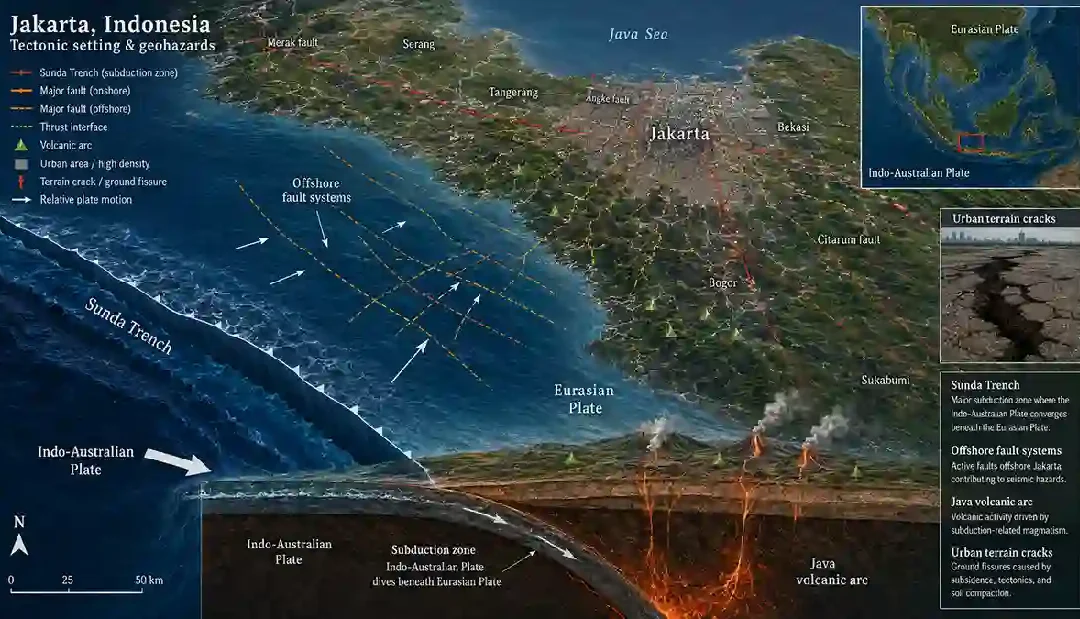
Jakarta, Indonesia’s capital, sits close to one of the most active tectonic regions on Earth. Although the city itself is not directly on a major fault line, it is heavily affected by nearby seismic systems. The main driver is the Sunda Trench, where tectonic plates collide beneath the ocean.
This makes Jakarta vulnerable to strong earthquakes — even when they occur far offshore.
If you’re new to earthquakes, begin here → what is an earthquake
Jakarta Seismic Zones
| Zone | Risk Level | Main Cause |
|---|---|---|
| Sunda Trench (Offshore) | Extremely High | Subduction zone |
| Java Island Fault Systems | High | Crustal movement |
| Volcanic Arc Region | Very High | Magma + tectonic stress |
| Southern Java | Extremely High | Megathrust earthquakes |
| Jakarta Basin | High | Soil amplification |
Jakarta’s risk comes mainly from offshore earthquakes and ground conditions.
To understand how faults work → fault lines
Why Do Earthquakes Affect Jakarta?
Jakarta is influenced by a powerful subduction system nearby.
Here’s the simple explanation:
- The Indo-Australian Plate moves northward
- It dives beneath the Eurasian Plate
- Large earthquakes occur along the subduction zone
- Seismic waves travel toward Java
- Jakarta experiences shaking even from distant earthquakes
The city’s soft ground can also increase shaking intensity.
Learn more → causes of earthquakes
Four Major Earthquake Systems Affecting Jakarta
Sunda Trench Subduction Zone (Main Source)
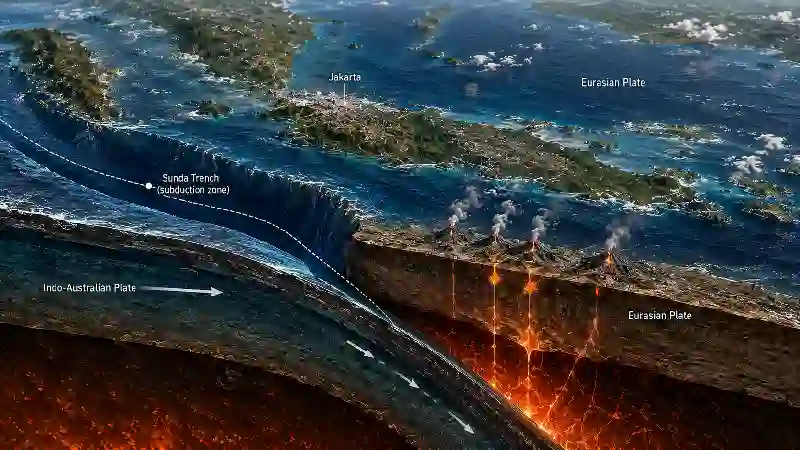
The Sunda Trench is the primary source of major earthquakes.
- Plates collide beneath the ocean
- Large earthquakes (M7–M9) can occur
- Tsunami risk is significant
Explore earthquake types
Megathrust Earthquakes (Major Regional Threat)
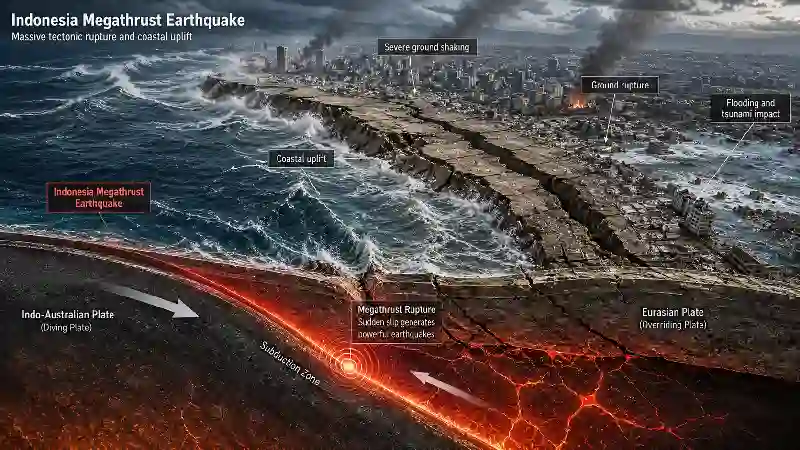
Megathrust earthquakes are the strongest in the region.
- Huge energy release
- Wide impact area
- Can affect Jakarta despite offshore location
Volcanic Arc Earthquakes
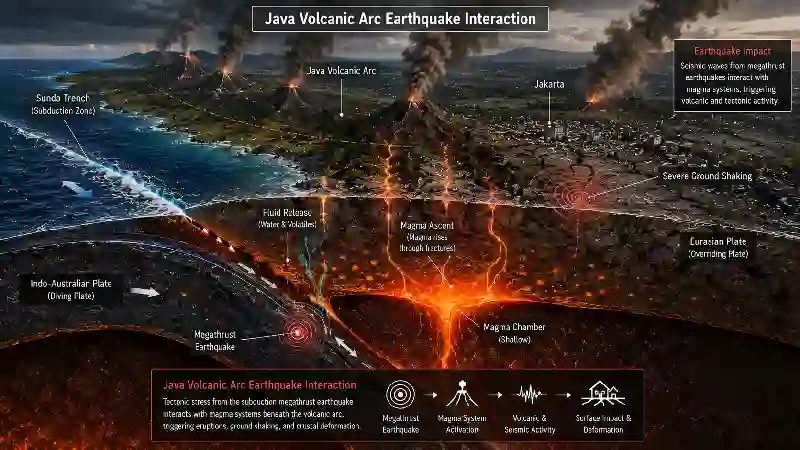
Indonesia lies along a volcanic arc.
- Magma movement beneath volcanoes
- Frequent seismic activity
- Earthquake swarms near volcanic regions
Jakarta Basin Amplification Effect
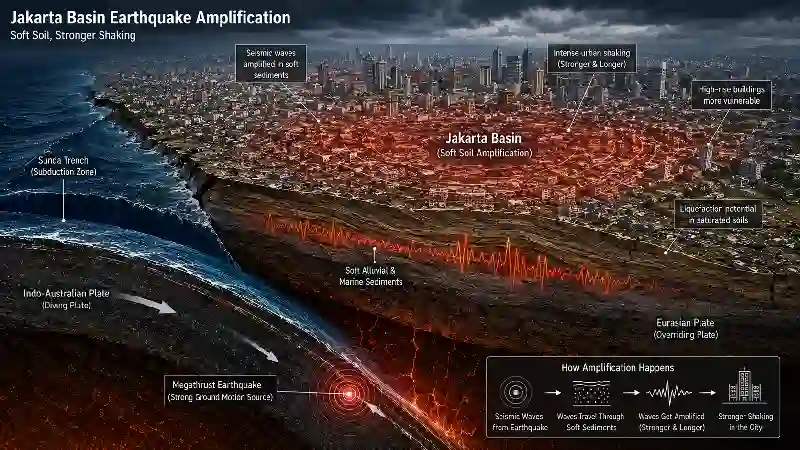
Jakarta’s ground can amplify shaking.
- Soft sediments beneath the city
- Seismic waves slow down and intensify
- Stronger shaking than surrounding areas
Recent Earthquake Activity Affecting Jakarta
Jakarta regularly feels earthquakes from surrounding regions.
Recent patterns show:
- Offshore earthquakes along the Sunda Trench
- Frequent seismic activity across Indonesia
- Occasional moderate shaking in Jakarta
Most earthquakes originate outside the city but still affect it.
Notable Earthquakes Affecting Jakarta
Jakarta has been affected by several major earthquakes.
- 2004 Sumatra-Andaman Earthquake (M9.1)
A massive event felt across Indonesia. - 2006 Java Earthquake (M6.3)
A damaging regional earthquake. - Frequent Java Offshore Earthquakes
Ongoing seismic activity affects Jakarta periodically.
Understand magnitude vs impact
Jakarta vs Other Earthquake Regions
Jakarta has a unique earthquake profile.
- Jakarta → subduction + volcanic + soil amplification
- Tokyo → multiple subduction zones
- Mexico City → strong soil amplification effects
- California → transform faults
Jakarta shares similarities with Mexico City in how ground conditions affect shaking.
Can Earthquakes in Jakarta Be Predicted?
No — earthquakes cannot be predicted precisely.
Scientists can:
- monitor tectonic activity
- track subduction zone movement
- observe volcanic systems
Indonesia also uses early warning systems for some events.
Learn more → Can earthquakes be predicted
Because of nearby subduction zones and regional seismic activity.
Most come from offshore or nearby regions.
Large subduction earthquakes and potential tsunamis.
Yes — soft ground can increase shaking intensity.
Final Thoughts
Jakarta’s earthquake risk comes from a powerful combination of offshore tectonic activity and local ground conditions. Even though the city is not directly on a major fault, nearby subduction zones and volcanic systems create frequent seismic activity that can strongly affect the region.
Understanding Jakarta earthquakes helps explain how distant tectonic forces can still impact large urban areas.