
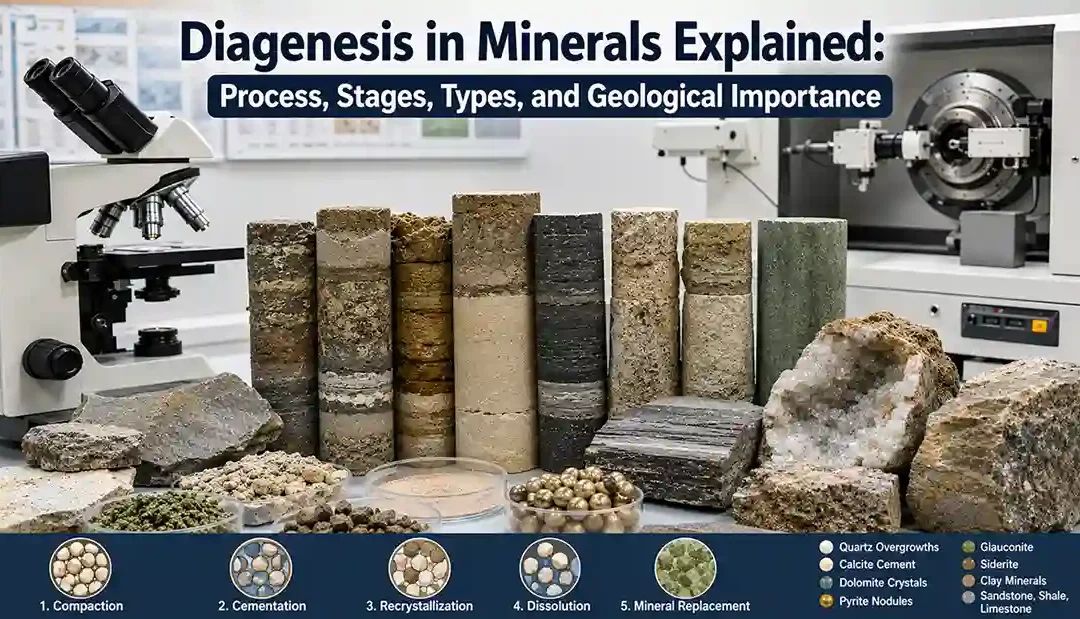
Diagenesis is the collection of physical, chemical, and biological processes that alter sediments after deposition but before they undergo metamorphism. During diagenesis, loose sediments are transformed into solid sedimentary rocks through compaction, cementation, recrystallization, dissolution, replacement, and the formation of new minerals known as diagenetic minerals.
Although sediments are initially deposited as loose particles, burial gradually changes their texture, porosity, permeability, and mineral composition. New minerals such as quartz overgrowths, calcite, dolomite, pyrite, glauconite, siderite, and various clay minerals commonly develop during this stage.
Diagenesis controls the quality of groundwater reservoirs, petroleum reservoirs, sedimentary rock properties, and many economically important mineral deposits.
This topic should be studied together with Sedimentary Mineral Formation, Minerals in Sedimentary Rocks, Clay Minerals, and Carbonate Minerals.
What Is Diagenesis?
Diagenesis refers to all physical, chemical, and biological changes that occur after sediment is deposited but before metamorphism begins.
These changes occur under relatively:
- Low temperature
- Low pressure
- Shallow burial conditions
Diagenesis transforms soft sediment into solid rock through mineralogical and structural changes.
When Does Diagenesis Occur?
Diagenesis begins almost immediately after deposition.
It continues during:
- Burial
- Groundwater circulation
- Chemical reactions
- Biological activity
Temperatures typically remain below 200°C, distinguishing diagenesis from metamorphism.
Stages of Diagenesis
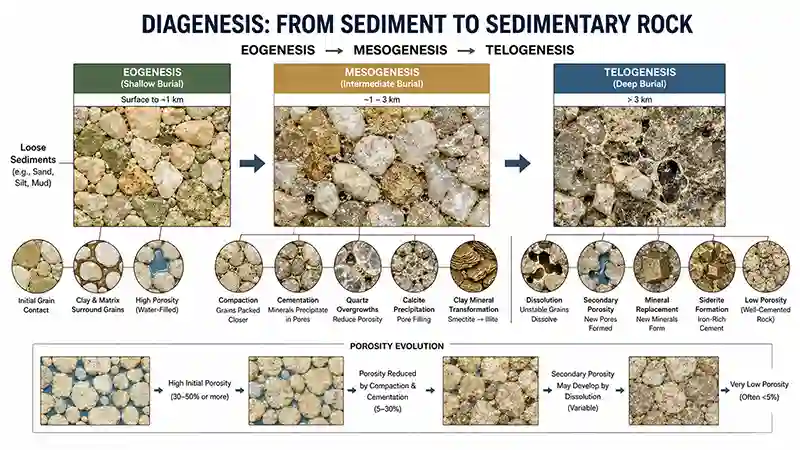
Most geologists divide diagenesis into three stages.
Eogenesis (Early Diagenesis)
Occurs shortly after deposition.
Characteristics include:
- Shallow burial
- Active groundwater circulation
- Biological activity
- Initial cement formation
Mesogenesis (Burial Diagenesis)
Occurs during deeper burial.
Characteristics include:
- Increased pressure
- Increased temperature
- Quartz cementation
- Clay mineral transformation
Most sandstone reservoir changes occur during mesogenesis.
Telogenesis (Late Diagenesis)
Occurs after uplift and exposure.
Characteristics include:
- Weathering
- Dissolution
- Oxidation
- Secondary porosity development
Major Diagenetic Processes
Compaction
As sediments are buried:
- Grain packing increases.
- Water is expelled.
- Porosity decreases.
Compaction is strongest in clay-rich sediments.
Cementation
Minerals precipitate from groundwater and bind sediment grains together.
Common cements include:
- Quartz
- Calcite
- Dolomite
- Hematite
- Clay minerals
Cementation converts loose sediment into solid rock.
Recrystallization
Existing minerals grow into larger, more stable crystals.
Common examples:
- Micrite becoming sparry calcite
- Aragonite changing to calcite
Dissolution
Groundwater dissolves unstable minerals.
This process creates:
- Secondary porosity
- Cavities
- Vugs
Dissolution improves reservoir quality in many carbonate rocks.
Replacement
One mineral replaces another while preserving the original rock texture.
Examples include:
- Calcite replaced by dolomite
- Wood replaced by silica
- Feldspar replaced by clay minerals
Authigenesis
New minerals crystallize directly within sediments.
Common authigenic minerals include:
- Glauconite
- Pyrite
- Siderite
- Zeolites
Common Diagenetic Minerals
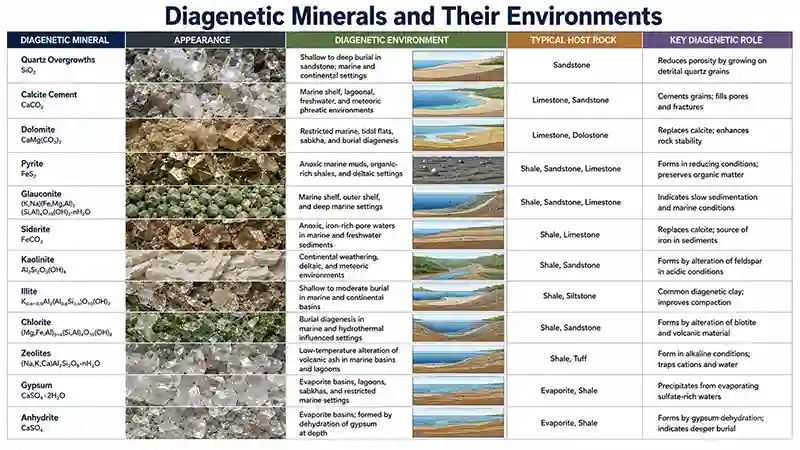
Quartz
Quartz commonly forms as:
- Quartz overgrowths
- Cement
It strengthens sandstone.
Calcite
- Calcite is one of the most common sedimentary cements.
- It commonly fills pore spaces.
Dolomite
- Dolomite forms through replacement of calcite during dolomitization.
Pyrite
- Pyrite commonly forms in oxygen-poor environments through bacterial activity.
Glauconite
- Glauconite develops in slowly deposited marine sediments.
- It is an important indicator of marine conditions.
Siderite
- Siderite commonly forms in organic-rich sediments.
Clay Minerals
Common diagenetic clay minerals include:
- Kaolinite
- Illite
- Chlorite
- Smectite
These minerals influence porosity and permeability.
Accessory Diagenetic Minerals
Other important diagenetic minerals include:
- Ankerite
- Barite
- Celestite
- Gypsum
- Anhydrite
- Zeolites
- Apatite
These minerals form under specialized chemical conditions.
Diagenesis in Different Sedimentary Rocks
| Rock Type | Common Diagenetic Changes |
|---|---|
| Sandstone | Quartz Cement, Clay Formation |
| Limestone | Calcite Recrystallization, Dolomitization |
| Shale | Clay Mineral Transformation |
| Evaporites | Dissolution, Recrystallization |
| Coal | Organic Maturation |
Each rock responds differently to burial.
Factors Controlling Diagenesis
Several factors influence diagenetic processes.
Major controls include:
- Burial depth
- Temperature
- Pressure
- Groundwater chemistry
- Organic matter
- Time
- Original mineral composition
Together they determine the final mineral assemblage.
Geological Importance
Diagenesis helps geologists:
- Understand sedimentary basin evolution
- Reconstruct burial history
- Evaluate groundwater systems
- Interpret ancient environments
- Assess reservoir quality
- Study mineral stability
It links sediment deposition with sedimentary rock formation.
Economic Importance
Diagenesis directly affects:
- Petroleum reservoirs
- Natural gas reservoirs
- Groundwater aquifers
- Industrial mineral deposits
- Carbon dioxide storage
- Building stone quality
Porosity and permeability are largely controlled by diagenetic processes.
Laboratory Identification
Diagenetic minerals are studied using:
- Petrographic Microscopy
- X-Ray Diffraction (XRD)
- Scanning Electron Microscopy (SEM)
- Electron Microprobe Analysis (EPMA)
- Cathodoluminescence Microscopy
- Stable Isotope Geochemistry
- X-Ray Fluorescence (XRF)
These methods reveal mineral growth history and fluid evolution.
Applications
Diagenesis studies are important in:
- Sedimentology
- Petroleum Geology
- Hydrogeology
- Mineralogy
- Basin Analysis
- Economic Geology
- Environmental Geology
- Engineering Geology
Advantages of Studying Diagenesis
Studying diagenesis helps scientists:
- Predict reservoir quality
- Understand sedimentary basin evolution
- Reconstruct groundwater history
- Interpret ancient climates
- Improve petroleum exploration
- Evaluate industrial mineral resources
Limitations
Studying diagenesis may be challenging because:
- Multiple diagenetic events may overprint earlier mineral changes.
- Original sedimentary textures may be partially destroyed.
- Similar minerals can form during different diagenetic stages.
- Detailed petrographic and geochemical analyses are often needed to determine the timing of mineral formation.
For comprehensive interpretation, combine diagenesis studies with:
- Sedimentary Mineral Formation
- Minerals in Sedimentary Rocks
- Clay Minerals
- Carbonate Minerals
- Evaporite Minerals
- Petrographic Microscopy
- Mineral Chemistry Analysis
- X-Ray Diffraction in Mineralogy
Comparison Table
| Diagenetic Process | Main Result | Common Minerals |
| Compaction | Reduced Porosity | — |
| Cementation | Grain Binding | Quartz, Calcite |
| Recrystallization | Crystal Growth | Calcite, Dolomite |
| Dissolution | Secondary Porosity | — |
| Replacement | New Mineral Formation | Dolomite, Clay Minerals |
| Authigenesis | New Mineral Growth | Pyrite, Glauconite, Siderite |
Summary Table
| Feature | Diagenesis in Minerals |
| Main Process | Post-Depositional Mineral Alteration |
| Major Stages | Eogenesis, Mesogenesis, Telogenesis |
| Common Minerals | Quartz, Calcite, Dolomite, Pyrite, Clay Minerals |
| Main Study Methods | Petrography, XRD, SEM, EPMA |
| Geological Importance | Sedimentary Rock Formation and Reservoir Evolution |
Diagenesis is the set of physical, chemical, and biological processes that alter sediments after deposition but before metamorphism, transforming loose sediment into sedimentary rock.
Diagenetic minerals are minerals that form during burial and alteration of sediments, including quartz overgrowths, calcite cement, dolomite, pyrite, glauconite, siderite, and clay minerals.
Diagenesis occurs at relatively low temperatures and pressures after sediment deposition, while metamorphism takes place under higher temperatures and pressures that significantly alter mineralogy and rock texture.
Diagenesis controls porosity, permeability, and mineral cementation, making it one of the most important factors affecting oil, gas, and groundwater reservoirs.
Geologists study diagenesis using petrographic microscopy, X-ray diffraction (XRD), scanning electron microscopy (SEM), electron microprobe analysis (EPMA), cathodoluminescence microscopy, stable isotope geochemistry, and sedimentological investigations.
Final Thoughts
Diagenesis is the critical transition between loose sediment and solid sedimentary rock. Through compaction, cementation, recrystallization, dissolution, replacement, and authigenic mineral growth, sediments evolve into rocks with distinctive mineral assemblages and physical properties. These changes influence groundwater movement, petroleum reservoirs, engineering behavior, and the preservation of Earth's geological history.
By combining field observations with petrographic microscopy, mineral chemistry, X-ray diffraction, scanning electron microscopy, isotope geochemistry, and basin analysis, geologists can reconstruct burial histories, interpret ancient environments, and evaluate natural resources. Diagenesis remains a cornerstone of sedimentology, petroleum geology, hydrogeology, mineralogy, and environmental geology.
Continue Learning
Continue exploring sedimentary processes with these related guides: