
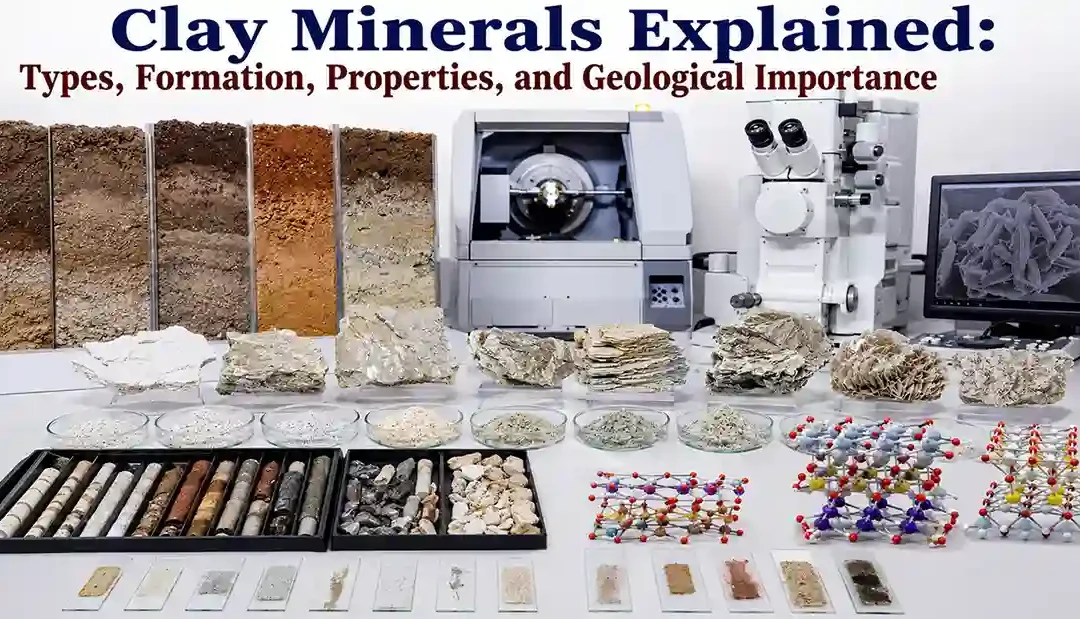
Clay minerals are extremely fine-grained, sheet-like silicate minerals that form primarily through the chemical weathering and alteration of rocks and primary minerals. Although they are usually less than 2 micrometers (µm) in size, clay minerals have an enormous influence on soil fertility, engineering properties, groundwater movement, sedimentation, weathering, and the global cycling of chemical elements.
Most clay minerals originate from the alteration of feldspar, mica, volcanic glass, pyroxene, and amphibole. During prolonged weathering, unstable primary minerals react with water, carbon dioxide, and dissolved ions to produce stable clay minerals such as kaolinite, illite, smectite, vermiculite, and chlorite.
Clay minerals are essential in geology, soil science, agriculture, petroleum geology, engineering geology, environmental science, and industrial mineral processing.
This topic should be studied together with Soil Minerals, Weathering and Mineral Formation, Mineral Weathering, and Mineral Stability.
What Are Clay Minerals?
Clay minerals are hydrous aluminum-rich silicate minerals with layered crystal structures.
They are characterized by:
- Extremely fine grain size
- Sheet-like crystal structure
- High surface area
- Water absorption capacity
- Ion exchange capability
Most belong to the phyllosilicate mineral group.
How Clay Minerals Form
Clay minerals develop mainly through chemical weathering.
The general process includes:
- Weathering of rocks
- Breakdown of primary minerals
- Dissolution of unstable elements
- Reorganization of aluminum-silicate sheets
- Formation of stable clay minerals
The process may continue for thousands to millions of years.
Sources of Clay Minerals
Clay minerals commonly originate from:
- Granite
- Basalt
- Volcanic ash
- Shale
- Gneiss
- Schist
- Feldspar-rich rocks
Volcanic materials often weather rapidly into smectite-rich clays.
Crystal Structure of Clay Minerals
Clay minerals consist of stacked sheets built from:
- Silica tetrahedral layers
- Aluminum octahedral layers
The arrangement of these sheets determines the mineral type and its physical properties.
Common structural groups include:
- 1:1 layer clays
- 2:1 layer clays
- 2:1:1 layer clays
Major Types of Clay Minerals
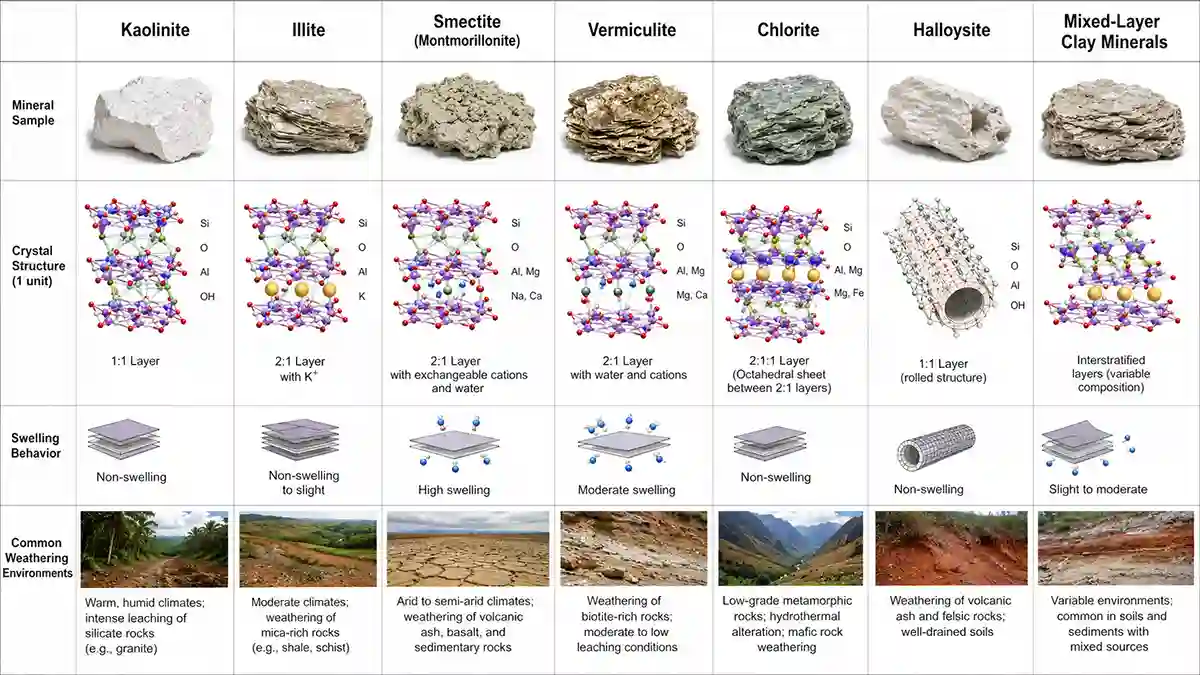
Kaolinite
Kaolinite is a 1:1 clay mineral.
Characteristics:
- Low shrink-swell behavior
- Low cation exchange capacity
- High chemical stability
- White color
Common environments:
- Tropical soils
- Highly weathered granite
- Kaolin deposits
Illite
Illite is a 2:1 clay mineral rich in potassium.
Characteristics:
- Moderate swelling
- Moderate cation exchange capacity
- Common in sedimentary rocks
Widely found in temperate soils.
Smectite
Smectite is one of the most expandable clay minerals.
Characteristics:
- Very high swelling
- High water absorption
- High cation exchange capacity
Common members include:
- Montmorillonite
- Beidellite
Smectite dominates many volcanic and arid-region soils.
Vermiculite
Vermiculite forms through alteration of mica.
Characteristics:
- Excellent nutrient retention
- High cation exchange capacity
- Moderate expansion
Common in weathered metamorphic rocks.
Chlorite
Chlorite commonly forms during low-grade metamorphism and weathering.
Characteristics:
- Green color
- Moderate stability
- Limited swelling
Often occurs with altered mafic rocks.
Halloysite
Halloysite is closely related to kaolinite.
Characteristics:
- Tubular crystal structure
- Forms in humid climates
- Often associated with volcanic ash
Mixed-Layer Clay Minerals
Some clay minerals contain alternating layers of different clay types.
Examples include:
- Illite-Smectite
- Chlorite-Vermiculite
These minerals record intermediate weathering stages.
Physical Properties of Clay Minerals
Clay minerals have distinctive properties.
Extremely Fine Grain Size
Typically less than 2 µm.
High Surface Area
Large surface area enhances chemical reactions.
Plasticity
Clay becomes moldable when wet.
Water Absorption
Many clay minerals absorb large amounts of water.
Cation Exchange Capacity (CEC)
Clay minerals exchange positively charged ions such as:
- Potassium
- Calcium
- Magnesium
- Sodium
- Ammonium
This property makes them extremely important for soil fertility.
Shrink-Swell Behavior
Smectite expands dramatically when wet and contracts upon drying.Kaolinite shows minimal volume change.
Clay Minerals in Soils
Different soil types contain different clay minerals.
| Clay Mineral | Typical Soil Environment |
|---|---|
| Kaolinite | Tropical soils |
| Illite | Temperate soils |
| Smectite | Arid and volcanic soils |
| Vermiculite | Weathered forest soils |
| Chlorite | Cool climates and metamorphic terrains |
Clay mineral composition strongly influences soil behavior.
Clay Minerals and Weathering
Weathering intensity determines which clay minerals form.
Weak Weathering
Produces:
- Illite
- Chlorite
Moderate Weathering
Produces:
- Vermiculite
- Smectite
Strong Weathering
Produces:
- Kaolinite
- Gibbsite
These minerals indicate advanced chemical weathering.
Engineering Importance
Clay minerals strongly influence engineering properties.
They affect:
- Foundation stability
- Slope stability
- Road construction
- Dam engineering
- Tunnel excavation
Expansive smectite-rich soils require special engineering design.
Industrial Uses
Clay minerals have numerous commercial applications.
Examples include:
- Ceramics
- Bricks
- Cement
- Paper coating
- Paint
- Cosmetics
- Pharmaceuticals
- Drilling mud
- Environmental barriers
Kaolin and bentonite are among the most valuable industrial clay minerals.
Laboratory Identification
Clay minerals are commonly identified using:
- X-Ray Diffraction (XRD)
- Scanning Electron Microscopy (SEM)
- Transmission Electron Microscopy (TEM)
- Electron Microprobe Analysis (EPMA)
- X-Ray Fluorescence (XRF)
- Differential Thermal Analysis (DTA)
- Infrared Spectroscopy (FTIR)
XRD is the primary method for identifying clay mineral species.
Importance of Clay Minerals
Studying clay minerals helps scientists:
- Understand weathering processes
- Interpret soil development
- Evaluate engineering conditions
- Improve agriculture
- Explore industrial minerals
- Investigate environmental contamination
Clay minerals are among the most influential minerals at Earth's surface.
Applications
Clay mineral studies are important in:
- Mineralogy
- Soil Science
- Agriculture
- Engineering Geology
- Petroleum Geology
- Environmental Geology
- Sedimentology
- Industrial Mineral Processing
Advantages of Studying Clay Minerals
Studying clay minerals allows scientists to:
- Improve soil fertility management
- Predict engineering behavior
- Interpret weathering intensity
- Explore industrial clay deposits
- Assess groundwater quality
- Understand environmental change
Limitations
Clay mineral identification may be challenging because:
- Individual clay particles are extremely small.
- Mixed-layer clays are difficult to distinguish.
- Weathering continuously modifies clay mineral assemblages.
- Advanced laboratory techniques are often required for accurate identification.
For comprehensive interpretation, combine clay mineral studies with:
- Soil Minerals
- Weathering and Mineral Formation
- Mineral Weathering
- Mineral Stability
- Mineral Chemistry Analysis
- X-Ray Diffraction in Mineralogy
- Petrographic Microscopy
Comparison Table
| Clay Mineral | Layer Type | Swelling | Cation Exchange Capacity | Common Environment |
| Kaolinite | 1:1 | Very Low | Low | Tropical Soils |
| Illite | 2:1 | Low | Moderate | Temperate Soils |
| Smectite | 2:1 | Very High | Very High | Volcanic & Arid Soils |
| Vermiculite | 2:1 | Moderate | High | Weathered Forest Soils |
| Chlorite | 2:1:1 | Very Low | Low | Metamorphic Terrains |
Summary Table
| Feature | Clay Minerals |
| Main Origin | Chemical Weathering |
| Major Groups | Kaolinite, Illite, Smectite, Vermiculite, Chlorite |
| Dominant Structure | Layered Phyllosilicates |
| Primary Identification Method | X-Ray Diffraction (XRD) |
| Geological Importance | Soil Formation, Weathering, Engineering, Agriculture |
Clay minerals are extremely fine-grained, layered hydrous aluminum silicate minerals that form mainly through the chemical weathering of primary rock-forming minerals.
Kaolinite has a 1:1 layer structure, low swelling capacity, and low cation exchange capacity. Smectite has a 2:1 layer structure, expands significantly when wet, and has a very high cation exchange capacity.
Smectite, particularly montmorillonite, has the greatest swelling capacity because water molecules enter between its crystal layers.
Clay minerals control nutrient retention, water-holding capacity, soil fertility, plasticity, and cation exchange, making them essential for healthy soil development and agriculture.
Clay minerals are identified using X-ray diffraction (XRD), scanning electron microscopy (SEM), transmission electron microscopy (TEM), electron microprobe analysis (EPMA), X-ray fluorescence (XRF), infrared spectroscopy (FTIR), and thermal analysis.
Final Thoughts
Clay minerals are among the most important secondary minerals formed during weathering and play a central role in soil development, engineering geology, agriculture, and environmental science. Their layered crystal structures, large surface areas, and ion-exchange properties make them uniquely important for controlling water movement, nutrient availability, and chemical reactions at Earth's surface.
By combining field observations with X-ray diffraction, electron microscopy, mineral chemistry, and soil analysis, geologists and soil scientists can better understand weathering processes, classify soils, evaluate engineering hazards, and manage natural resources. The study of clay minerals remains fundamental to mineralogy, sedimentology, environmental geology, and sustainable land management.
Continue Learning
Continue exploring weathering and soil mineralogy with these related guides: