
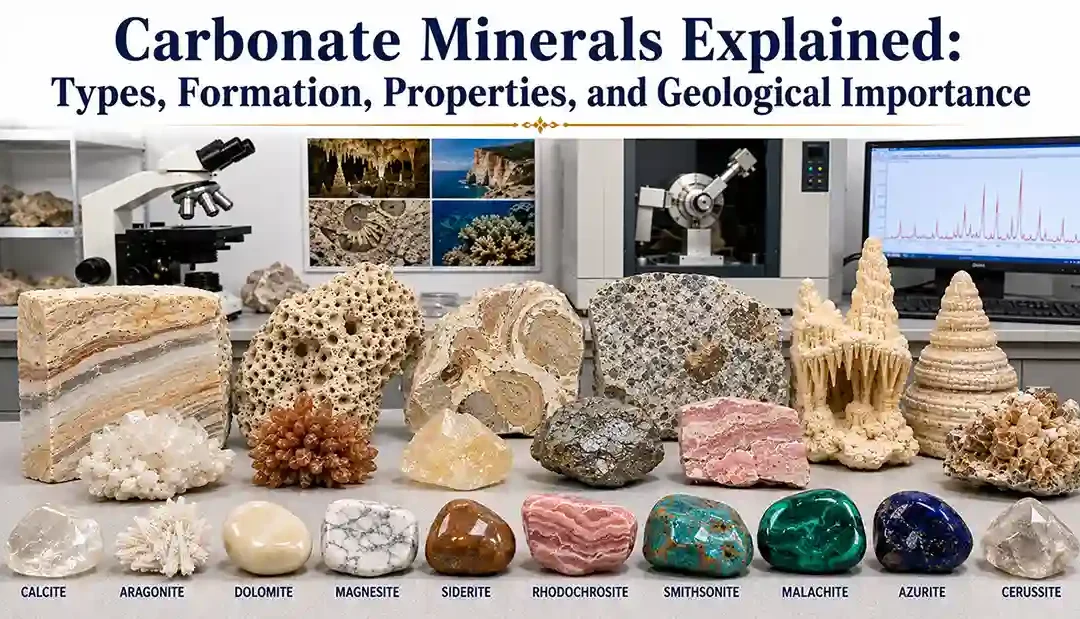
Carbonate minerals are one of the most important groups of minerals on Earth. They are characterized by the presence of the carbonate ion (CO₃²⁻) combined with metal cations such as calcium, magnesium, iron, manganese, zinc, copper, or lead. Carbonate minerals play a vital role in sedimentary geology, the global carbon cycle, cave formation, marine ecosystems, and many industrial applications.
The most abundant carbonate minerals are calcite, aragonite, and dolomite, which form the majority of limestone, marble, and dolostone. Other important carbonate minerals include magnesite, siderite, rhodochrosite, smithsonite, malachite, azurite, and cerussite, many of which are economically valuable ore minerals.
Understanding carbonate minerals is essential in mineralogy, sedimentology, economic geology, environmental geology, paleontology, hydrogeology, and geochemistry.
This topic should be studied together with Evaporite Minerals, Minerals in Sedimentary Rocks, Weathering and Mineral Formation, and Hydrothermal Minerals.
What Are Carbonate Minerals?
Carbonate minerals are minerals that contain the carbonate ion (CO₃²⁻) as their primary anionic group.
They commonly form through:
- Chemical precipitation
- Biological activity
- Hydrothermal processes
- Weathering
- Metamorphism
Carbonate minerals occur in nearly every geological environment.
Chemical Composition
The defining feature of carbonate minerals is the carbonate ion.
General chemical formula: MCO₃
where M represents a metal such as:
- Calcium (Ca)
- Magnesium (Mg)
- Iron (Fe)
- Manganese (Mn)
- Zinc (Zn)
- Copper (Cu)
- Lead (Pb)
Some carbonate minerals contain multiple metal cations.
How Carbonate Minerals Form
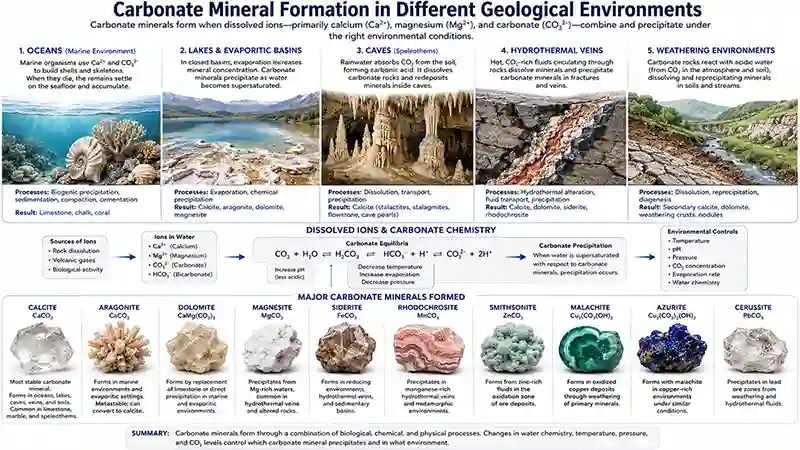
Carbonate minerals form through several geological processes.
Common formation mechanisms include:
- Marine chemical precipitation
- Biological shell formation
- Groundwater precipitation
- Hydrothermal mineralization
- Weathering reactions
- Metamorphic recrystallization
Different environments produce different carbonate mineral assemblages.
Major Carbonate Minerals
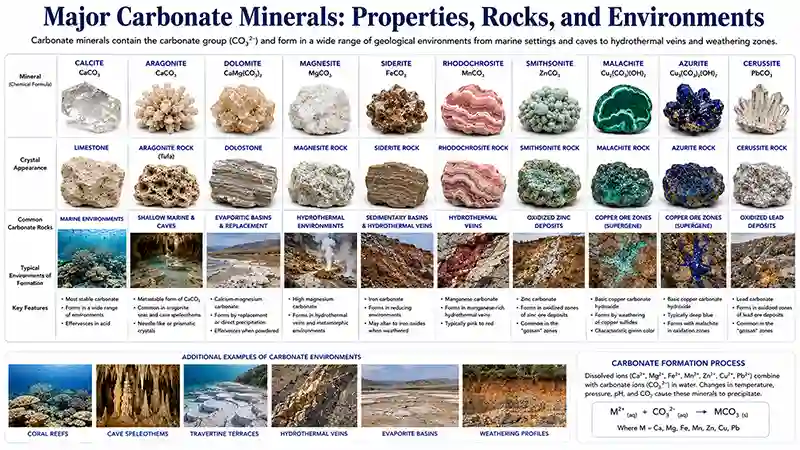
Calcite
Calcite is the most abundant carbonate mineral.
Chemical Formula: CaCO₃
Characteristics:
- Hardness 3
- Rhombohedral cleavage
- Strong reaction with dilute hydrochloric acid
Common occurrences:
- Limestone
- Marble
- Cave deposits
- Coral reefs
Uses:
- Cement
- Lime
- Building stone
- Agriculture
Aragonite
Aragonite has the same chemical composition as calcite but a different crystal structure.
Chemical Formula:CaCO₃
Common occurrences:
- Coral skeletons
- Mollusk shells
- Cave deposits
- Marine sediments
Aragonite gradually transforms into calcite over geological time.
Dolomite
Dolomite contains both calcium and magnesium.
Chemical Formula: CaMg(CO₃)₂
Common occurrences:
- Dolostone
- Hydrothermal veins
- Replacement deposits
Uses:
- Construction
- Magnesium source
- Refractory materials
Magnesite
Magnesite is the principal magnesium carbonate mineral.
Chemical Formula: MgCO₃
Uses:
- Refractory bricks
- Magnesium production
- Chemical industry
Siderite
Siderite is an iron carbonate.
Chemical Formula: FeCO₃
Characteristics:
- Brown to yellow
- Iron ore mineral
Common occurrence:
- Sedimentary iron formations
- Hydrothermal veins
Rhodochrosite
Rhodochrosite is a manganese carbonate.
Chemical Formula: MnCO₃
Characteristics:
- Pink to red
- Attractive banding
Uses:
- Manganese ore
- Gemstone
Smithsonite
Smithsonite is a zinc carbonate.
Chemical Formula: ZnCO₃
Common occurrence:
- Oxidized zinc deposits
Economic importance:
- Zinc ore
Malachite
Malachite is a hydrated copper carbonate.
Chemical Formula: Cu₂CO₃(OH)₂
Characteristics:
- Bright green
- Banded texture
Uses:
- Copper ore
- Ornamental stone
Azurite
Azurite is another hydrated copper carbonate.
Chemical Formula: Cu₃(CO₃)₂(OH)₂
Characteristics:
- Deep blue
- Often associated with malachite
Cerussite
Cerussite is a lead carbonate.
Chemical Formula: PbCO₃
Economic importance:
- Lead ore
Accessory Carbonate Minerals
Other important carbonate minerals include:
- Witherite
- Strontianite
- Dawsonite
- Ankerite
- Kutnohorite
- Huntite
These minerals occur in specialized geological environments.
Carbonate Rocks
Carbonate minerals form many important sedimentary and metamorphic rocks.
| Rock Type | Dominant Minerals |
|---|---|
| Limestone | Calcite |
| Dolostone | Dolomite |
| Marble | Recrystallized Calcite or Dolomite |
| Travertine | Calcite |
| Chalk | Calcite |
| Reef Limestone | Aragonite and Calcite |
These rocks cover large portions of Earth's continents.
Carbonate Minerals and the Carbon Cycle
Carbonate minerals are major reservoirs of carbon.
They help regulate:
- Atmospheric carbon dioxide
- Ocean chemistry
- Long-term climate
- Marine ecosystems
Carbonate deposition and dissolution play key roles in the global carbon cycle.
Carbonate Minerals and Weathering
Carbonate minerals dissolve relatively easily in weak acids.
This leads to:
- Karst landscapes
- Sinkholes
- Caves
- Underground drainage systems
Calcite reacts vigorously with dilute hydrochloric acid, making it easy to identify in the field.
Economic Importance
Carbonate minerals are valuable industrial resources.
Major applications include:
- Cement production
- Building stone
- Lime manufacturing
- Steel industry
- Agriculture
- Water treatment
- Chemical manufacturing
- Metal ores
Copper, zinc, lead, manganese, magnesium, and iron carbonate minerals are important ore sources.
Laboratory Identification
Carbonate minerals are identified using:
- Acid reaction tests
- Petrographic Microscopy
- X-Ray Diffraction (XRD)
- Electron Microprobe Analysis (EPMA)
- Scanning Electron Microscopy (SEM)
- Raman Spectroscopy
- X-Ray Fluorescence (XRF)
These techniques determine mineral composition, crystal structure, and trace elements.
Importance of Carbonate Minerals
Studying carbonate minerals helps geologists:
- Reconstruct ancient marine environments
- Interpret climate change
- Understand groundwater systems
- Explore carbonate-hosted ore deposits
- Study biological evolution
- Investigate carbon cycling
Carbonate minerals connect Earth's lithosphere, hydrosphere, atmosphere, and biosphere.
Applications
Carbonate mineral studies are important in:
- Mineralogy
- Sedimentology
- Economic Geology
- Environmental Geology
- Hydrogeology
- Paleontology
- Petroleum Geology
- Geochemistry
Advantages of Studying Carbonate Minerals
Studying carbonate minerals allows scientists to:
- Interpret ancient oceans
- Understand climate evolution
- Explore mineral resources
- Improve groundwater management
- Investigate cave systems
- Support construction and industrial applications
Limitations
Studying carbonate minerals may be challenging because:
- Calcite and dolomite may appear visually similar.
- Carbonate minerals often undergo recrystallization during diagenesis.
- Weathering can alter original carbonate assemblages.
- Some species require laboratory analyses for accurate identification.
For comprehensive interpretation, combine carbonate mineral studies with:
- Evaporite Minerals
- Minerals in Sedimentary Rocks
- Weathering and Mineral Formation
- Hydrothermal Minerals
- Petrographic Microscopy
- X-Ray Diffraction in Mineralogy
- Mineral Chemistry Analysis
Comparison Table
| Mineral | Chemical Formula | Major Environment | Main Economic Use |
| Calcite | CaCO₃ | Limestone, Marble | Cement, Lime |
| Aragonite | CaCO₃ | Marine Shells, Reefs | Biomineral |
| Dolomite | CaMg(CO₃)₂ | Dolostone | Construction |
| Magnesite | MgCO₃ | Hydrothermal | Magnesium |
| Siderite | FeCO₃ | Sedimentary Basins | Iron Ore |
| Rhodochrosite | MnCO₃ | Hydrothermal | Manganese Ore |
| Smithsonite | ZnCO₃ | Oxidized Ore Deposits | Zinc Ore |
| Malachite | Cu₂CO₃(OH)₂ | Copper Deposits | Copper Ore |
| Azurite | Cu₃(CO₃)₂(OH)₂ | Copper Deposits | Copper Ore |
| Cerussite | PbCO₃ | Lead Deposits | Lead Ore |
Summary Table
| Feature | Carbonate Minerals |
| Main Chemical Group | Carbonates (CO₃²⁻) |
| Dominant Minerals | Calcite, Aragonite, Dolomite |
| Major Rock Types | Limestone, Dolostone, Marble |
| Common Identification Methods | Acid Test, XRD, SEM, EPMA |
| Geological Importance | Carbon Cycle, Sedimentary Geology, Ore Deposits |
Carbonate minerals are minerals that contain the carbonate ion (CO₃²⁻) combined with metal cations such as calcium, magnesium, iron, copper, zinc, or lead.
Calcite is the most abundant carbonate mineral and is the primary component of limestone, marble, and many marine sediments.
Both have the chemical formula CaCO₃, but they have different crystal structures. Aragonite is less stable at Earth's surface and gradually transforms into calcite over time.
Carbonate ions react with acids to release carbon dioxide gas, producing visible effervescence. This property is commonly used to identify carbonate minerals in the field.
Geologists identify carbonate minerals using dilute hydrochloric acid tests, petrographic microscopy, X-ray diffraction (XRD), electron microprobe analysis (EPMA), scanning electron microscopy (SEM), Raman spectroscopy, and geochemical analyses.
Final Thoughts
Carbonate minerals are among the most significant mineral groups on Earth, forming extensive sedimentary rocks, supporting marine ecosystems, regulating the global carbon cycle, and providing essential industrial raw materials. From calcite-rich limestones to copper-bearing malachite and azurite, carbonate minerals record a wide range of geological, biological, and chemical processes.
By combining field observations with petrographic microscopy, acid testing, X-ray diffraction, mineral chemistry, and geochemical investigations, geologists can reconstruct ancient environments, evaluate mineral resources, and better understand Earth's dynamic carbon system. The study of carbonate minerals remains fundamental to mineralogy, sedimentology, economic geology, hydrogeology, and environmental science.
Continue Learning
Continue exploring sedimentary and chemical mineralogy with these related guides: