
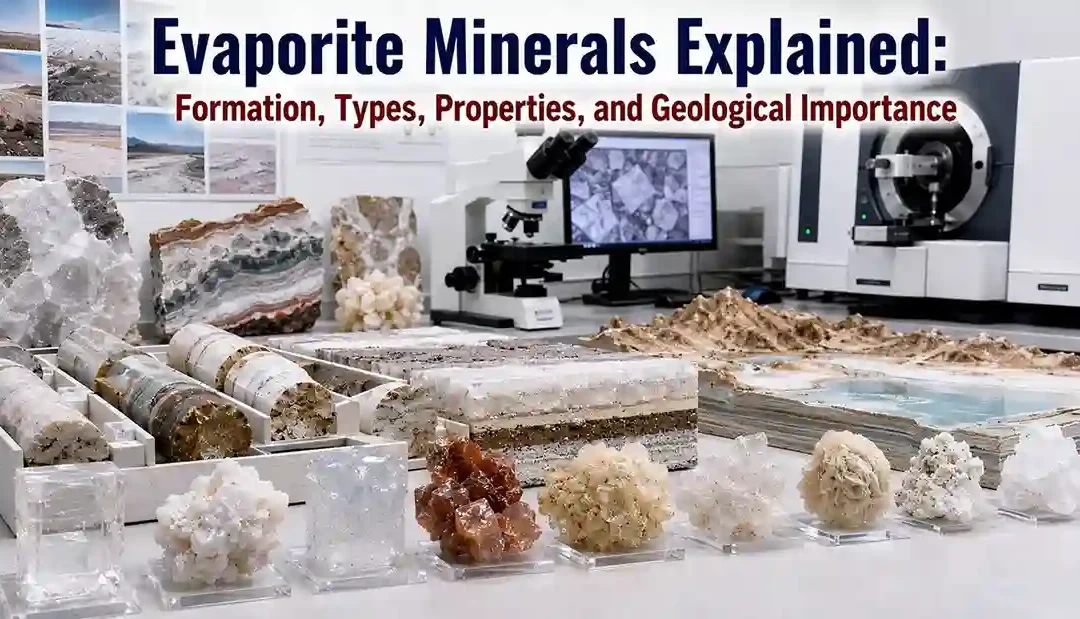
Evaporite minerals are sedimentary minerals that form when saline water evaporates, leaving dissolved minerals behind as crystalline deposits. They commonly develop in environments where evaporation exceeds precipitation, such as arid lakes, coastal lagoons, inland seas, salt flats, and restricted marine basins.
The most abundant evaporite minerals include halite, gypsum, anhydrite, sylvite, carnallite, polyhalite, kieserite, borax, and trona. These minerals are important sources of salt, gypsum, potash, boron, magnesium, sodium carbonate, and other industrial raw materials.
Evaporite minerals provide valuable evidence of ancient climates, changing sea levels, basin evolution, and sedimentary environments. They are also essential resources for agriculture, construction, chemical manufacturing, and food production.
This topic should be studied together with Minerals in Sedimentary Rocks, Weathering and Mineral Formation and Soil Minerals.
What Are Evaporite Minerals?
Evaporite minerals are minerals that precipitate directly from highly concentrated saline water during evaporation.
They typically form in:
- Salt lakes
- Desert playas
- Coastal lagoons
- Restricted marine basins
- Inland seas
- Sabkha environments
Unlike most sedimentary minerals, evaporites crystallize chemically rather than from transported rock fragments.
How Do Evaporite Minerals Form?
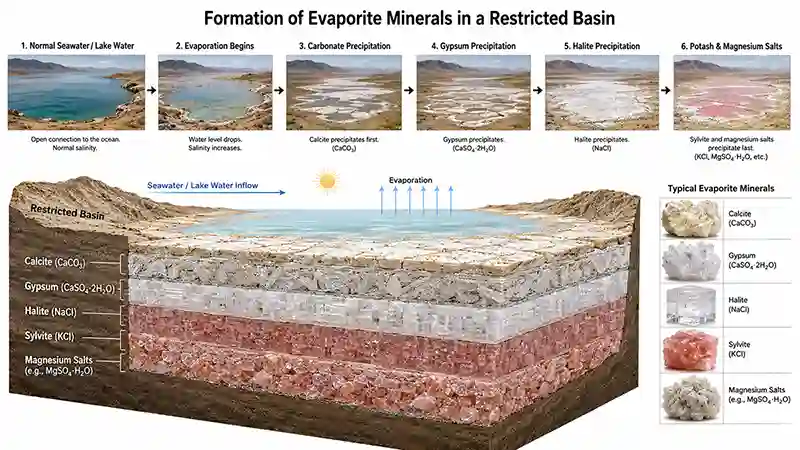
Evaporite formation follows a predictable sequence.
The general process includes:
- Water enters a closed basin.
- Dissolved salts accumulate.
- Evaporation exceeds water input.
- Salinity increases.
- Minerals precipitate according to their solubility.
- Thick evaporite layers accumulate.
Over long periods, repeated flooding and evaporation can produce hundreds of meters of evaporite deposits.
Conditions Required for Evaporite Formation
Several conditions favor evaporite deposition.
High Evaporation
Warm, dry climates promote rapid water loss.
Limited Water Circulation
Restricted basins prevent dissolved salts from being flushed away.
Continuous Salt Supply
Rivers, groundwater, or seawater continually deliver dissolved ions.
Closed Basin
Many evaporites form where water has no outlet.
Sequence of Evaporite Mineral Formation
As evaporation continues, minerals crystallize in order of decreasing solubility.
| Stage | Common Minerals |
|---|---|
| Early | Calcite, Dolomite |
| Intermediate | Gypsum, Anhydrite |
| Advanced | Halite |
| Final | Sylvite, Carnallite, Magnesium Salts |
This sequence is known as the evaporite precipitation sequence.
Major Evaporite Minerals
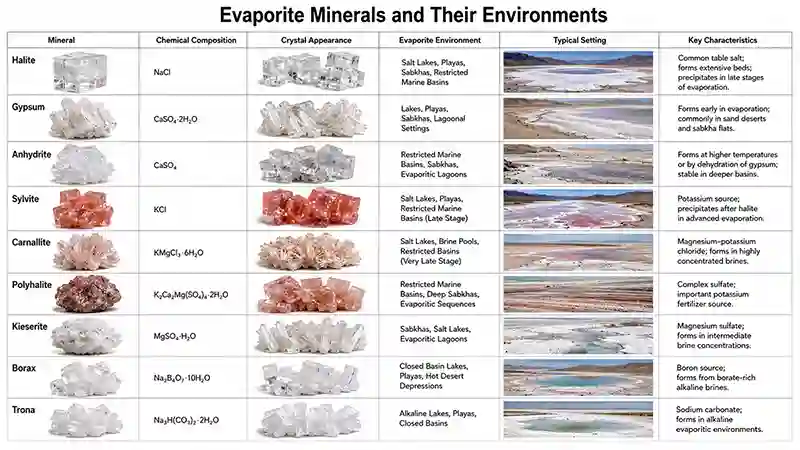
Halite
Halite is the most abundant evaporite mineral.
Chemical Formula:NaCl
Characteristics:
- Colorless to white
- Cubic crystals
- Salty taste
- Hardness 2.5
Uses:
- Food salt
- Chemical industry
- Road de-icing
- Water treatment
Gypsum
Gypsum forms before halite during evaporation.
Chemical Formula: CaSO₄·2H₂O
Characteristics:
- Soft (Hardness 2)
- Colorless or white
- Perfect cleavage
Uses:
- Plaster
- Drywall
- Cement
- Agriculture
Anhydrite
Anhydrite forms in drier conditions than gypsum.
Chemical Formula: CaSO₄
Characteristics:
- Harder than gypsum
- White to gray
It may hydrate to gypsum near Earth's surface.
Sylvite
Sylvite is an important potassium mineral.
Chemical Formula: KCl
Uses:
- Potash fertilizer
- Chemical manufacturing
Carnallite
Carnallite is a hydrated potassium-magnesium chloride.
Chemical Formula: KMgCl₃·6H₂O
Major use:
- Potash production
Polyhalite
Polyhalite contains potassium, calcium, magnesium, and sulfate. It is increasingly used as a multi-nutrient fertilizer.
Kieserite
Kieserite is a magnesium sulfate mineral.
Common use:
- Magnesium fertilizer
Borax
Borax forms in highly alkaline saline lakes.
Uses:
- Glass manufacturing
- Cleaning products
- Ceramics
Trona
Trona is a sodium carbonate mineral.
Uses:
- Soda ash production
- Glass industry
- Chemical manufacturing
Accessory Evaporite Minerals
Other evaporite minerals include:
- Epsomite
- Glauberite
- Mirabilite
- Thenardite
- Langbeinite
- Bischofite
These minerals occur in specialized evaporitic environments.
Common Evaporite Depositional Environments
Major evaporite environments include:
- Salt lakes
- Inland saline basins
- Coastal lagoons
- Sabkhas
- Playa lakes
- Restricted marine shelves
These settings commonly occur in arid and semi-arid climates.
Physical Properties of Evaporite Minerals
Typical properties include:
- High solubility (many species)
- Low hardness
- Good cleavage
- Low density
- Colorless to white appearance
- Formation in layered beds
Many evaporite minerals dissolve rapidly when exposed to groundwater.
Economic Importance
Evaporite minerals are among the world's most valuable industrial minerals.
Major products include:
- Table salt
- Fertilizers
- Cement
- Drywall
- Soda ash
- Boron compounds
- Magnesium products
- Chemical feedstocks
Large evaporite basins support major mining industries worldwide.
Geological Importance
Evaporite minerals help geologists:
- Reconstruct ancient climates
- Identify arid environments
- Interpret sea-level changes
- Understand sedimentary basin evolution
- Locate petroleum traps
- Study groundwater salinity
Thick evaporite layers often act as seals for oil and natural gas reservoirs.
Laboratory Identification
Evaporite minerals are commonly studied using:
- Hand specimen examination
- Petrographic Microscopy
- X-Ray Diffraction (XRD)
- Scanning Electron Microscopy (SEM)
- Electron Microprobe Analysis (EPMA)
- X-Ray Fluorescence (XRF)
- Raman Spectroscopy
These techniques identify mineral composition, crystal structure, and chemical purity.
Applications
Evaporite mineral studies are important in:
- Mineralogy
- Sedimentology
- Economic Geology
- Petroleum Geology
- Environmental Geology
- Hydrogeology
- Agriculture
- Chemical Engineering
Advantages of Studying Evaporite Minerals
Studying evaporite minerals helps scientists:
- Understand ancient climate conditions
- Explore industrial mineral deposits
- Evaluate groundwater chemistry
- Interpret sedimentary basins
- Improve fertilizer production
- Support petroleum exploration
Limitations
Studying evaporite minerals may be challenging because:
- Many evaporite minerals dissolve easily after deposition.
- Groundwater can alter original mineral assemblages.
- Hydration and dehydration reactions may transform minerals.
- Accurate identification often requires laboratory analyses.
For comprehensive interpretation, combine evaporite mineral studies with:
- Minerals in Sedimentary Rocks
- Weathering and Mineral Formation
- Soil Minerals
- Clay Minerals
- Petrographic Microscopy
- X-Ray Diffraction in Mineralogy
- Mineral Chemistry Analysis
Comparison Table
| Mineral | Chemical Formula | Main Use | Relative Solubility |
| Halite | NaCl | Salt & Chemicals | Very High |
| Gypsum | CaSO₄·2H₂O | Cement & Drywall | Moderate |
| Anhydrite | CaSO₄ | Cement | Moderate |
| Sylvite | KCl | Fertilizer | Very High |
| Carnallite | KMgCl₃·6H₂O | Potash | Very High |
| Borax | Na₂B₄O₇·10H₂O | Glass & Detergents | High |
| Trona | Na₃(CO₃)(HCO₃)·2H₂O | Soda Ash | High |
Summary Table
| Feature | Evaporite Minerals |
| Main Formation Process | Evaporation of Saline Water |
| Dominant Minerals | Halite, Gypsum, Anhydrite |
| Common Environments | Salt Lakes, Playas, Restricted Seas |
| Main Identification Methods | XRD, SEM, EPMA, Petrography |
| Geological Importance | Climate Indicators & Industrial Resources |
Evaporite minerals are chemical sedimentary minerals that crystallize when saline water evaporates and dissolved salts become concentrated enough to precipitate.
Carbonate minerals such as calcite typically precipitate first, followed by gypsum, then halite, and finally highly soluble potassium- and magnesium-rich minerals such as sylvite and carnallite.
Halite (rock salt) is the most abundant evaporite mineral, followed by gypsum and anhydrite.
They are essential sources of salt, potash, gypsum, boron, magnesium, and soda ash, and they provide evidence of ancient arid climates and sedimentary basin evolution.
Geologists identify evaporite minerals using field observations, petrographic microscopy, X-ray diffraction (XRD), scanning electron microscopy (SEM), electron microprobe analysis (EPMA), Raman spectroscopy, and geochemical analysis.
Final Thoughts
Evaporite minerals form through the simple yet powerful process of water evaporation, creating some of the world's most valuable industrial mineral deposits. From halite and gypsum to sylvite and borax, these minerals preserve evidence of ancient saline environments while supplying essential raw materials for construction, agriculture, chemical manufacturing, and everyday life.
By combining sedimentological observations with petrographic microscopy, X-ray diffraction, mineral chemistry, and geochemical analyses, geologists can reconstruct past climates, understand sedimentary basin evolution, and locate economically significant evaporite deposits. The study of evaporite minerals remains fundamental to sedimentary geology, mineralogy, economic geology, hydrogeology, and environmental science.
Continue Learning
Continue exploring sedimentary mineralogy with these related guides: