
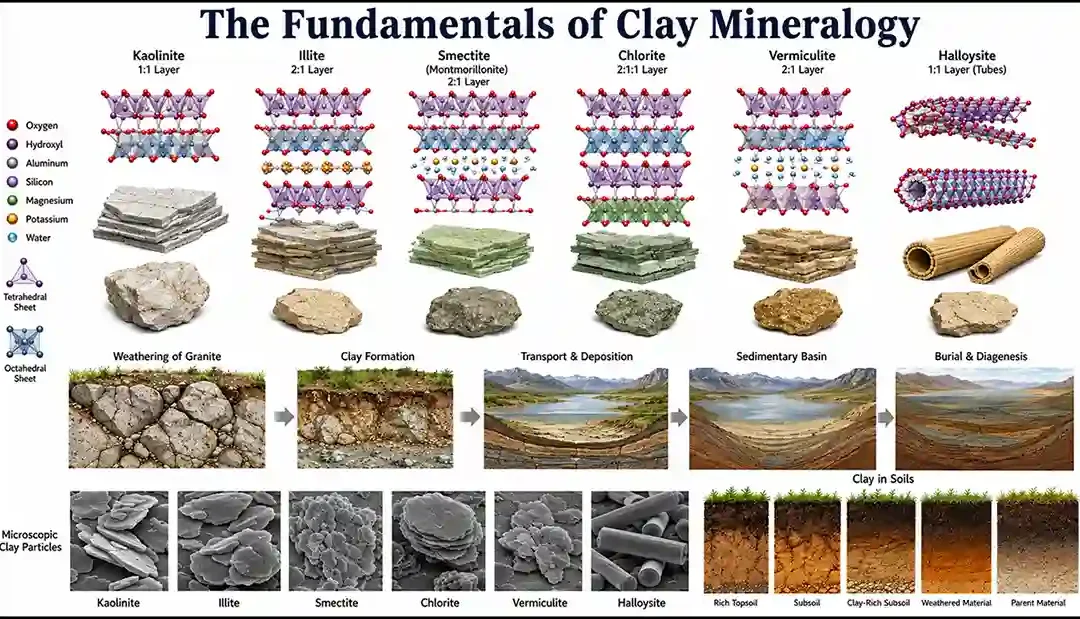
Clay minerals are among the most abundant and scientifically important minerals on Earth. They form through the weathering of rocks and are major components of soils, sediments, sedimentary rocks, and hydrothermal alteration zones. Although individual clay particles are microscopic, they strongly influence soil fertility, groundwater movement, engineering properties, petroleum reservoirs, and environmental processes.
Clay mineralogy is the study of the origin, composition, crystal structure, classification, properties, and behavior of clay minerals. Because these minerals possess unique layered crystal structures and large surface areas, they exhibit remarkable properties such as swelling, ion exchange, and water absorption.
Understanding clay mineralogy is essential in geology, soil science, environmental science, civil engineering, petroleum geology, mining, and ceramics.
This topic should be studied together with Clay Minerals, Silicate Minerals, Weathering and Mineral Formation, and Mineralogy.
What Is Clay Mineralogy?
Clay mineralogy is the branch of mineralogy that focuses on the study of clay minerals and their:
- Crystal structures
- Chemical compositions
- Formation processes
- Physical properties
- Classification
- Geological occurrence
- Industrial applications
Most clay minerals belong to the phyllosilicate (sheet silicate) group because their crystal structures consist of stacked sheets of silica tetrahedra and alumina or magnesia octahedra.
Why Clay Mineralogy Matters
Clay minerals play vital roles in:
- Soil formation
- Nutrient storage
- Water retention
- Sedimentary rock formation
- Hydrothermal alteration
- Petroleum reservoirs
- Environmental remediation
They are also essential raw materials for ceramics, cement, bricks, drilling muds, cosmetics, paper, and pharmaceuticals.
Formation of Clay Minerals
Most clay minerals form through the chemical weathering of silicate minerals.
Common parent minerals include:
- Feldspar
- Mica
- Pyroxene
- Amphibole
- Volcanic glass
During weathering:
- Water reacts with minerals.
- Hydrogen ions replace metal cations.
- Silicates decompose.
- New clay minerals crystallize.
Clay minerals may also form through:
- Hydrothermal alteration
- Burial diagenesis
- Low-grade metamorphism
- Volcanic ash alteration
Crystal Structure of Clay Minerals
Clay minerals consist of repeating sheets.
Tetrahedral Sheet (T)
Composed mainly of:
- Silicon
- Oxygen
Each silicon atom is surrounded by four oxygen atoms.
Octahedral Sheet (O)
Contains:
- Aluminum
- Magnesium
- Iron
Each cation is surrounded by six oxygen or hydroxyl ions.
Types of Layer Structures
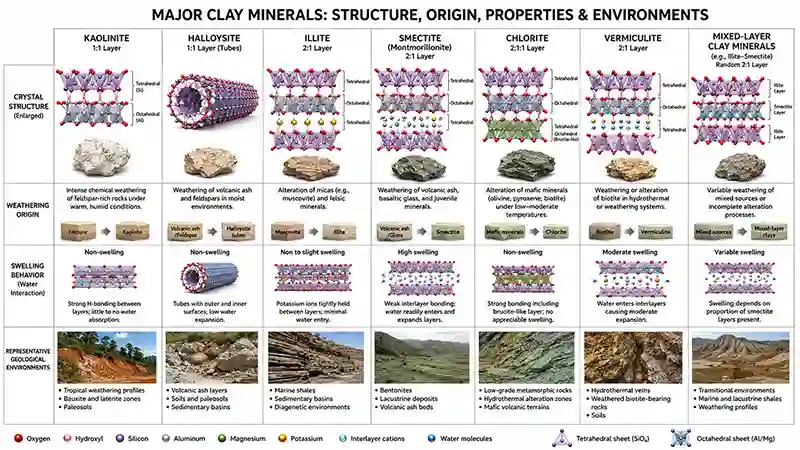
1:1 Layer Clay Minerals
One tetrahedral sheet + one octahedral sheet.
Example:
- Kaolinite
Characteristics:
- Low swelling
- Stable structure
- Low cation exchange capacity
2:1 Layer Clay Minerals
Two tetrahedral sheets surrounding one octahedral sheet.
Examples:
- Smectite
- Illite
- Vermiculite
Characteristics:
- High surface area
- Greater water absorption
- Higher cation exchange capacity
Classification of Clay Minerals
Kaolinite Group
Main minerals:
- Kaolinite
- Halloysite
Properties:
- Non-expanding
- Soft
- White color
Common uses:
- Ceramics
- Paper coating
- Porcelain
Smectite Group
Main minerals:
- Montmorillonite
- Beidellite
Properties:
- High swelling
- Excellent water absorption
- Very high cation exchange capacity
Applications:
- Drilling mud
- Landfill liners
- Environmental remediation
Illite Group
Characteristics:
- Moderate swelling
- Potassium-rich
- Common in sedimentary rocks
Chlorite Group
Characteristics:
- Magnesium-rich
- Green color
- Stable during metamorphism
Vermiculite Group
Characteristics:
- High expansion when heated
- Excellent insulation
Uses:
- Horticulture
- Construction
- Fireproof materials
Mixed-Layer Clays
Some clay minerals contain alternating layer types.
Examples:
- Illite–Smectite
- Chlorite–Vermiculite
These are common during diagenesis.
Physical Properties of Clay Minerals
Clay minerals are known for their unique physical characteristics.
Extremely Fine Grain Size
Most particles are smaller than 2 micrometers.
High Surface Area
Large surface area increases adsorption and chemical reactivity.
Water Absorption
Many clay minerals absorb significant amounts of water.
Swelling
Smectite expands when hydrated. Kaolinite shows very little swelling.
Cation Exchange Capacity (CEC)
Clay minerals exchange positively charged ions such as:
- Calcium
- Sodium
- Potassium
- Magnesium
CEC is important in soil fertility.
Plasticity
Wet clay becomes moldable and retains its shape after drying.
Occurrence of Clay Minerals
Clay minerals occur in:
- Soils
- River sediments
- Marine sediments
- Lakes
- Weathering profiles
- Hydrothermal systems
- Sedimentary rocks
- Volcanic deposits
Geological Importance
Clay mineralogy helps geologists:
- Interpret weathering intensity
- Reconstruct paleoclimates
- Understand sediment transport
- Study diagenesis
- Identify hydrothermal alteration
- Evaluate petroleum reservoirs
Different clay minerals indicate different environmental conditions.
Laboratory Investigation
Clay minerals are identified using:
- X-Ray Diffraction (XRD)
- Scanning Electron Microscopy (SEM)
- Transmission Electron Microscopy (TEM)
- Electron Microprobe Analysis
- Infrared Spectroscopy (FTIR)
- Raman Spectroscopy
- Thermal Analysis (DTA/TGA)
XRD is the most widely used method because it identifies clay minerals based on their basal spacing.
Industrial Applications
Clay mineralogy is essential in:
- Ceramic manufacturing
- Cement production
- Brick making
- Paper coating
- Paint production
- Cosmetics
- Pharmaceuticals
- Drilling fluids
- Water purification
- Environmental remediation
- Agriculture
- Nanotechnology
Advantages of Studying Clay Mineralogy
Studying clay mineralogy helps scientists:
- Improve soil management
- Discover mineral resources
- Understand sedimentary environments
- Evaluate engineering properties
- Predict landslides and slope stability
- Develop advanced industrial materials
Limitations
Despite their importance, clay minerals present several challenges.
- Their extremely small grain size makes identification difficult.
- Many clay minerals have similar chemical compositions.
- Mixed-layer clays complicate mineral classification.
- Weathering and alteration can modify clay mineral assemblages over time.
For a complete understanding, study this topic together with:
- Clay Minerals
- Silicate Minerals
- Weathering and Mineral Formation
- Hydrothermal Alteration
- Sedimentary Mineral Formation
- X-Ray Diffraction in Mineralogy
- Optical Mineralogy
- Mineralogy
Comparison Table
| Clay Mineral Group | Layer Type | Swelling | Common Uses |
|---|---|---|---|
| Kaolinite | 1:1 | Very Low | Ceramics, Paper |
| Smectite | 2:1 | Very High | Drilling Mud, Liners |
| Illite | 2:1 | Low | Sedimentary Rocks |
| Chlorite | 2:1:1 | Very Low | Metamorphic Rocks |
| Vermiculite | 2:1 | Moderate to High | Insulation, Agriculture |
Summary Table
| Feature | Clay Mineralogy |
| Definition | Study of Clay Minerals |
| Main Mineral Class | Phyllosilicates |
| Common Groups | Kaolinite, Smectite, Illite, Chlorite, Vermiculite |
| Major Study Method | X-Ray Diffraction (XRD) |
| Geological Importance | Soils, Sediments, Weathering, Petroleum, Engineering |
Clay mineralogy is the branch of mineralogy that studies the composition, structure, classification, formation, properties, and applications of clay minerals.
The major clay mineral groups are kaolinite, smectite, illite, chlorite, vermiculite, and mixed-layer clays.
Clay minerals influence soil fertility, groundwater movement, sedimentary processes, engineering behavior, and numerous industrial applications.
X-ray diffraction (XRD) is the most widely used technique because it accurately identifies clay minerals based on their layered crystal structures.
Smectite, particularly montmorillonite, has the highest swelling capacity because water molecules can enter its expandable interlayer spaces.
Final Thoughts
Clay mineralogy provides a detailed understanding of one of Earth's most abundant and influential mineral groups. Although clay minerals are microscopic, they play a major role in weathering, soil formation, sedimentary geology, hydrothermal alteration, and environmental processes. Their unique layered crystal structures give them exceptional properties such as swelling, ion exchange, and water retention, making them valuable in both natural systems and industrial applications.
By combining field observations with laboratory techniques such as X-ray diffraction, electron microscopy, and spectroscopy, scientists continue to uncover how clay minerals record Earth's geological history and contribute to sustainable resource management.
Continue Learning
Continue exploring related mineralogy topics: